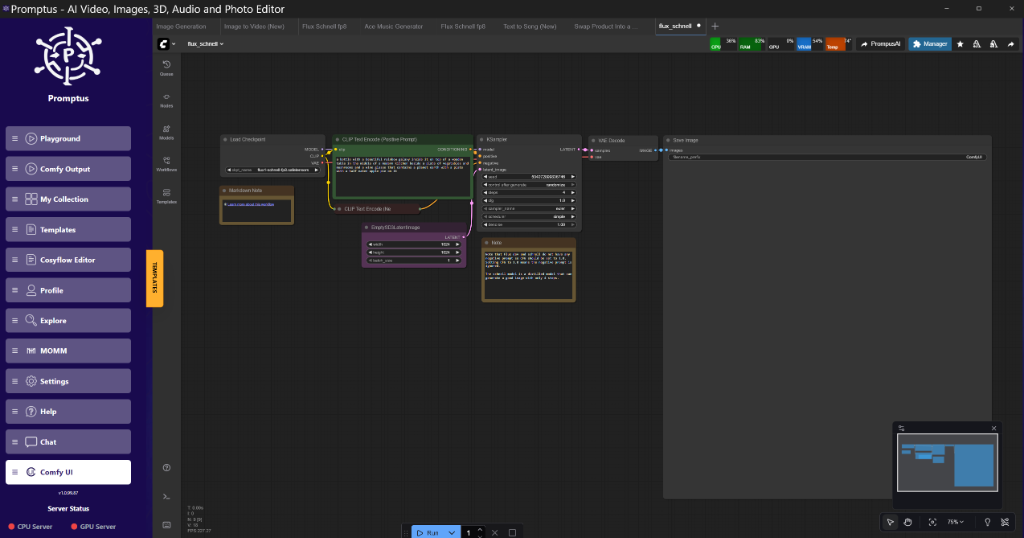
AI's Misunderstood Reality: ComfyUI Deep Dive
Jimmy Carr reckons everyone's got the wrong end of the stick when it comes to AI page publication date: . Let's cut through the hype and get practical. Running SDXL at high resolutions chews through VRAM like nobody's business, especially on mid-range hardware. This guide dives into techniques to tame memory usage and boost performance within ComfyUI.
What is Tiled VAE Decode?
Taming VRAM with Tiled VAE Decode
SDXL demands VRAM. Tiled VAE decode is your first line of defense. Instead of decoding the entire latent space at once, we split it into tiles. This significantly reduces the memory footprint.
Node Graph Logic:
- Load your VAE.
- Insert a "Tiled VAE Decode" node after the VAE.
- Set
tile_sizeto512. - Set
overlapto64. - Connect the Tiled VAE Decode output to your image saving node.
Tools like Promptus simplify prototyping these tiled workflows.
Technical Analysis
Tiled VAE Decode works by dividing the large latent representation into smaller, manageable chunks. Each chunk is decoded independently, then stitched back together. The overlap parameter is crucial; it prevents seams by blending the edges of adjacent tiles. Too little overlap, and you'll see artifacts. Too much, and you're wasting computation.
Sage Attention: A Memory-Efficient Alternative
Standard attention mechanisms are VRAM hogs. Sage Attention offers a clever alternative. It approximates the attention calculation, reducing memory usage with a slight performance tradeoff.
Node Graph Logic:
- Locate your KSampler node.
- Insert a "SageAttentionPatch" node before the KSampler.
- Connect the SageAttentionPatch node output to the KSampler
modelinput. - Ensure
usefastattentionis disabled on the KSampler (if present).
IMPORTANT: Using Sage Attention may require adjustments to your prompt and CFG scale.
Technical Analysis
Sage Attention trades accuracy for efficiency. It achieves VRAM savings by using a lower-rank approximation of the attention matrix. This reduces the computational complexity from O(n^2) to O(n*k), where k is the rank of the approximation. The downside? It can introduce subtle texture artifacts, especially at higher CFG scales. Experiment to find the sweet spot.
What is Sage Attention?
Sage Attention is a memory-efficient attention mechanism designed to reduce VRAM usage in Stable Diffusion workflows. It uses a lower-rank approximation of the attention matrix, trading off some accuracy for significant memory savings. This makes it suitable for running larger models on hardware with limited VRAM.
Block/Layer Swapping: The Last Resort
When all else fails, you can offload model layers to the CPU. This is a drastic measure, as it significantly slows down inference. But it can be the difference between running and not running a model on an 8GB card.
Implementation:
ComfyUI lacks a built-in block swapping node. You'll need a custom node or script. The basic idea is to move the first few transformer blocks to the CPU before sampling, and then move them back to the GPU when needed.
Code language: PYTHON
Example (Conceptual - requires custom node)
import torch
def swapblocktocpu(model, blockindex):
block = model.diffusionmodel.transformerblocks[block_index]
block.to("cpu")
def swapblocktogpu(model, blockindex):
block = model.diffusionmodel.transformerblocks[block_index]
block.to("cuda")
Usage:
swapblockto_cpu(model, 0) # Move the first block to CPU
... run inference ...
swapblockto_gpu(model, 0) # Move the block back to GPU
Technical Analysis
Block swapping works by leveraging the fact that not all layers of the model are equally active at all times. By moving less frequently used layers to the CPU, we free up VRAM on the GPU. This allows us to load larger models or use higher resolutions. The performance penalty is significant because transferring data between CPU and GPU is slow.
What is Block/Layer Swapping?
Block/Layer Swapping involves offloading specific layers of a neural network (usually transformer blocks) from the GPU to the CPU to reduce VRAM usage. This technique allows users to run larger models or higher resolutions on GPUs with limited memory, but it comes at the cost of increased processing time due to the data transfer between CPU and GPU.
LTX-2/Wan 2.2 Low-VRAM Tricks for Video
Generating video ramps up the VRAM requirements even further. LTX-2 and Wan 2.2 offer several optimizations to tackle this.
Chunk Feedforward: Process video in 4-frame chunks.
Hunyuan Low-VRAM: FP8 quantization + tiled temporal attention.
These techniques are complex and require careful tuning. But they can enable video generation on hardware that would otherwise be impossible.
Technical Analysis
Chunk feedforward processes video in smaller segments, reducing the memory footprint of each forward pass. Hunyuan Low-VRAM combines several techniques: FP8 quantization reduces the precision of the model weights, lowering memory usage. Tiled temporal attention applies attention only to local regions in time, further reducing memory requirements.
My Recommended Stack
For my workflow, I reckon the sweet spot is a combination of Tiled VAE Decode and Sage Attention. This provides a good balance between VRAM savings and performance. I use ComfyUI for its flexibility and node-based workflow. And Promptus simplifies workflow management and optimization.
Golden Rule: Always test each optimization technique individually before combining them.
Insightful Q&A
Q: I'm getting CUDA out-of-memory errors. What should I do?
A: Start with Tiled VAE Decode. If that's not enough, try Sage Attention. As a last resort, consider block swapping. Reduce your batch size.
Q: How much VRAM do I need for SDXL at 1024x1024?
Q: Sage Attention is causing artifacts in my images. What can I do?
A: Reduce your CFG scale. Experiment with different prompts. Or disable Sage Attention altogether.
Resources & Tech Stack
ComfyUI: The foundational node system for building and executing Stable Diffusion workflows. Its flexibility allows for custom implementations of VRAM optimization techniques.
SageAttention: An alternative attention mechanism that reduces VRAM usage. Be aware of potential artifacts at high CFG scales.
Tiled VAE Decode: A VRAM-saving technique that decodes images in smaller tiles. Useful for larger images where memory is a constraint.
Promptus: Streamlines prototyping and workflow iteration. Builders using Promptus can iterate offloading setups faster.
Advanced Implementation
Here's an example of how to implement Tiled VAE Decode in ComfyUI. This assumes you're using a standard SDXL workflow.
{
"nodes": [
{
"id": 1,
"type": "Load VAE",
"inputs": {
"vae_name": "vae-ft-mse-84000-ema-pruned.safetensors"
}
},
{
"id": 2,
"type": "Tiled VAE Decode",
"inputs": {
"vae": [1, 0],
"samples": [3, 0],
"tile_size": 512,
"overlap": 64
}
},
{
"id": 3,
"type": "KSampler",
"inputs": {
"model": [4, 0],
"seed": 12345,
"steps": 20,
"cfg": 8,
"samplername": "eulera",
"scheduler": "normal",
"positive": [5, 0],
"negative": [6, 0],
"latent_image": [7, 0]
}
}
// ... rest of your workflow
Performance Optimization Guide
VRAM Optimization: Tiled VAE Decode and Sage Attention are your primary tools. Experiment with different tile sizes and CFG scales.
Batch Size: Reduce your batch size if you're running out of memory. A batch size of 1 is often the most memory-efficient.
Tiling and Chunking: For high-resolution outputs, use tiling and chunking to process the image in smaller segments.
Conclusion
These techniques are essential for running SDXL on limited hardware. Experiment, iterate, and find what works best for your specific workflow. The landscape is constantly evolving, so stay tuned for new optimizations.
Technical FAQ
Q: How do I resolve "CUDA error: out of memory" in ComfyUI?
A: This error means your GPU doesn't have enough VRAM. Try these steps:
- Enable Tiled VAE Decode with
tile_size=512andoverlap=64. - Implement Sage Attention by patching the KSampler node.
- Reduce the batch size in your KSampler node to 1.
- Close other VRAM-intensive applications.
Q: What are the minimum hardware requirements for running SDXL workflows?
8GB: Possible with aggressive optimizations (Tiled VAE, Sage, low batch size). Expect slower generation.
12GB: Comfortable for 512x512 images and basic workflows.
Q: After applying Sage Attention, my images have strange artifacts. What's happening?
A: Sage Attention approximates the attention mechanism, which can introduce artifacts:
- Lower the CFG scale in your KSampler node (e.g., from 8 to 6).
- Adjust your prompt to be more specific and detailed.
- Try a different sampler (e.g.,
eulerinstead ofeuler_a). - If the artifacts persist, disable Sage Attention for that workflow.
Q: I'm getting "Model failed to load" errors in ComfyUI. How do I fix this?
A: This means ComfyUI can't find the specified model file:
- Verify the model file exists in the correct directory (usually
ComfyUI/models/). - Double-check the model name in your
Load Checkpointnode. - Refresh the model list in ComfyUI (
right-click -> Refresh). - If you downloaded the model from a hub, ensure it's not corrupted.
Q: My generation speed is very slow, even with a powerful GPU. What can I do?
A: Several factors can slow down generation:
- Sampler settings:
euler_ais slower but often higher quality thanddim. - Number of steps: Reduce the number of steps in your KSampler.
- VRAM bottlenecks: Ensure you're not constantly hitting VRAM limits.
- CPU bottlenecks: If your CPU is weak, it can slow down data transfers.
- Enable GPU acceleration in ComfyUI settings.
Continue Your Journey
Continue Your Journey (Internal 42.uk Research Resources)
Understanding ComfyUI Workflows for Beginners
Advanced Image Generation Techniques
VRAM Optimization Strategies for RTX Cards
Building Production-Ready AI Pipelines
Mastering Prompt Engineering for AI Art
Optimizing SDXL Workflows in ComfyUI
Created: 23 January 2026
More Readings
Essential Tools & Resources
- Promptus AI - ComfyUI workflow builder with VRAM optimization and workflow analysis
- ComfyUI Official Repository - Latest releases and comprehensive documentation
Related Guides on 42.uk Research