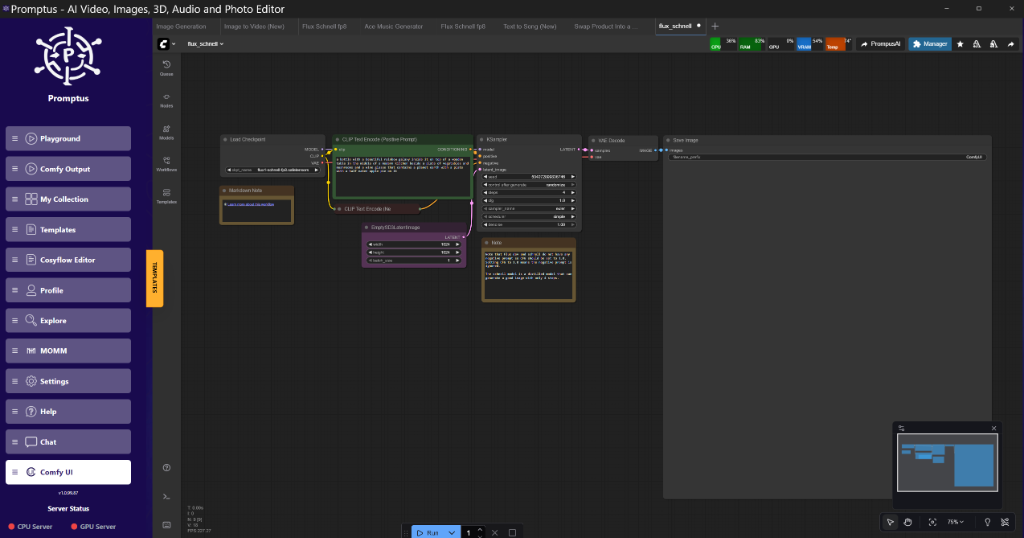
ComfyUI: Master Workflows & Node Optimisation
Running SDXL at high resolutions can quickly overwhelm even powerful GPUs. This guide tackles common ComfyUI challenges, offering practical solutions for memory optimisation and workflow efficiency. We'll explore advanced techniques to push your AI image generation further.
Installing ComfyUI [0:00]
ComfyUI installation involves cloning the repository, installing dependencies, and downloading models. Ensure you have Python installed. Clone the ComfyUI repository from GitHub. Navigate to the directory in your terminal and install the necessary Python packages using pip install -r requirements.txt. Download the required Stable Diffusion models and place them in the models directory.
Technical Analysis
The installation process is straightforward, but dependency conflicts can occur. Creating a virtual environment using venv can isolate ComfyUI's dependencies, preventing conflicts with other Python projects. This ensures a clean and stable environment for running ComfyUI.
Updating ComfyUI and Custom Nodes [2:32]
Keep ComfyUI and your custom nodes up-to-date to benefit from the latest features and bug fixes. Within the ComfyUI interface, use the built-in update functionality (usually found in the manager or settings menu) to update the core ComfyUI installation. For custom nodes, check their respective repositories for update instructions, which often involve using git pull within the custom nodes directory.
Technical Analysis
Regular updates are crucial for maintaining compatibility with new models and features. Custom nodes are frequently updated by their developers to address bugs and improve performance. Staying current ensures you have access to the most stable and efficient versions of these nodes.
Starting Your First Generation [3:21]
Generating an image involves loading a workflow, adjusting parameters, and executing the workflow. Load a pre-built workflow from a file or create one from scratch. Adjust the prompt, seed, steps, CFG scale, and sampler settings in the KSampler node. Click the "Queue Prompt" button to start the image generation process.
Technical Analysis
The initial generation is a critical step to verify that your ComfyUI installation is working correctly and that you understand the basic workflow execution. Experiment with different parameters to observe their effects on the generated image.
Understanding Nodes and Connections [11:20, 13:18]
Nodes are the fundamental building blocks of ComfyUI workflows, and connections define the flow of data between them. Each node performs a specific task, such as loading a model, applying a prompt, or sampling an image. Connections represent the data flow between nodes, with the output of one node serving as the input to another.
Technical Analysis
ComfyUI's node-based architecture provides unparalleled flexibility and control over the image generation process. By connecting nodes in different configurations, you can create complex workflows tailored to your specific needs. Understanding the purpose of each node and how they interact is essential for mastering ComfyUI.
ComfyUI Color Codes [14:15]
ComfyUI uses color codes to visually represent the data types flowing through the connections. Different colors indicate different data types, such as images, models, prompts, and latent spaces. Understanding these color codes helps you quickly identify potential errors in your workflow connections.
Technical Analysis
The color-coding system simplifies the debugging process by providing a visual representation of the data flow. If a connection is not working as expected, the color codes can help you pinpoint the source of the problem.
Workflows: Text2Image Explained [16:25]
A workflow is a collection of interconnected nodes that defines the entire image generation process, from text prompt to final image. A typical Text2Image workflow includes nodes for loading a model, encoding a text prompt, sampling a latent space, decoding the latent space into an image, and saving the image.
Technical Analysis
Workflows are the core of ComfyUI's power. They allow you to create reusable pipelines for generating images with specific styles and parameters. By understanding the components of a Text2Image workflow, you can customize it to achieve your desired results.
KSampler Deep Dive [23:07]
The KSampler node is responsible for the iterative denoising process that generates the image from a latent space. It takes a latent space, a model, a prompt, and sampler settings as input and iteratively refines the latent space until it represents a coherent image.
Technical Analysis
The KSampler is one of the most important nodes in ComfyUI. Its settings, such as steps, CFG scale, sampler, and scheduler, significantly impact the quality and style of the generated image. Experimenting with these settings is crucial for achieving optimal results.
Seed, Steps, CFG, Sampler, and Scheduler [24:13, 27:12, 28:00, 29:36, 30:54]
These parameters control the image generation process within the KSampler node.
Seed: Determines the initial noise pattern, allowing for reproducible results.
Steps: Number of denoising iterations; higher values usually improve quality but increase processing time.
CFG Scale: Controls how closely the image adheres to the prompt; higher values enforce the prompt more strongly.
Sampler: Algorithm used for denoising; different samplers produce different styles.
Scheduler: Controls the noise schedule during denoising; affects the image's overall coherence.
Technical Analysis
These parameters offer fine-grained control over the image generation process. Understanding their effects allows you to tailor the output to your specific artistic vision. Experimenting with different combinations of these parameters is essential for mastering the KSampler.
Denoise and Image2Image [31:31]
Denoise controls the amount of noise added to the initial latent space, while Image2Image uses an existing image as a starting point for the generation process. A denoise value of 1.0 corresponds to a completely random latent space, while a value of 0.0 corresponds to no added noise. Image2Image allows you to iteratively refine an existing image based on a text prompt.
Technical Analysis
Denoise and Image2Image provide powerful ways to control the image generation process. Denoise allows you to create images from scratch with varying degrees of randomness, while Image2Image allows you to transform existing images into new styles.
Image Sizes [38:24]
The image size affects the level of detail and VRAM usage. Larger image sizes require more VRAM and processing time. It's crucial to balance image size with the capabilities of your hardware. Techniques like tiled VAE decode can reduce VRAM usage for high-resolution images.
Technical Analysis
Choosing the right image size is a critical aspect of optimizing your ComfyUI workflow. Experiment with different sizes to find the optimal balance between detail and performance. For low-VRAM cards, consider using smaller image sizes or implementing VRAM optimization techniques.
My Recommended Stack
For rapid ComfyUI workflow prototyping and optimisation, I reckon tools like Promptus are brilliant. The visual builder lets you quickly connect nodes and test different configurations, which speeds up the experimentation process massively. It's not a magic bullet, but it certainly helps sort out complex workflows faster.
Resources & Tech Stack
This section details the tools and resources used and how they contribute to efficient ComfyUI workflows.
ComfyUI Official: The core node-based interface. Its flexibility allows for intricate workflow design.
Promptus AI: A workflow builder that streamlines the prototyping process.
SageAttention: A memory-efficient alternative to standard attention mechanisms in the KSampler node. This saves VRAM but may introduce subtle texture artifacts at high CFG.
Block Swapping: Allows offloading model layers to CPU during sampling, enabling larger models to run on less powerful hardware. For example, swap first 3 transformer blocks to CPU, keep rest on GPU.
LTX-2 Chunk Feedforward: Optimises video model generation by processing in chunks, thus lowering VRAM requirements.
Advanced Implementation
To implement Sage Attention, you'll need to install the appropriate custom node. Then, within your KSampler workflow, replace the standard attention mechanism with the SageAttentionPatch node. Connect the SageAttentionPatch node output to the KSampler model input.
For tiled VAE decode, ensure you are using a custom VAE Decode node that supports tiling. Set the tile size to 512x512 pixels and the overlap to 64 pixels.
Here's a snippet demonstrating a simplified workflow JSON:
{
"nodes": [
{
"id": 1,
"type": "Load Checkpoint",
"inputs": {
"ckptname": "sdxlbase_1.0.safetensors"
}
},
{
"id": 2,
"type": "CLIPTextEncode",
"inputs": {
"text": "A majestic cat",
"clip": [1, 0]
}
},
{
"id": 3,
"type": "Empty Latent Image",
"inputs": {
"width": 1024,
"height": 1024,
"batch_size": 1
}
},
{
"id": 4,
"type": "KSampler",
"inputs": {
"model": [1, 0],
"seed": 12345,
"steps": 20,
"cfg": 8,
"samplername": "eulera",
"scheduler": "normal",
"positive": [2, 0],
"negative": [2, 0],
"latent_image": [3, 0]
}
},
{
"id": 5,
"type": "VAEDecodeTiled",
"inputs": {
"samples": [4, 0],
"vae": [1, 2],
"tile_size": 512,
"overlap": 64
}
},
{
  "id": 6,
  "type": "Save Image",
  "inputs": {
    "filename_prefix": "output",
    "images": [
      5,
      0
    ]
  }
}
Performance Optimisation Guide
VRAM optimisation strategies: Use Tiled VAE Decode for memory savings when decoding high-resolution images. SageAttention is a good choice if you can tolerate minor artifacts.
Batch size recommendations by GPU tier: On my 4090, I can run a batch size of 4 at 1024x1024, but on an 8GB card, a batch size of 1 is more realistic.
Tiling and chunking for high-res outputs: Implement Tiled VAE Decode with 512x512 tiles and 64px overlap for high-resolution outputs without exceeding VRAM limits. For video, use LTX-2's chunk feedforward in 4-frame chunks.
Technical FAQ
Q: I'm getting CUDA out-of-memory errors. What can I do?
A: Reduce the image size, lower the batch size, use Tiled VAE Decode, or try Sage Attention. Block swapping is a last resort if quality degradation is acceptable.
Q: What are the minimum hardware requirements for running ComfyUI?
Q: ComfyUI is crashing when loading a specific model. How do I fix this?
A: Ensure the model file is not corrupted and is compatible with your ComfyUI version. Try redownloading the model from the source. Also, make sure you have sufficient RAM available.
Q: How can I update custom nodes in ComfyUI?
A: Navigate to the custom nodes directory in your ComfyUI installation and use git pull to update the node from its repository. If the node was installed via the manager, use the manager to update.
Q: My generated images have seams when using Tiled VAE Decode. How can I fix this?
A: Increase the overlap between tiles. Community tests suggest an overlap of 64 pixels minimises seams.
Continue Your Journey
Continue Your Journey (Internal 42.uk Research Resources)
Understanding ComfyUI Workflows for Beginners
Advanced Image Generation Techniques
VRAM Optimization Strategies for RTX Cards
Building Production-Ready AI Pipelines
Prompt Engineering Tips and Tricks
Mastering ControlNet for AI Art
Created: 23 January 2026
More Readings
Essential Tools & Resources
- Promptus AI - ComfyUI workflow builder with VRAM optimization and workflow analysis
- ComfyUI Official Repository - Latest releases and comprehensive documentation
Related Guides on 42.uk Research