ComfyUI: Install & Optimize Stable Diffusion
SDXL at 1024x1024 can be a resource hog. This guide provides a practical, no-nonsense approach to installing and optimising ComfyUI for Stable Diffusion, focusing on memory-saving techniques. We'll cover installation, basic usage, and advanced optimisations to get the most out of your hardware.
Installing ComfyUI
ComfyUI is a node-based interface for Stable Diffusion. It's installed by cloning the GitHub repository, installing dependencies, and optionally, downloading models. This provides a modular and customisable workflow for image generation.
First, you'll need to clone the ComfyUI repository from GitHub:
Code language: BASH
git clone https://github.com/comfyanonymous/ComfyUI
cd ComfyUI
Next, install the required dependencies. It's highly recommended to create a virtual environment to avoid conflicts with other Python packages:
Code language: BASH
python -m venv venv
source venv/bin/activate # On Linux/macOS
venv\Scripts\activate.bat # On Windows
pip install -r requirements.txt
Optionally, if you have an NVIDIA GPU, install the CUDA toolkit for accelerated performance. This typically involves downloading and installing the appropriate CUDA version from NVIDIA's website and ensuring your CUDA_PATH environment variable is set correctly.

Technical Analysis
The base installation provides a functional environment, but its VRAM consumption can be problematic. Tiled VAE decoding reduces VRAM load by processing the image in smaller chunks, but introduces minor overhead. Sage Attention offers substantial VRAM savings with a slight performance hit and potential artifacts.
Basic ComfyUI Usage
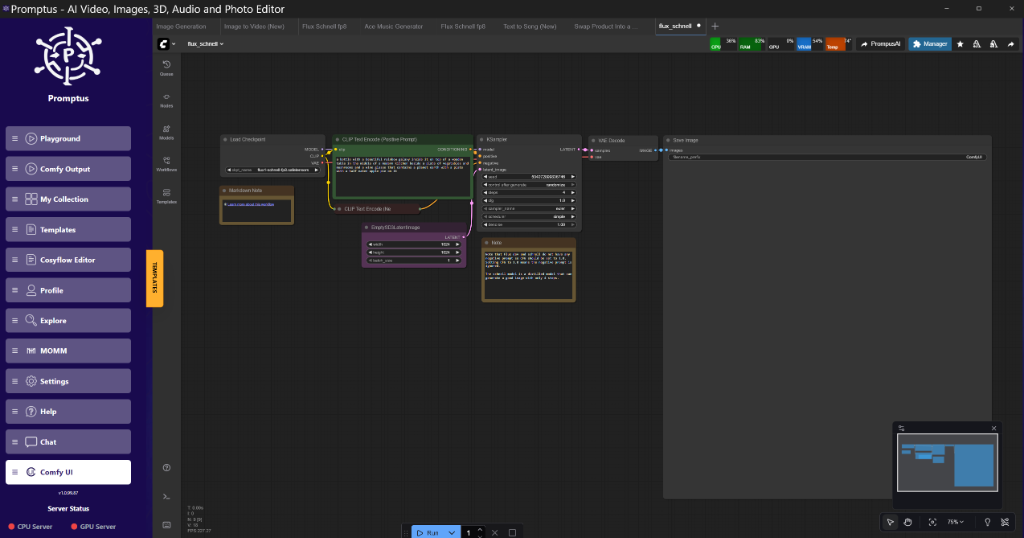
ComfyUI operates using a node graph. Each node performs a specific function, such as loading a model, sampling, or encoding/decoding the VAE. Connecting these nodes creates a workflow for image generation.
ComfyUI works by connecting nodes together to form a workflow. You start with loading a model (e.g., SDXL), then you'll need nodes for:
Prompt Encoding: Text to conditioning
Sampler: KSampler is a common choice
VAE Decode: Convert latent space back to an image
Save Image: Output the final result
Connect the nodes logically: Load Checkpoint -> Prompt Encode -> KSampler -> VAE Decode -> Save Image. Experiment with different samplers (Euler, LMS, DPM++ 2M Karras) and adjust the CFG Scale and Steps in the KSampler for different effects.
Optimising VRAM Usage
VRAM optimisation is crucial for running larger models and resolutions on limited hardware. Techniques like Tiled VAE Decode, Sage Attention, and Block Swapping can significantly reduce VRAM consumption.
Running out of VRAM is a common problem. Here are a few tricks to mitigate it:
Sage Attention: Replace the standard attention mechanism in the KSampler with Sage Attention. This saves VRAM but may introduce subtle texture artifacts at high CFG scales. You'll need to install the SageAttention custom node. Then, insert a SageAttentionPatch node before the KSampler. Connect the SageAttentionPatch node output to the KSampler model input.
Block Swapping: Offload model layers to CPU during sampling. This is a more aggressive approach for really tight VRAM situations. Experiment with swapping the first 3 transformer blocks to CPU, keeping the rest on the GPU.
Model Quantization: Using FP16 or even FP8 versions of models can reduce VRAM footprint, though it might slightly impact quality.
Technical Analysis
Tiled VAE Decode and Sage Attention reduce peak VRAM usage, allowing for higher resolutions or more complex workflows. Block swapping is the most aggressive approach, trading off processing speed for reduced VRAM footprint. Model quantization offers a balance between VRAM usage and image quality.
Advanced Techniques for Video Generation
For video generation, techniques like Chunk Feedforward and Hunyuan Low-VRAM deployment can help manage VRAM and improve performance. These methods break down the video processing into smaller chunks, allowing for more efficient memory utilisation.
For video models, memory management becomes even more critical. Here are a couple of techniques:
LTX-2 Chunk Feedforward: Process the video in 4-frame chunks. This involves modifying the model to process frames in smaller batches.
Hunyuan Low-VRAM Deployment: This combines FP8 quantization with tiled temporal attention.
Workflow Examples
Let's look at an example of integrating SageAttention into a standard SDXL workflow. First, install the custom node that provides SageAttention. After installing the custom node, your ComfyUI install needs to be restarted. You can install custom nodes using the ComfyUI Manager.
{
"nodes": [
{
"id": 1,
"type": "Load Checkpoint",
"inputs": {
"ckptname": "sdxlbase_1.0.safetensors"
}
},
{
"id": 2,
"type": "Prompt Encode",
"inputs": {
"text": "A futuristic cityscape",
"conditioning": 1
}
},
{
"id": 3,
"type": "KSampler",
"inputs": {
"model": 1,
"seed": 12345,
"steps": 20,
"cfg": 8,
"samplername": "eulera",
"positive": 2,
"negative": 3,
"latent_image": 4
}
},
{
"id": 4,
"type": "VAE Decode",
"inputs": {
"samples": 3,
"vae": 1
}
},
{
  "id": 5,
  "type": "Save Image",
  "inputs": {
    "image": 4,
    "filename_prefix": "output"
  }
}
To integrate SageAttention, you'd insert a SageAttentionPatch node between the Load Checkpoint and the KSampler. Connect the model output of the Load Checkpoint node to the model input of the SageAttentionPatch node. Then, connect the model output of the SageAttentionPatch node to the model input of the KSampler node.
My Recommended Stack
ComfyUI provides a flexible environment for building custom workflows. Tools like Promptus simplify prototyping these workflows, allowing you to focus on the creative aspects rather than the technical details.
Insightful Q&A
Let's address some common questions.
Q: How much VRAM do I really need for SDXL?
Q: I keep getting CUDA errors. What gives?
A: Ensure you have the correct CUDA toolkit version installed for your GPU and PyTorch. Double-check your environment variables. Sometimes a reinstall of the drivers sorts it.
Q: Why does my image look weird with Sage Attention?
A: Sage Attention can introduce artifacts, especially at high CFG scales. Try lowering the CFG or disabling Sage Attention for that specific workflow.
Q: ComfyUI is crashing when loading a large model. Help!
A: This is likely an OOM (Out Of Memory) error. Try the VRAM optimisation techniques mentioned above. Also, close other applications that might be consuming GPU memory.
Q: How do I update ComfyUI?
A: Navigate to your ComfyUI directory in the terminal and run git pull. Then, update the dependencies with pip install -r requirements.txt.
Conclusion
ComfyUI offers a powerful platform for Stable Diffusion, but requires a bit of tweaking to get the most out of your hardware. By understanding VRAM optimisation techniques and workflow construction, you can unlock its full potential.
Advanced Implementation
To demonstrate a full implementation, let's consider a workflow incorporating tiled VAE decode. This workflow assumes you have a basic SDXL setup with Load Checkpoint, Prompt Encode, KSampler, and VAE Decode nodes.
- Add Tiled VAE Decode Node: Add a
Tiled VAE Decodenode after the standardVAE Decodenode. - Configure Tiling: Set the
tile_sizeparameter to512,512and theoverlapto64. Experiment with different overlap values; 64 pixels is a good starting point. - Connect Nodes: Connect the
samplesoutput of theKSamplerto thesamplesinput of the standardVAE Decode. Connect thevaeoutput of theLoad Checkpointto thevaeinput of the standardVAE Decode. Connect theimageoutput of the standardVAE Decodeto thesamplesinput of theTiled VAE Decodenode. - Save Image: Connect the
imageoutput of theTiled VAE Decodenode to theimageinput of theSave Imagenode.
This setup processes the VAE decode operation in tiles, significantly reducing VRAM usage.
Performance Optimization Guide
Optimising ComfyUI performance involves balancing VRAM usage, processing speed, and image quality. Here are some tips:
VRAM Optimization: Use Tiled VAE Decode, Sage Attention, and Block Swapping as needed. Monitor VRAM usage with tools like nvidia-smi.
Batch Size: Experiment with different batch sizes in the KSampler. A smaller batch size reduces VRAM usage but increases processing time.
Tiling and Chunking: For high-resolution outputs or video generation, tiling and chunking are essential. Adjust tile sizes and chunk sizes to find the optimal balance for your hardware.
Here's a table of approximate batch sizes based on GPU VRAM:
| GPU VRAM | Recommended Batch Size |
| :------- | :--------------------- |
| 8GB | 1 |
| 12GB | 2-4 |
| 16GB+ | 4-8 |
More Readings
Continue Your Journey (Internal 42.uk Research Resources)
Understanding ComfyUI Workflows for Beginners
Advanced Image Generation Techniques
VRAM Optimization Strategies for RTX Cards
Building Production-Ready AI Pipelines
Prompt Engineering: The Art of Guiding AI
Mastering Stable Diffusion Parameters
Technical FAQ
Q: I'm getting an "out of memory" (OOM) error. How do I fix it?
A: OOM errors mean your GPU ran out of VRAM. Try these solutions: reduce image resolution, lower the batch size, use Tiled VAE Decode, enable Sage Attention, or offload model layers to CPU. Restart ComfyUI to clear memory.
Q: What are the minimum hardware requirements for running ComfyUI?
Q: How do I troubleshoot CUDA errors in ComfyUI?
A: CUDA errors usually indicate issues with your NVIDIA drivers or CUDA toolkit installation. Ensure your drivers are up to date and compatible with your CUDA version. Reinstall the CUDA toolkit if necessary. Verify that ComfyUI is configured to use your GPU in the settings.
Q: The images generated with ComfyUI are blurry or have artifacts. What's wrong?
A: Image quality issues can be caused by various factors. Check your prompt for errors, adjust the CFG scale and sampling steps in the KSampler, and ensure your VAE is correctly configured. Experiment with different samplers and models.
Q: How do I fix "ModuleNotFoundError" errors when running ComfyUI?
A: "ModuleNotFoundError" errors indicate that a required Python package is missing. Install the missing package using pip install [package_name]. Double-check that you have activated your virtual environment before installing packages.
Created: 22 January 2026