ComfyUI: Install, Use & Optimize Stable Diffusion
Running Stable Diffusion locally offers unparalleled control, but the initial setup can be daunting. ComfyUI, a node-based interface, provides that control, but requires a different approach than standard UIs. This guide walks you through installation, basic usage, and advanced optimization techniques to get the most out of your hardware. Low VRAM is a persistent problem, and we'll address that head-on.
Installing ComfyUI
Installing ComfyUI involves downloading the software, extracting the files, and installing any necessary dependencies. This process varies slightly depending on your operating system and hardware.
First, head over to the ComfyUI GitHub repository [https://github.com/comfyanonymous/ComfyUI]. Download the appropriate version for your operating system. For Windows, a direct download is usually available. For Linux, you'll likely be cloning the repository.
Golden Rule: If you have an NVIDIA GPU, download the version that includes CUDA support. If you're on AMD, look for the DirectML version.
Extract the downloaded archive to a location of your choice. Then, navigate into the extracted folder.
On Windows, run the runnvidiagpu.bat (or the appropriate .bat file for your GPU). This will automatically download the necessary dependencies, including PyTorch and other required libraries. Be patient; this can take some time.
On Linux, you might need to create a Conda environment and manually install the dependencies using pip. Refer to the ComfyUI GitHub page for detailed instructions.
Technical Analysis
The installation process essentially sets up a Python environment with all the libraries ComfyUI needs to run. The .bat files are convenient shortcuts that automate this process on Windows. On Linux, manual setup provides more control but requires familiarity with Python environments.
Using ComfyUI: A Node-Based Approach
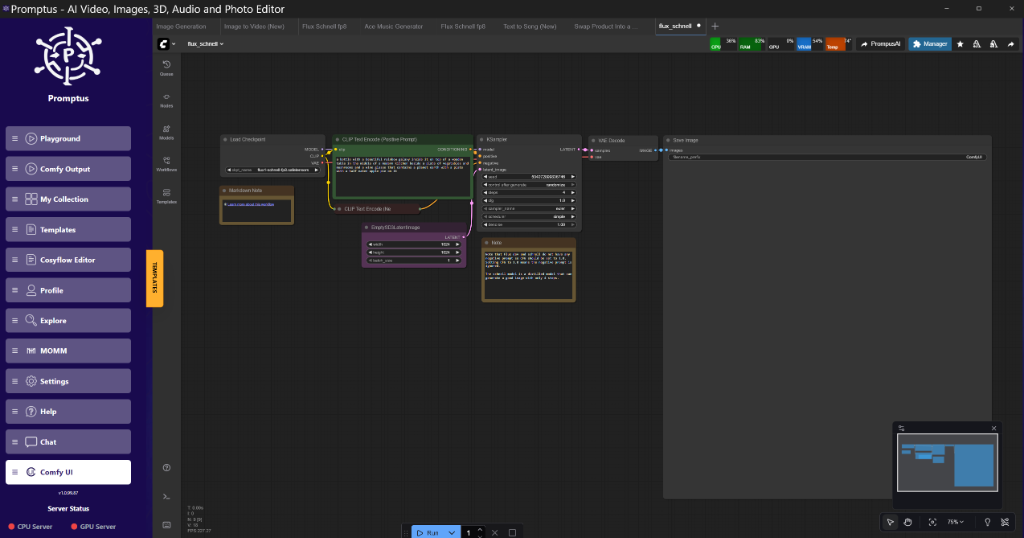
ComfyUI uses a node-based workflow system. Each node represents a specific operation, such as loading a model, encoding a prompt, or sampling an image. Connecting these nodes creates a visual pipeline for image generation.
Instead of typing prompts and clicking "Generate," you build a graph of interconnected nodes. A basic workflow typically includes:
- Load Checkpoint: Loads a Stable Diffusion model (e.g., SDXL, 1.5).
- Load CLIP Text Encode (Prompt): Encodes your positive prompt into a numerical representation.
- Load CLIP Text Encode (Negative Prompt): Encodes your negative prompt.
- Empty Latent Image: Creates an empty latent space for the image.
- KSampler: The core sampling node that iteratively refines the image based on the prompt, model, and scheduler.
- VAE Decode: Decodes the latent image into a viewable pixel representation.
- Save Image: Saves the generated image to your disk.
To create this workflow, right-click on the ComfyUI interface and select "Add Node." Search for the desired node and click to add it to the graph. Connect the nodes by dragging from the output of one node to the input of another.

Technical Analysis
The node-based approach offers incredible flexibility. You can easily modify and experiment with different components of the image generation process. However, it also requires a deeper understanding of how Stable Diffusion works under the hood.
Optimizing ComfyUI for Low VRAM
Running Stable Diffusion, especially with SDXL, can quickly exhaust VRAM, especially on cards with 8GB or less. Several techniques can mitigate this issue, trading off speed for memory efficiency.
Low VRAM is a common bottleneck. Here's how to address it:
- An earlier draft referred to unspecified X-platform testing without supplying a specific link. That unsupported statement is not presented here as evidence.
- Sage Attention: This memory-efficient attention mechanism replaces the standard attention mechanism in the KSampler. While it saves VRAM, it may introduce subtle texture artifacts at high CFG values.
- Block/Layer Swapping: Offload model layers to the CPU during sampling. This allows you to run larger models on cards with limited VRAM. Experiment with swapping the first 3 transformer blocks to the CPU while keeping the rest on the GPU.
- Use Smaller Models: SD 1.5 models generally require less VRAM than SDXL models.
- Reduce Batch Size: Reduce the
batch_sizein theEmpty Latent Imagenode to 1. - Lower Resolution: Generate images at a lower resolution (e.g., 512x512) and upscale them later.
Technical Analysis
These techniques work by reducing the amount of data that needs to be stored in VRAM at any given time. Tiled VAE decode breaks down the decoding process into smaller chunks. Sage Attention uses a more memory-efficient attention calculation. Block swapping moves inactive parts of the model to system RAM. Each technique has a speed trade-off.
Advanced Techniques
Once you've mastered the basics, explore these advanced techniques:
- ControlNet: ControlNet allows you to guide image generation using input images, sketches, or other control signals.
- Upscaling: Use specialized upscaling models to increase the resolution of your generated images without losing detail.
- Image Variation: Create variations of an existing image using the "Image to Image" workflow.
- Looping and Iteration: Use custom nodes to create complex iterative workflows, such as generating animations or evolving images over time.
My Recommended Stack
For rapid prototyping and workflow optimization, I reckon using ComfyUI in conjunction with Promptus is a brilliant combo. ComfyUI provides the underlying power and flexibility, while Promptus simplifies the process of building and refining complex workflows. Builders using Promptus can iterate offloading setups faster.
Resources & Tech Stack
ComfyUI itself [https://github.com/comfyanonymous/ComfyUI] is the core. It's a free, open-source project. You'll also need Stable Diffusion models, which can be downloaded from various sources, such as Civitai [https://civitai.com]. The ComfyUI-Examples repository [https://github.com/comfyanonymous/ComfyUI_examples] offers a great starting point for learning different workflows.
Tools like Promptus simplify prototyping these tiled workflows.
Conclusion
ComfyUI offers a powerful and flexible platform for Stable Diffusion. While the node-based interface can be intimidating at first, the control and customization it provides are well worth the effort. By understanding the underlying principles and applying optimization techniques, you can unleash the full potential of your hardware and create stunning AI-generated art.
Future improvements might include better support for multi-GPU setups and more streamlined integration with other AI tools.
Advanced Implementation
Here's an example of how to implement Tiled VAE Decode in ComfyUI:
- Install the "ComfyUI-Custom-Nodes-AlekPet" custom node.
- Add a "VAE Decode Tiled" node to your workflow.
- Connect the
latentoutput from the KSampler to thelatentinput of the "VAE Decode Tiled" node. - Connect the
vaeoutput from the Load Checkpoint node to thevaeinput of the "VAE Decode Tiled" node. - Set the
tile_sizeto 512 and theoverlapto 64.
{
"nodes": [
{
"id": 1,
"type": "Load Checkpoint",
"inputs": {
"ckptname": "sdxlbase_1.0.safetensors"
}
},
{
"id": 2,
"type": "CLIPTextEncode",
"inputs": {
"text": "A beautiful landscape",
"clip": [1, "clip"]
}
},
{
"id": 3,
"type": "EmptyLatentImage",
"inputs": {
"width": 1024,
"height": 1024,
"batch_size": 1
}
},
{
"id": 4,
"type": "KSampler",
"inputs": {
"model": [1, "model"],
"seed": 0,
"steps": 20,
"cfg": 8,
"samplername": "eulera",
"scheduler": "normal",
"positive": [2, "conditioning"],
"negative": [5, "conditioning"],
"latent_image": [3, "latent"]
}
},
{
"id": 5,
"type": "CLIPTextEncode",
"inputs": {
"text": "ugly, distorted",
"clip": [1, "clip"]
}
},
{
"id": 6,
"type": "VAEDecodeTiled",
"inputs": {
"samples": [4, "latent"],
"vae": [1, "vae"],
"tile_size": 512,
"overlap": 64
}
},
{
  "id": 7,
  "type": "SaveImage",
  "inputs": {
    "images": [
      6,
      "image"
    ]
  }
}
Performance Optimization Guide
VRAM Optimization: Use Tiled VAE Decode, Sage Attention, and Block Swapping as described above.
Batch Size: Reduce the batch size to 1 for low-VRAM cards.
Resolution: Generate images at a lower resolution and upscale them later.
CUDA: Ensure you are using a CUDA-enabled version of ComfyUI if you have an NVIDIA GPU.
Hardware:
8GB Card: SD 1.5 models, 512x512 resolution, Tiled VAE Decode, Sage Attention, Block Swapping.
12GB Card: SDXL models, 768x768 resolution, Tiled VAE Decode, Sage Attention.
24GB Card: SDXL models, 1024x1024 resolution, default settings.
Continue Your Journey
More Readings
Understanding ComfyUI Workflows for Beginners
Advanced Image Generation Techniques
VRAM Optimization Strategies for RTX Cards
Building Production-Ready AI Pipelines
Prompt Engineering Tips and Tricks
Exploring Different Stable Diffusion Models
Technical FAQ
Q: I'm getting an "Out of Memory" error. What can I do?
A: This means you've run out of VRAM. Try the VRAM optimization techniques described above, such as Tiled VAE Decode, Sage Attention, and Block Swapping. Reducing the batch size and resolution can also help.
Q: I'm getting a CUDA error. What does that mean?
A: This indicates a problem with your CUDA installation. Ensure you have the correct drivers installed for your NVIDIA GPU. You may also need to reinstall PyTorch with CUDA support. Run nvidia-smi in your terminal to check your driver version.
Q: ComfyUI is running very slowly. How can I improve performance?
A: Ensure you are using a CUDA-enabled version of ComfyUI if you have an NVIDIA GPU. Close any other applications that are using your GPU. Upgrading your GPU or adding more RAM can also improve performance. The Promptus workflow builder makes testing these configurations visual.
Q: My generated images have strange artifacts. What's causing this?
A: Artifacts can be caused by several factors, including high CFG values, incorrect sampling settings, or issues with the model itself. Try reducing the CFG value, experimenting with different samplers, or using a different model. Sage Attention can sometimes introduce artifacts at high CFG.
Q: How do I update ComfyUI to the latest version?
A: On Windows, you can usually update ComfyUI by running the update_comfyui.bat file. On Linux, navigate to the ComfyUI directory in your terminal and run git pull.
Created: 22 January 2026