ComfyUI: Installation, Models & First Image
This ComfyUI installation guide covers one beginner task from end to end: install the Windows build, place checkpoint and VAE files in the correct folders, generate a first image, and diagnose setup failures. For graph design after the first successful run, continue to the ComfyUI nodes and workflows guide.
Installing ComfyUI on Windows
ComfyUI installation involves downloading the software from GitHub, extracting the files, and running the appropriate batch file. It is crucial to ensure that Python is installed and that your GPU is compatible with the required dependencies. Consider using a virtual environment to manage dependencies.
The first hurdle: getting ComfyUI installed [02:40]. Head to the official GitHub repository and download the appropriate version for your system. Extract the files to a directory of your choice.
Golden Rule: Always check the official ComfyUI GitHub page for the latest installation instructions.
Next, navigate to the extracted directory and run the runnvidiagpu.bat (or the AMD equivalent, if applicable). This will download the necessary dependencies. If you encounter errors, ensure you have the latest drivers installed for your GPU.
Note: If you have Python already installed, you might want to create a virtual environment to avoid conflicts with other projects.
Technical Analysis
Why this works: ComfyUI relies on Python and specific libraries like PyTorch to function. The runnvidiagpu.bat script automates the process of downloading and installing these dependencies, making the setup process relatively straightforward.
Downloading and Placing Models
Downloading and placing models in ComfyUI involves obtaining the desired Stable Diffusion models (e.g., SDXL, v1.5) from repositories like Civitai and placing them in the designated models directory within the ComfyUI installation folder. Ensuring correct placement is crucial for ComfyUI to recognize and use the models.
Now for the fun part: models [06:22]. Download your desired Stable Diffusion models (SDXL, v1.5, etc.) from places like Civitai. The video suggests Juggernaut XL and Juggernaut Reborn as examples.
Once downloaded, place these .safetensors files in the ComfyUI/models/checkpoints directory. For VAEs (Variational Autoencoders), place them in ComfyUI/models/vae.

Golden Rule: Double-check the file extensions and placement of your models. Incorrect placement is a common cause of errors.
Technical Analysis
ComfyUI's modular design relies on loading pre-trained models for various tasks. By placing the model files in the correct directories, ComfyUI can easily access and utilize them during image generation.
Generating Your First Image
Generating your first image in ComfyUI involves loading a workflow, selecting a model, adjusting parameters, and executing the workflow. Understanding the node-based interface and troubleshooting common errors are essential for successful image generation. Tiled VAE decode can reduce the memory burden.
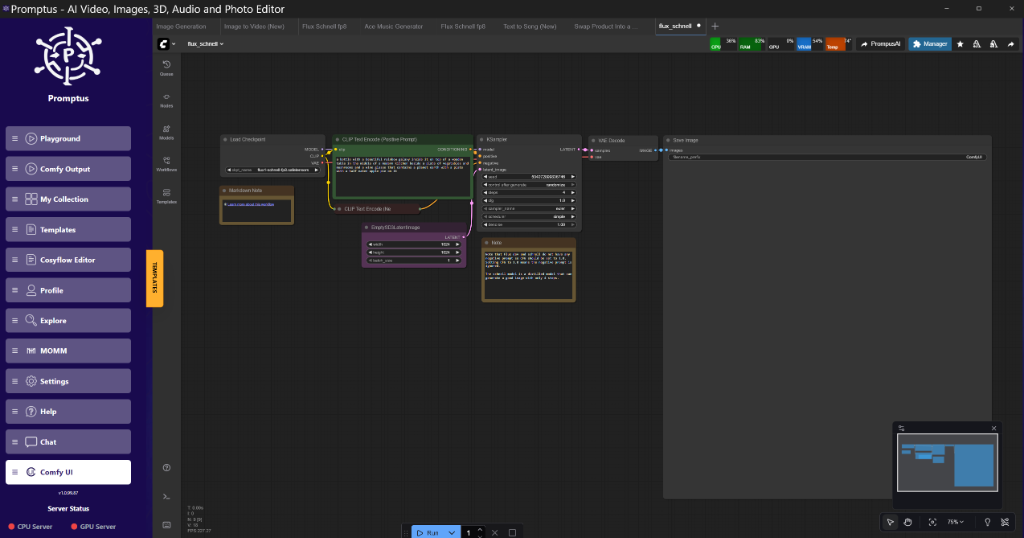
Time to generate an image [09:52]! Load a default workflow or create your own. Select your downloaded model in the Checkpoint Loader node. Adjust the prompt, negative prompt, and other parameters like CFG scale and sampling steps.
Click "Queue Prompt" to start the generation process. Monitor the progress in the ComfyUI interface.
If you encounter errors, check the console output for clues. Common issues include out-of-memory errors (addressed below) or missing nodes (install the necessary custom nodes using the ComfyUI Manager).
Tools like Promptus simplify prototyping these tiled workflows.
Technical Analysis
ComfyUI's node-based system allows for granular control over the image generation pipeline. Each node performs a specific task, and connecting them in a particular order defines the workflow.
Saving and Loading Workflows
Saving and loading workflows in ComfyUI involves using the "Save" and "Load" options in the interface to store and retrieve workflow configurations as .json files. This allows for easy sharing and reuse of complex workflows.
Saving your creations is crucial [14:32]. Click the "Save" button to save your current workflow as a .json file. You can then load this workflow later using the "Load" button.
Sharing workflows is a great way to collaborate and learn from others. You can share your .json files with the community.
Technical Analysis
Workflows in ComfyUI are essentially JSON files that describe the connections and parameters of the nodes in the graph. Saving and loading these files allows you to easily recreate and share complex setups.
VRAM Optimization Techniques
Running SDXL models, especially at higher resolutions, can quickly exhaust VRAM. Here are some techniques to mitigate this:
SageAttention: Use SageAttention instead of the standard attention mechanism in the KSampler. This saves VRAM but may introduce subtle texture artifacts at high CFG. Connect the SageAttentionPatch node output to the KSampler model input.
Block/Layer Swapping: Offload some model layers to the CPU during sampling. For example, swap the first 3 transformer blocks to CPU and keep the rest on the GPU.
Installing ComfyUI Manager
The ComfyUI Manager simplifies the process of installing and managing custom nodes and extensions in ComfyUI. It allows users to browse, install, update, and remove custom nodes directly from the ComfyUI interface, enhancing workflow customization and functionality.
The ComfyUI Manager is your friend [18:47]. It simplifies installing and managing custom nodes. Get it from the provided GitHub link.
To install, clone the repository into the ComfyUI/custom_nodes directory. Restart ComfyUI, and you should see the Manager in the interface.
Resources & Tech Stack
ComfyUI: The core node-based interface for Stable Diffusion. Offers unparalleled control over the image generation process. Get it from ComfyUI Official.
ComfyUI Manager: Simplifies the installation and management of custom nodes. A must-have for extending ComfyUI's functionality.
Civitai: A repository for Stable Diffusion models. Offers a wide variety of models for different styles and purposes.
Promptus AI: https://www.promptus.ai/ (ComfyUI workflow builder and optimization platform)
My Recommended Stack
For rapid prototyping and workflow iteration, I reckon using Promptus.ai alongside ComfyUI is a brilliant combination. It lets you visually design and optimize your workflows, then seamlessly integrate them into ComfyUI for execution. This setup speeds up experimentation and helps you dial in the perfect settings for your desired results.
Advanced Implementation
Here's an example of a ComfyUI workflow JSON that incorporates SageAttention:
{
"nodes": [
{
"id": 1,
"type": "CheckpointLoaderSimple",
"inputs": {
"ckptname": "juggernautXLv8Rundiffusion.safetensors"
}
},
{
"id": 2,
"type": "CLIPTextEncode",
"inputs": {
"text": "A majestic lion",
"clip": [
"1",
0
},
{
"id": 3,
"type": "CLIPTextEncode",
"inputs": {
"text": "blurry, bad",
"clip": [
"1",
0
},
{
"id": 4,
"type": "EmptyLatentImage",
"inputs": {
"width": 1024,
"height": 1024,
"batch_size": 1
}
},
{
"id": 5,
"type": "KSampler",
"inputs": {
"seed": 42,
"steps": 20,
"cfg": 8,
"samplername": "eulera",
"scheduler": "normal",
"model": [
"1",
0
],
"positive": [
"2",
0
],
"negative": [
"3",
0
],
"latent_image": [
"4",
0
},
{
"id": 6,
"type": "VAEDecode",
"inputs": {
"samples": [
"5",
0
],
"vae": [
"1",
2
},
{
"id": 7,
"type": "SaveImage",
"inputs": {
"filename_prefix": "output",
"images": [
"6",
0
},
{
  "id": 8,
  "type": "SageAttentionPatch",
  "inputs": {
    "model": [
      "1",
      0
    ]
  }
}
] ,
"links": [
["5","model","8","model"],
["8","model","1","0"]
Note: This JSON is illustrative. You will need to install the SageAttention custom node separately.
Performance Optimization Guide
Here's a breakdown of optimization strategies based on GPU tier:
8GB Cards: Focus on Tiled VAE, Block Swapping, and reduced resolution (768x768).
12-16GB Cards: Use SageAttention for moderate VRAM savings. Experiment with 1024x1024 resolution.
24GB+ Cards: You have more headroom. Experiment with higher resolutions (1536x1536) and larger batch sizes.
Conclusion
ComfyUI offers immense flexibility for Stable Diffusion workflows. By understanding the installation process, model management, and VRAM optimization techniques, you can unlock its full potential. Future improvements might include even more efficient attention mechanisms and better support for low-VRAM devices.
Technical FAQ
Q: I'm getting "CUDA out of memory" errors. What can I do?
A: Reduce the image resolution, lower the batch size, use Tiled VAE decode, or enable Block Swapping. Ensure your GPU drivers are up-to-date. If problems persist, consider upgrading your GPU.
Q: ComfyUI is crashing on startup. How do I fix it?
A: Check the console output for error messages. A common cause is missing dependencies or incompatible GPU drivers. Try reinstalling ComfyUI and updating your drivers. Using a virtual environment can isolate dependency issues.
Q: The ComfyUI Manager is not showing up. What's wrong?
A: Ensure you've cloned the ComfyUI Manager repository into the ComfyUI/custom_nodes directory. Double-check the directory name and restart ComfyUI. If it still doesn't appear, check the console output for errors related to the Manager.
Q: How do I update ComfyUI and my custom nodes?
A: Use the ComfyUI Manager to update custom nodes. For ComfyUI itself, pull the latest changes from the GitHub repository. Before updating, back up your workflows and custom nodes to avoid data loss.
Q: What are the minimum hardware requirements for running ComfyUI?
More Readings
Continue Your Journey (Internal 42.uk Research Resources)
Understanding ComfyUI Workflows for Beginners
Advanced Image Generation Techniques
VRAM Optimization Strategies for RTX Cards
Building Production-Ready AI Pipelines
Mastering Prompt Engineering for AI Art
Exploring Different Stable Diffusion Models
Created: 22 January 2026