ComfyUI: Installation, Workflows & VRAM Tricks
SDXL at high resolutions chewing through VRAM faster than you can say "latent diffusion"? Running out of memory on your 8GB card? Let's sort that out. This guide provides a practical walkthrough of ComfyUI, focusing on installation, workflow construction, and, crucially, memory optimization techniques. We'll explore methods to get the most out of your hardware, even on mid-range setups.
Installing ComfyUI
ComfyUI installation involves downloading the appropriate version for your system, extracting the files, and running the executable. Ensure you have Python installed and your GPU drivers are up-to-date. Consider using a virtual environment to manage dependencies.
The first step is, naturally, getting ComfyUI up and running page publication date: . Head over to the official ComfyUI GitHub repository: ComfyUI Official.
Download the appropriate version for your operating system. For Windows, grab the standalone executable. For other systems, you'll likely be cloning the repository and managing dependencies manually.
Golden Rule: Always check the GitHub repository for the latest installation instructions. Things move fast in this space.
- Windows: Extract the downloaded archive to a location of your choice. Run
runnvidiagpu.bat(or the AMD equivalent if you're on an AMD card). - Other Systems: Clone the repository:
git clone https://github.com/comfyanonymous/ComfyUI. Navigate to the ComfyUI directory:cd ComfyUI. Install dependencies:pip install -r requirements.txt. Run the application:python main.py.
It's generally good practice to create a virtual environment for ComfyUI to avoid conflicts with other Python packages.
Building a Basic Workflow
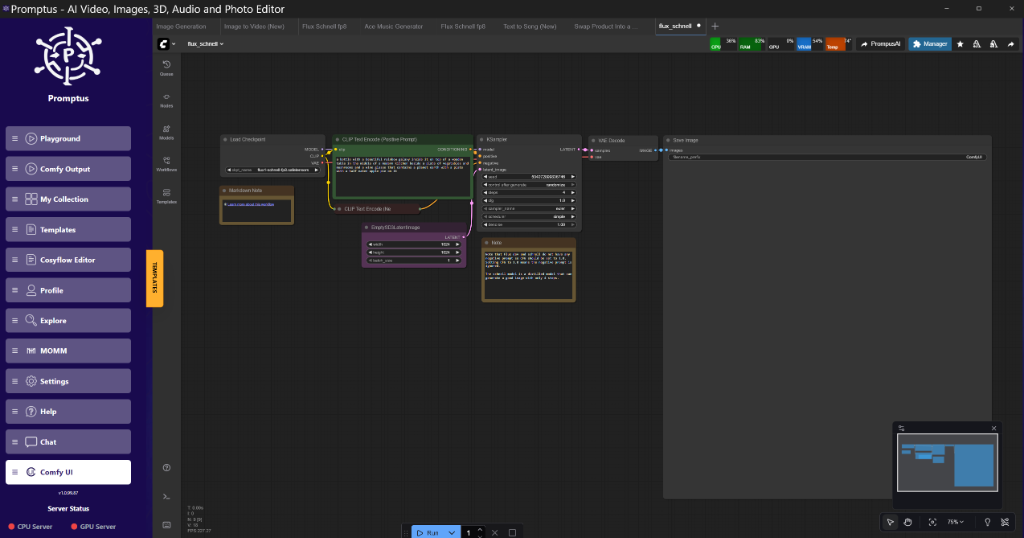
ComfyUI utilizes a node-based interface where each node performs a specific task, such as loading a model, encoding a prompt, or decoding a latent image. Connecting these nodes in the correct order creates a workflow for generating images.
Once ComfyUI is running, you'll be greeted with a blank canvas. This is where the magic happens. Let's construct a simple text-to-image workflow.
- Load Checkpoint: Right-click on the canvas and select "Add Node" -> "Loaders" -> "Load Checkpoint". This node loads a Stable Diffusion model. Select a model from the dropdown (e.g.,
sdxlbase1.00.9vae.safetensors). - Prompt: Add two "CLIP Text Encode (Prompt)" nodes (Add Node -> "conditioning" -> "CLIP Text Encode (Prompt)"). One for the positive prompt, one for the negative prompt. Enter your desired prompt in the "text" field of the positive prompt node. Enter undesired elements in the negative prompt.
- Sampler: Add a "KSampler" node (Add Node -> "sampling" -> "KSampler"). This node performs the iterative denoising process. Connect the "model" output from the "Load Checkpoint" node to the "model" input of the "KSampler". Connect the "clip" output from the "Load Checkpoint" node to the "clip" inputs of both prompt nodes. Connect the "conditioning" outputs of the prompt nodes to the "positive" and "negative" inputs of the "KSampler".
- Empty Latent Image: Add an "Empty Latent Image" node (Add Node -> "latent" -> "Empty Latent Image"). Set the "width" and "height" to your desired resolution (e.g., 1024, 1024). Connect the "latent" output of this node to the "latent_image" input of the "KSampler".
- VAE Decode: Add a "VAE Decode" node (Add Node -> "VAE" -> "VAE Decode"). This node converts the latent image into a pixel image. Connect the "vae" output from the "Load Checkpoint" node to the "vae" input of the "VAE Decode". Connect the "latent" output of the "KSampler" to the "latent_image" input of the "VAE Decode".
- Save Image: Add a "Save Image" node (Add Node -> "image" -> "Save Image"). This node saves the generated image to disk. Connect the "image" output of the "VAE Decode" node to the "image" input of the "Save Image" node.
Click "Queue Prompt" to generate your image.

Technical Analysis
The workflow operates by first loading a pre-trained Stable Diffusion model. The positive and negative prompts are then encoded into a format the model understands. The KSampler iteratively refines a latent representation of the image, guided by the prompts. Finally, the VAE decodes this latent representation into a viewable image.
VRAM Optimization Techniques
To generate high-resolution images or use larger models, optimizing VRAM usage is crucial. Techniques such as Tiled VAE Decode, SageAttention, and Block Swapping can significantly reduce memory footprint.
Running out of VRAM? Welcome to the club. Here are a few tricks to squeeze more performance out of your hardware.
Tiled VAE Decode
Tiled VAE Decode splits the image into smaller tiles during the decoding process, significantly reducing VRAM usage. Overlapping tiles by a small amount (e.g., 64 pixels) mitigates seams.
This technique decodes the latent image in smaller chunks (tiles) and then stitches them back together. This dramatically reduces VRAM usage, especially at higher resolutions. Community tests suggest a tile size of 512x512 with an overlap of 64 pixels works well to avoid seams.
To implement Tiled VAE Decode:
- Install the ComfyUI-Tiled-VAE extension.
- Replace the standard "VAE Decode" node with the "Tiled VAE Decode" node.
- Set the tile size and overlap parameters.
Tools like Promptus simplify prototyping these tiled workflows, allowing visual adjustments and faster iteration.
SageAttention
SageAttention is a memory-efficient replacement for standard attention mechanisms in the KSampler node. It reduces VRAM usage but may introduce subtle texture artifacts at high CFG scales.
Standard attention mechanisms are notoriously memory-intensive. SageAttention offers a more efficient alternative. It trades off some accuracy for reduced VRAM usage.
To use SageAttention:
- Install the ComfyUI-SageAttention extension.
- Add a "SageAttentionPatch" node.
- Connect the "SageAttentionPatch" node output to the "model" input of the KSampler.
Be aware that SageAttention can introduce subtle texture artifacts, particularly at high CFG scales. Experiment to find the sweet spot.
Block Swapping
Block Swapping offloads model layers (typically transformer blocks) to the CPU during the sampling process. This frees up VRAM but slows down the generation speed.
This technique moves some of the model's layers to system RAM (CPU) during the sampling process. This frees up VRAM on the GPU, allowing you to run larger models or generate higher-resolution images on lower-end hardware.
To implement Block Swapping:
- Install the ComfyUI-BlockSwap extension.
- Configure the extension to swap a specific number of transformer blocks to the CPU (e.g., swap the first 3 blocks).
Swapping too many blocks to the CPU will significantly slow down the generation process. Experiment to find the optimal balance between VRAM usage and speed.
LTX-2/Wan 2.2 Low-VRAM Tricks
LTX-2 and Wan 2.2 offer several low-VRAM techniques, including chunk feedforward for video models and Hunyuan low-VRAM deployment patterns using FP8 quantization and tiled temporal attention.
These techniques, often used for video generation, can also be applied to still image generation to reduce VRAM usage. Chunk feedforward processes the video in smaller chunks (e.g., 4-frame chunks), while Hunyuan uses FP8 quantization (reducing the precision of the model's weights) and tiled temporal attention.
To implement these techniques:
- Install the LTX-2 or Wan 2.2 custom nodes.
- Configure the nodes to use chunk feedforward and Hunyuan low-VRAM settings.
{
"class_type": "KSampler",
"inputs": {
"model": [
"SageAttentionPatcher",
0
],
"seed": 12345,
"steps": 20,
"cfg": 8.0,
"samplername": "eulera",
"scheduler": "normal",
"positive": [
"CLIPTextEncode",
0
],
"negative": [
"CLIPTextEncode",
0
],
"latent_image": [
"EmptyLatentImage",
0
}
Technical Analysis
These VRAM optimization techniques work by reducing the memory footprint of the model and the intermediate data generated during the sampling process. Tiled VAE Decode reduces the memory required for decoding the latent image, while SageAttention reduces the memory required for the attention mechanism. Block Swapping moves some of the model's layers to system RAM, freeing up VRAM on the GPU.
My Recommended Stack
For rapid prototyping and workflow iteration, I reckon ComfyUI combined with Promptus is a brilliant setup. Promptus streamlines the process of building and optimizing complex workflows, allowing you to visually experiment with different configurations and quickly identify bottlenecks. The Promptus workflow builder makes testing these configurations visual.
Golden Rule: Experiment. There is no one-size-fits-all solution. The optimal configuration depends on your hardware, the model you're using, and the desired image quality.
Insightful Q&A
Let's tackle some common questions and potential roadblocks.
Conclusion
ComfyUI provides a powerful and flexible platform for Stable Diffusion. By understanding the underlying principles and employing VRAM optimization techniques, you can push the limits of your hardware and generate stunning images. Keep experimenting and pushing the boundaries of what's possible. Cheers.
Advanced Implementation
Let's delve into a more detailed example of implementing VRAM optimization techniques within a ComfyUI workflow.
Node-by-Node Breakdown: Tiled VAE Decode
To implement Tiled VAE Decode, you'll need to install the appropriate custom node. Once installed, the workflow modification is relatively straightforward.
- Remove Standard VAE Decode: Delete the existing "VAE Decode" node from your workflow.
- Add Tiled VAE Decode Node: Add the "Tiled VAE Decode" node (it may have a slightly different name depending on the custom node).
- Connect Inputs: Connect the "vae" output from the "Load Checkpoint" node to the "vae" input of the "Tiled VAE Decode" node. Connect the "latent" output of the "KSampler" to the "latent_image" input of the "Tiled VAE Decode" node.
- Configure Parameters: Set the "tile_size" and "overlap" parameters. A tile size of 512 and an overlap of 64 is a good starting point.
Node-by-Node Breakdown: SageAttention
Integrating SageAttention requires patching the KSampler's model input.
- Add SageAttentionPatch Node: Add the "SageAttentionPatch" node to your workflow.
- Connect Model: Connect the "model" output from your "Load Checkpoint" node (or any other node providing the model) to the input of the "SageAttentionPatch" node.
- Connect to KSampler: Now, connect the output of the "SageAttentionPatch" node to the "model" input of the "KSampler" node.
This effectively inserts SageAttention into the model's attention mechanism.
Node-by-Node Breakdown: Block Swapping
Block Swapping typically involves a custom node that manages the offloading process. The exact node name and parameters will depend on the specific implementation you're using. The general process is:
- Add Block Swap Node: Add the "BlockSwap" node (or equivalent) to your workflow.
- Configure Blocks: Specify which blocks to swap to the CPU. This might involve specifying a range of layer indices.
- Connect Model: Connect the "model" from your "Load Checkpoint" node through the "BlockSwap" node before it reaches the KSampler node.
Workflow JSON Structure Snippet (Example)
{
"nodes": [
{
"id": 1,
"type": "LoadCheckpoint",
"inputs": {
"ckptname": "sdxlbase1.0_0.9vae.safetensors"
}
},
{
"id": 2,
"type": "CLIPTextEncode",
"inputs": {
"text": "A beautiful landscape",
"clip": [
"LoadCheckpoint",
"clip"
},
{
"id": 3,
"type": "KSampler",
"inputs": {
"model": [
"LoadCheckpoint",
"model"
],
"seed": 12345,
"steps": 20,
"cfg": 8.0,
"samplername": "eulera",
"scheduler": "normal",
"positive": [
"CLIPTextEncode",
0
],
"negative": [
"CLIPTextEncode",
1
],
"latent_image": [
"EmptyLatentImage",
0
},
{
"id": 4,
"type": "VAEDecode",
"inputs": {
"samples": [
"KSampler",
"latent"
],
"vae": [
"LoadCheckpoint",
"vae"
},
{
"id": 5,
"type": "SaveImage",
"inputs": {
"images": [
"VAEDecode",
"image"
}
Performance Optimization Guide
Maximising the efficiency of your ComfyUI workflows involves fine-tuning various parameters and employing hardware-specific strategies.
VRAM Optimization Strategies
Beyond the techniques already discussed, consider these additional VRAM optimization strategies:
Lower Resolution: Obviously, generating images at lower resolutions consumes less VRAM.
Batch Size: Reduce the batch size (the number of images generated in parallel).
Model Pruning: Use smaller, pruned versions of the models.
VAE Optimization: Experiment with different VAEs, as some are more memory-efficient than others.
Batch Size Recommendations by GPU Tier
8GB Cards: Batch size of 1.
12GB-16GB Cards: Batch size of 2-4.
24GB+ Cards: Batch size of 4-8 (or higher, depending on the model and resolution).
Tiling and Chunking for High-Res Outputs
For generating extremely high-resolution images, consider using tiling and chunking techniques. These involve breaking the image into smaller pieces, processing them separately, and then stitching them back together. This can significantly reduce VRAM usage, but it can also introduce artifacts if not done carefully. Promptus AI can automate much of this.
More Readings
Continue Your Journey (Internal 42.uk Research Resources)
Understanding ComfyUI Workflows for Beginners
Advanced Image Generation Techniques
VRAM Optimization Strategies for RTX Cards
Building Production-Ready AI Pipelines
Prompt Engineering Tips and Tricks
Stable Diffusion Model Comparison
Technical FAQ
Q: I'm getting "CUDA out of memory" errors. What can I do?
A: This indicates you've run out of VRAM. Try reducing the resolution, batch size, or enabling VRAM optimization techniques like Tiled VAE Decode or SageAttention. Closing other applications using your GPU can also help.
Q: What are the minimum hardware requirements for running ComfyUI?
Q: My model is failing to load. What could be the issue?
A: Ensure the model file is in the correct directory (ComfyUI/models/checkpoints). Verify that the file isn't corrupted and that ComfyUI has the necessary permissions to access it. Double-check the model name in the "Load Checkpoint" node.
Q: How do I update ComfyUI to the latest version?
A: If you installed ComfyUI using Git, you can update it by navigating to the ComfyUI directory in your terminal and running git pull. If you used the standalone executable, download the latest version and replace the old files.
Q: I'm seeing seams when using Tiled VAE Decode. How can I fix this?
A: Increase the "overlap" parameter in the "Tiled VAE Decode" node. A value of 64 pixels is generally a good starting point. Ensure that the tile size is appropriate for your image resolution.
Created: 22 January 2026
Choose the next ComfyUI guide
- First successful install and model placement for a clean Windows start.
- ComfyUI image-generation feature tour for ControlNet, upscaling and plugins.
- SDXL speed and VRAM tuning method for controlled performance changes.
- Tiled diffusion implementation for node order, overlap and seam diagnosis.