ComfyUI: Master AI Image Generation
SDXL at 1024x1024 chews through VRAM. Running complex workflows with ControlNet can bring even a 4090 to its knees. This guide breaks down ComfyUI, from installation to advanced techniques, focusing on practical solutions for resource-constrained environments. We'll cover upscaling, image-to-image, ControlNet, and faceswap, along with crucial VRAM optimization strategies.
What is ComfyUI?
ComfyUI is a powerful, node-based interface for Stable Diffusion. Unlike simpler tools, it offers granular control over every step of the image generation process. This flexibility is both its strength and its challenge: mastering ComfyUI requires understanding the underlying mechanics of diffusion models.
ComfyUI provides a modular approach to image generation. Each node represents a specific operation, like loading a model, sampling, or applying a VAE. By connecting these nodes, you create custom workflows tailored to your specific needs. This level of control is essential for advanced techniques and achieving consistent results. Tools like Promptus simplify prototyping these tiled workflows, allowing builders to iterate offloading setups faster.
Installation and Setup [1:48]
First, grab the latest version from the official ComfyUI GitHub repository: ComfyUI Official. Installation varies slightly depending on your operating system. On Windows, a portable version is available, requiring only extraction. Linux users will need to clone the repository and install dependencies.
Golden Rule: Ensure you have the latest drivers for your GPU. Outdated drivers are a common cause of errors and performance bottlenecks.
After installation, launch ComfyUI. The default interface presents a blank canvas. This is where you'll build your workflows.
Downloading Models [4:00]
ComfyUI supports a wide range of Stable Diffusion models, VAEs, and ControlNet models. Civitai is a popular resource for finding community-created models. Hugging Face also hosts numerous models. Place downloaded models in the appropriate directories within the ComfyUI folder structure.
models/Stable-diffusion: For base Stable Diffusion models.
models/VAE: For VAE (Variational Autoencoder) models.
models/ControlNet: For ControlNet models.
Restart ComfyUI after adding new models for them to appear in the node selection menus.
Text-to-Image Workflow [7:25]
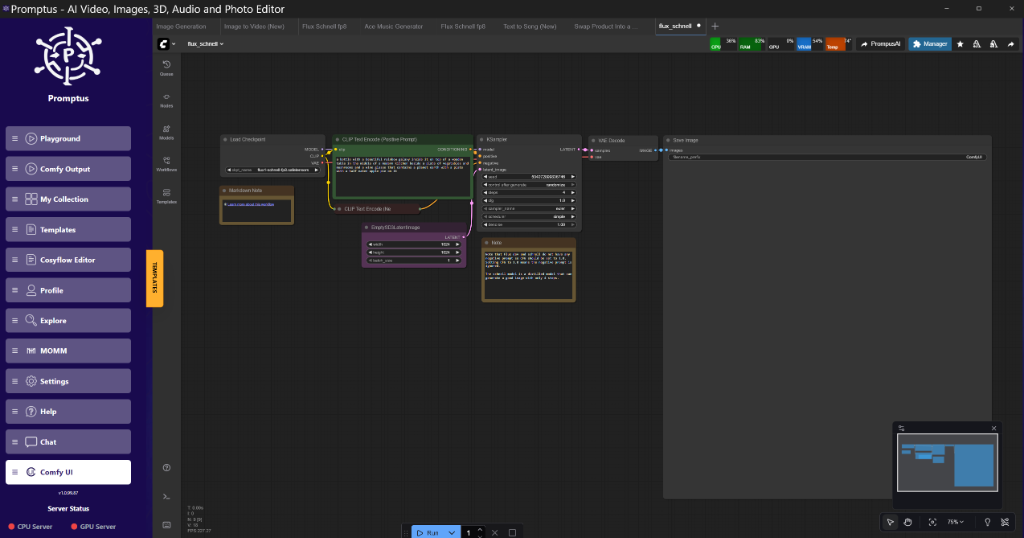
Let's construct a basic text-to-image workflow. This will illustrate the core concepts of ComfyUI.
- Load Checkpoint: Add a "Load Checkpoint" node. Select your desired Stable Diffusion model.
- CLIP Text Encode (Prompt): Add two "CLIP Text Encode" nodes. One for the positive prompt and one for the negative prompt.
- Empty Latent Image: Add an "Empty Latent Image" node. Configure the size and batch count. For SDXL, 1024x1024 is common.
- KSampler: Add a "KSampler" node. This is the heart of the sampling process.
- VAE Decode: Add a "VAE Decode" node. This converts the latent image into a visible image.
- Save Image: Add a "Save Image" node.
Connect the nodes as follows:
Load Checkpoint -> CLIP Text Encode (Positive)
Load Checkpoint -> CLIP Text Encode (Negative)
Load Checkpoint -> KSampler (model, clip)
Empty Latent Image -> KSampler (latent_image)
CLIP Text Encode (Positive) -> KSampler (positive)
CLIP Text Encode (Negative) -> KSampler (negative)
KSampler -> VAE Decode (samples)
Load Checkpoint -> VAE Decode (vae)
VAE Decode -> Save Image (images)

Adjust the KSampler parameters (seed, steps, CFG scale, sampler name, scheduler) to influence the generated image. A higher CFG scale forces the image to adhere more closely to the prompt, but can introduce artifacts.
Navigation, Editing, and Shortcuts [21:30]
ComfyUI's interface can be daunting at first. Familiarize yourself with these essential shortcuts:
Right-click: Opens the node context menu.
Ctrl+C, Ctrl+V: Copy and paste nodes.
Delete: Deletes selected nodes.
Shift+Drag: Moves multiple nodes simultaneously.
Ctrl+Click Drag: Connects multiple nodes.
Double-Click: Searches for a node to add.
Experiment with different layouts and organization techniques. ComfyUI allows you to group nodes and add labels for clarity.
ComfyUI Manager [26:15]
The ComfyUI Manager is an invaluable extension that simplifies installing and managing custom nodes and models. It's essentially a package manager for ComfyUI.
What is the ComfyUI Manager?
The ComfyUI Manager simplifies the installation and management of custom nodes and models within ComfyUI. It acts as a package manager, allowing users to easily browse, install, update, and remove extensions without manual file manipulation.
To install the ComfyUI Manager:
- Navigate to your ComfyUI installation directory.
- Clone the ComfyUI Manager repository into the
custom_nodesfolder:git clone https://github.com/ltdrdata/ComfyUI-Manager - Restart ComfyUI.
The ComfyUI Manager will appear as a new menu item in the ComfyUI interface. Use it to browse and install custom nodes, update existing nodes, and manage dependencies.
Upscaling [28:43]
Upscaling increases the resolution of an image. ComfyUI offers several upscaling methods. A common approach involves using a dedicated upscaling model.
- Load Image: Add a "Load Image" node. Load the image you want to upscale.
- Upscale Model Loader: Add an "Upscale Model Loader" node. Select your desired upscaling model (e.g., a RealESRGAN model).
- Upscale Image: Add an "Upscale Image" node. Connect the "image" output from the "Load Image" node and the "model" output from the "Upscale Model Loader" node to the "Upscale Image" node.
- Save Image: Add a "Save Image" node to save the upscaled image.
Experiment with different upscaling models and scaling factors to achieve the desired results.
Image-to-Image Workflow [37:49]
Image-to-image generation uses an existing image as a starting point. This allows you to modify and transform images based on a prompt.
- Load Image: Add a "Load Image" node. Load the image you want to use as input.
- VAE Encode: Add a "VAE Encode" node. Connect the "image" output from the "Load Image" node to the "VAE Encode" node.
- KSampler: Add a "KSampler" node. Connect the "latent" output from the "VAE Encode" node to the "latent_image" input of the "KSampler" node. Connect the "model" and "clip" outputs from the "Load Checkpoint" node to the corresponding inputs of the "KSampler" node.
- CLIP Text Encode (Prompt): Add two "CLIP Text Encode" nodes (positive and negative prompts). Connect them to the "positive" and "negative" inputs of the "KSampler" node.
- VAE Decode: Add a "VAE Decode" node. Connect the "samples" output from the "KSampler" node to the "latent_image" input of the "VAE Decode" node. Connect the "VAE" output of the "Load Checkpoint" node to the "VAE" input of the "VAE Decode" node.
- Save Image: Add a "Save Image" node to save the generated image.
Adjust the KSampler parameters and prompts to control the transformation process. The "denoise" parameter in the KSampler determines how much the input image is altered. A lower denoise value preserves more of the original image.
Tile Upscaling [43:07]
Tile upscaling addresses VRAM limitations when upscaling large images. It divides the image into smaller tiles, upscales each tile individually, and then stitches them back together.
- Load Image: Add a "Load Image" node.
- Tiled Upscale: Use custom nodes or Python scripts to split the image into tiles.
- Upscale Each Tile: Process each tile through an upscaling workflow (as described above).
- Stitch Tiles: Use custom nodes or Python scripts to reassemble the upscaled tiles into a single image.
ControlNet [51:53]
ControlNet provides precise control over image generation by using input images to guide the process. It allows you to control the pose, depth, or other aspects of the generated image.
- Load Image: Add a "Load Image" node. Load the ControlNet input image (e.g., a pose image).
- ControlNet Loader: Add a "ControlNet Loader" node. Select the appropriate ControlNet model (e.g., ControlNet-Openpose).
- ControlNet Apply: Add a "ControlNet Apply" node. Connect the "image" output from the "Load Image" node and the "control_net" output from the "ControlNet Loader" node to the "ControlNet Apply" node.
- KSampler: Connect the "model" output from the "Load Checkpoint" node to the "model" input of the "KSampler" node. Connect the "positive" and "negative" prompts to the corresponding inputs of the "KSampler" node. Connect the "latentimage" output from an "Empty Latent Image" node to the "latentimage" input of the "KSampler" node. Finally, connect the "conditioning" output from the "ControlNet Apply" node to the "control" input of the "KSampler" node.
- VAE Decode: Add a "VAE Decode" node. Connect the outputs as before.
- Save Image: Add a "Save Image" node.
You can download ControlNet models from Hugging Face, such as Controlnet Union SDXL 1.0.
Faceswap [1:03:54]
Faceswap replaces faces in an image with a different face. This requires a dedicated faceswap extension.
- Install Faceswap Extension: Use the ComfyUI Manager to install a faceswap extension, such as ComfyUI InstantID.
- Load Image (Source): Load the image containing the face you want to replace.
- Load Image (Target): Load the image where you want to insert the new face.
- Faceswap Node: Add the faceswap node from the installed extension. Configure the node to use the source and target images.
- Connect to Workflow: Integrate the faceswap node into your existing workflow.
The specific configuration will depend on the faceswap extension you are using.
Flux, Auraflow, and Newer Models [1:16:08]
ComfyUI is constantly evolving. New models and workflows are regularly released. Stay updated with the latest developments in the ComfyUI community. Explore resources like the ComfyUI subreddit and Discord servers.
My Recommended Stack
My workflow leans heavily on ComfyUI for its flexibility. For complex workflows, like those involving ControlNet and upscaling, I use Promptus to visually design and optimize node graphs. This speeds up prototyping and makes it easier to experiment with different configurations. ComfyUI offers powerful workflow capabilities and builders using Promptus can iterate offloading setups faster.
VRAM Optimization Techniques
Running out of VRAM is a common problem. Here are several techniques to reduce VRAM usage:
Tiled VAE Decode: Divide the image into smaller tiles before decoding. This significantly reduces VRAM usage. Experiment with tile sizes; 512x512 with a 64-pixel overlap is a good starting point.
Sage Attention: Replace the standard attention mechanism in the KSampler with Sage Attention. This is a memory-efficient alternative, but can introduce subtle texture artifacts at high CFG scales.
Block/Layer Swapping: Offload model layers to the CPU during sampling. This allows you to run larger models on GPUs with limited VRAM. Swap the first few transformer blocks to the CPU while keeping the rest on the GPU.
Chunk Feedforward: When generating videos, process the video in smaller chunks (e.g., 4-frame chunks).
Hunyuan Low-VRAM: Use FP8 quantization and tiled temporal attention for video generation.
Advanced Implementation
Here's an example of how to implement tiled VAE decode in ComfyUI. You'll need a custom node for this, such as the "Divide and Conquer" node.
First, install the custom node. Then, construct the following workflow:
- Load Image: Load your image.
- Divide Image: Use the "Divide and Conquer" node to split the image into tiles (e.g., 512x512 tiles with a 64-pixel overlap).
- VAE Encode (Tile): Encode each tile individually.
- KSampler (Tile): Process each tile through the KSampler.
- VAE Decode (Tile): Decode each tile individually.
- Combine Image: Use the "Divide and Conquer" node to reassemble the tiles into a single image.
- Save Image: Save the final image.
The key is to process each tile independently to minimize VRAM usage.