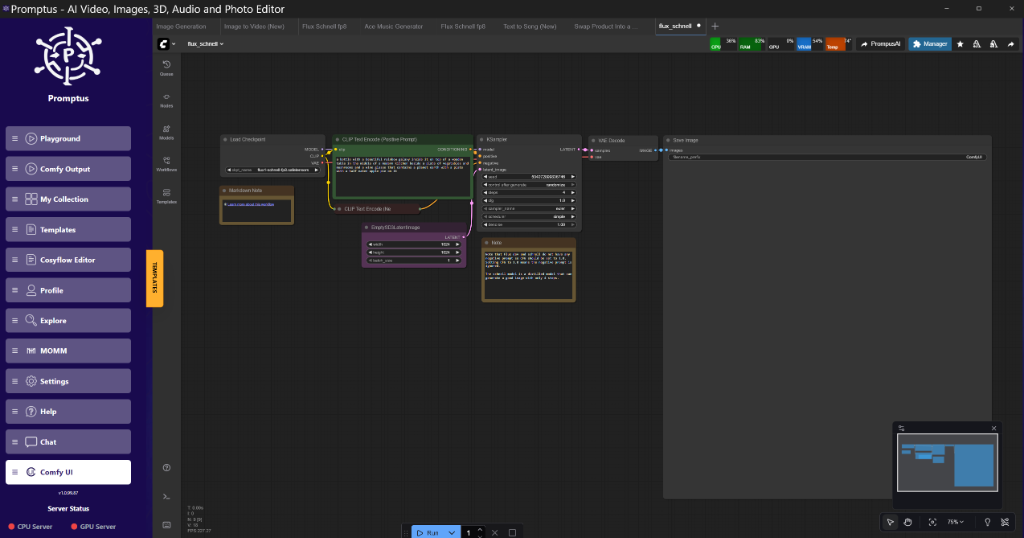
ComfyUI Power User Guide: Optimizing SDXL Workflows for Speed & VRAM
This advanced ComfyUI SDXL guide is a tuning method, not an installation tutorial or a hardware promise. Start from a working workflow, capture a baseline, change one memory-control technique at a time, and compare output, runtime and peak allocation before keeping the change. Use the low-VRAM benchmark methodology when recording measurements.
What is ComfyUI?
ComfyUI is a node-based interface for Stable Diffusion, offering flexibility and control over image generation workflows. Unlike simpler UIs, ComfyUI allows you to build complex pipelines, experiment with custom nodes, and fine-tune every aspect of the process. This power comes with a steeper learning curve but unlocks significant performance and creative possibilities.
ComfyUI, available on ComfyUI GitHub, gives you precise control over every stage of the diffusion process. Forget about opaque "one-click" solutions. With ComfyUI, you see exactly what's happening and can intervene at any point. The node-based graph system, while initially daunting, is the key to optimizing resource usage and achieving specific artistic goals.
The Problem: SDXL and VRAM
SDXL, with its larger model size and increased resolution, demands significantly more VRAM than its predecessors. Even users with relatively powerful GPUs (like my 4090) can encounter OOM errors when generating high-resolution images with complex workflows. Mid-range setups, such as those with 8GB cards, are especially vulnerable.
The default SDXL workflow pushes even high-end hardware. We need to find ways to intelligently reduce memory footprint without sacrificing image quality. Several techniques exist, including:
- Tiling: Breaking the image into smaller chunks.
- Attention Slicing: Processing attention operations in smaller batches.
- VAE Optimization: Reducing VRAM usage during the Variational Autoencoder (VAE) stage.
- Offloading: Moving parts of the model to system RAM (slower, but avoids OOM).
How to Implement Tiling in ComfyUI
Tiling involves splitting the image into smaller sections and processing them individually. This reduces the memory footprint by only loading a portion of the image at a time, enabling high-resolution rendering even on GPUs with limited VRAM. While adding some overhead, it prevents out-of-memory errors, making complex workflows feasible.
Implementing tiling in ComfyUI requires a few extra nodes in your workflow. Here's a breakdown:
- Load Image: Start with your standard
Load Imagenode. This will feed your image to be processed. - Tile Image: Use a custom node (installable via ComfyUI Manager) called
Tile Image. This node splits the input image into smaller tiles of a specified size. You'll need to set thetilewidthandtileheightparameters. Experiment with different tile sizes to find the optimal balance between VRAM usage and render time. 512x512 or 256x256 are good starting points. Tiling Node Setup | TIMESTAMP — Illustrative diagram derived from the visible article text; not a measured result. - Process Tiles: Connect the output of the
Tile Imagenode to your image generation pipeline (e.g., KSampler, VAE Decode). The pipeline will now process each tile individually. - Combine Tiles: After processing, use another custom node called
Combine Tilesto stitch the processed tiles back together into a single, complete image.
Here’s an example of what the JSON for the workflow might look like (simplified):
{
"nodes": [
{
"id": 1,
"type": "Load Image",
"inputs": {
"image": "path/to/your/image.png"
}
},
{
"id": 2,
"type": "Tile Image",
"inputs": {
"image": [1, 0],
"tile_width": 512,
"tile_height": 512
}
},
{
"id": 3,
"type": "KSampler",
"inputs": {
"model": [4, 0],
"seed": 12345,
"steps": 20,
"cfg": 8,
"samplername": "eulera",
"denoise": 1
}
},
{
"id": 4,
"type": "SDXL Checkpoint Loader",
"inputs": {
"ckptname": "sdxlbase1.0.safetensors"
}
},
{
"id": 5,
"type": "Combine Tiles",
"inputs": {
"tiles": [3, 0],
"original_width": 1024,
"original_height": 1024
}
}
Don't copy this verbatim - it's just an example. You'll need to adapt it to your specific workflow and install the necessary custom nodes.
Technical Analysis: Why Tiling Works
Tiling works by dividing a large memory operation (processing the entire image) into smaller, more manageable chunks. The GPU only needs to hold one tile in VRAM at a time, drastically reducing the peak memory footprint. The trade-off is the overhead of splitting and reassembling the image, which adds to the processing time. However, this is usually preferable to an OOM error.
Optimizing VAE for Reduced Memory
VAE (Variational Autoencoder) encoding and decoding consume significant VRAM. Optimizing the VAE process can lead to substantial memory savings, especially when dealing with high-resolution images in ComfyUI. Techniques like VAE tiling and specific VAE checkpoint selection can improve performance on lower-end GPUs.
The VAE (Variational Autoencoder) stage, responsible for encoding the image into a latent space and decoding it back into a pixel representation, can also be a major VRAM hog. Fortunately, there are ways to optimize it:
- VAE Tiling: Similar to image tiling, VAE tiling splits the image into smaller chunks during the VAE encoding and decoding process. This can significantly reduce VRAM usage, especially at high resolutions. Look for custom nodes that offer VAE tiling functionality.
- fp16 Precision: Ensure your VAE is running in fp16 (half-precision) mode. This reduces the memory footprint of the VAE model itself. Many VAE loaders have an option to load the model in fp16.
- Choose VAE Carefully: Some VAEs are more memory-efficient than others. Experiment with different VAE checkpoints to see which one performs best on your hardware. The default SDXL VAE is a good starting point, but you might find alternatives that offer better performance.
Attention Slicing and Sub-Quadratic Attention
Attention slicing and sub-quadratic attention techniques reduce the computational complexity of the attention mechanism within Stable Diffusion. By processing attention in smaller slices or using approximations, these methods decrease VRAM usage and improve performance, particularly for high-resolution images.
Attention mechanisms are crucial for image generation, but they can be computationally expensive, especially at high resolutions. Attention slicing and sub-quadratic attention are two techniques to mitigate this:
- Attention Slicing: This involves processing the attention operation in smaller slices. Instead of calculating the attention weights for the entire image at once, it's done in smaller batches. This reduces the peak VRAM usage, but can increase the overall processing time.
- Sub-Quadratic Attention: These techniques use approximations to reduce the computational complexity of the attention mechanism. Examples include:
- xFormers: A library that provides optimized attention implementations.
- SWA (Sliding Window Attention): Restricts the attention to a sliding window around each pixel, reducing the number of calculations required.
- Sage Attention: A more efficient attention mechanism than the standard attention.
Sage Attention Deep Dive
Sage Attention is a memory-efficient alternative to standard attention mechanisms, designed to reduce the VRAM footprint during image generation. While it can introduce minor texture artifacts, the VRAM savings often outweigh the drawbacks, making it suitable for lower-end GPUs or high-resolution rendering.
Sage Attention offers VRAM savings but may introduce subtle texture artifacts at high CFG scales. The benefits usually outweigh the drawbacks, particularly on lower-end GPUs. To implement Sage Attention, you'll need to find the appropriate custom node. Once installed, you'll typically insert it into your workflow before the KSampler. You'll need to connect the SageAttentionPatch node output to the KSampler model input. Sage Attention Node Integration | TIMESTAMP — Illustrative diagram derived from the visible article text; not a measured result.
ComfyUI vs. Automatic1111: A Quick Comparison
ComfyUI provides greater control and flexibility through its node-based system, allowing for detailed customization and optimization of workflows. Automatic1111 WebUI offers a simpler, more user-friendly interface, making it easier for beginners to get started with Stable Diffusion. The choice depends on your technical proficiency and need for granular control.
While ComfyUI offers unparalleled control, it's not the only game in town. Automatic1111 WebUI (Automatic1111 WebUI) is a popular alternative with a more user-friendly interface. Here's a quick comparison:
- ComfyUI:
- Node-based workflow.
- Highly customizable.
- Steeper learning curve.
- Excellent for optimization and experimentation.
- Automatic1111:
- Web-based interface.
- Easier to use for beginners.
- Less flexible than ComfyUI.
- Good for general-purpose image generation.
If you're new to Stable Diffusion, Automatic1111 might be a better starting point. However, if you're serious about optimizing your workflows and pushing the limits of your hardware, ComfyUI is the way to go.
My Recommended Stack: ComfyUI and Promptus AI
A powerful combination involves using ComfyUI for detailed workflow design and Promptus AI for automation and pipeline management. ComfyUI's flexibility combined with Promptus AI's ability to orchestrate workflows provides a comprehensive solution for efficient AI image generation, especially in production environments.
For serious AI image generation, I recommend a stack centered around ComfyUI. Now, to orchestrate these workflows at scale, that's where the AI pipeline management platform, Promptus AI (www.promptus.ai/"Promptus AI Official), comes into play. Promptus AI allows you to automate ComfyUI workflows, manage resources, and build production-ready AI pipelines.
Here's how I see the two working together:
- ComfyUI: Use ComfyUI to design and optimize your image generation workflows. Experiment with different techniques, such as tiling, attention slicing, and VAE optimization, to find the best settings for your hardware and desired image quality.
- Promptus AI: Once you have a working ComfyUI workflow, integrate it with Promptus AI. Use Promptus AI to automate the workflow, manage resources, and scale your image generation pipeline.
With Promptus AI, you can:
- Automate ComfyUI workflows with triggers and schedulers.
- Manage GPU resources and optimize utilization.
- Build end-to-end AI pipelines for various applications.
- Monitor performance and track costs.
This combination gives you the best of both worlds: the flexibility and control of ComfyUI, and the automation and scalability of Promptus AI.
Scaling and Production Tips
For production-level AI image generation, consider techniques like distributed processing, cloud-based rendering, and automated testing to ensure scalability and reliability. Optimizing resource utilization and implementing robust monitoring can improve efficiency and reduce costs in the long run.
If you're planning to use ComfyUI for production-level image generation, here are a few additional tips:
- Distributed Processing: Distribute your workflow across multiple GPUs or machines to increase throughput. This can be achieved using cloud-based rendering services or by setting up your own distributed computing cluster.
- Automated Testing: Implement automated testing to ensure the quality and consistency of your generated images. This can involve metrics such as image similarity, sharpness, and aesthetic score.
- Resource Monitoring: Monitor your GPU usage, memory consumption, and processing time to identify bottlenecks and optimize resource allocation.
Insightful Q&A
Let's tackle some common questions I get from other engineers.
Q: "I'm still getting OOM errors even with tiling. What gives?"
A: First, double-check that tiling is actually enabled and that the tile size is small enough. Try reducing the tile size further (e.g., to 256x256). Also, make sure you're not running any other memory-intensive applications in the background. Finally, consider enabling other VRAM optimization techniques, such as attention slicing and VAE optimization, in conjunction with tiling.
Q: "Is Sage Attention always better than standard attention?"
A: Not necessarily. Sage Attention can introduce subtle texture artifacts, especially at high CFG scales. Experiment with both and compare the results. If you're not seeing any artifacts with Sage Attention, then it's a good choice for saving VRAM. If you are, then stick with standard attention.
Q: "How do I choose the right VAE for my workflow?"
A: There's no one-size-fits-all answer. The best VAE depends on your specific model, prompt, and desired image style. Experiment with different VAEs and compare the results. Look for VAEs that are known to be memory-efficient and produce high-quality images. The default SDXL VAE is a good starting point.
Q: "What's the best tile size for my GPU?"
A: This depends on your GPU's VRAM capacity and the complexity of your workflow. Start with a tile size of 512x512 and adjust it based on your VRAM usage. If you're still getting OOM errors, reduce the tile size. If you have plenty of VRAM to spare, you can increase the tile size to reduce the processing time.
Q: "How does Promptus AI integrate with ComfyUI in practice?"
A: Promptus AI can orchestrate your ComfyUI workflows through its API. You can define triggers (e.g., a new image request) that automatically launch your ComfyUI workflow. Promptus AI can also manage the GPU resources, ensuring that your workflow has enough VRAM and compute power to run efficiently. The platform also lets you chain multiple ComfyUI workflows together to create complex AI pipelines.
Conclusion
Optimizing ComfyUI for SDXL image generation is an ongoing process of experimentation and refinement. Tiling, VAE optimization, and attention slicing are just a few of the techniques you can use to reduce VRAM usage and improve performance. By combining these techniques with a powerful AI pipeline management platform like Promptus AI, you can build production-ready AI pipelines that deliver high-quality images without breaking the bank.
Technical Deep Dive
Let's go deeper into implementing these techniques in ComfyUI.
Advanced Implementation: Node-by-Node Breakdown
Here's a more detailed breakdown of the ComfyUI workflow with tiling, including node connections and parameters.
- Load Image:
- Node Type:
Load Image - Inputs:
image(path to your image file) - Output:
image
- Tile Image:
- Node Type: (Custom Node - install via ComfyUI Manager)
Tile Image - Inputs:
image: Connect fromLoad Imageoutputtile_width: Integer (e.g., 512)tile_height: Integer (e.g., 512)- Output:
tiles(list of image tiles)
- KSampler:
- Node Type:
KSampler - Inputs:
model: Connect fromSDXL Checkpoint Loaderor other model processing nodesseed: Integer (seed value)steps: Integer (number of steps)cfg: Float (CFG scale)samplername: String (sampler type, e.g., "eulera")denoise: Float (denoise strength)latent_image: Connect from VAE Encode or other latent processing nodes. Connect the tiled image through aLoopnode if needed.- Output:
latent(latent representation of the image)
- SDXL Checkpoint Loader:
- Node Type:
SDXL Checkpoint Loader - Inputs:
ckpt_name(path to your SDXL checkpoint file) - Output:
model,clip
- VAE Decode:
- Node Type:
VAE Decode - Inputs:
samples: Connect from KSampler outputvae: Connect fromSDXL Checkpoint Loaderor VAE Loader node- Output:
image(decoded image)
- Combine Tiles:
- Node Type: (Custom Node - install via ComfyUI Manager)
Combine Tiles - Inputs:
tiles: Connect fromVAE Decodeoutput (after processing through aLoopnode)original_width: Integer (original image width)original_height: Integer (original image height)- Output:
image(combined image)
- Save Image:
- Node Type:
Save Image - Inputs:
image: Connect fromCombine Tilesoutput - Output: None
This detailed node breakdown clarifies the connections and parameters needed for a tiling workflow.
Generative AI Automation with Promptus AI
Promptus AI can automate this ComfyUI workflow through its API. Here's a conceptual example:
Code language: PYTHON
Pseudo-code - adapt to Promptus AI's actual API
import promptus_ai
Define the ComfyUI workflow ID
workflowid = "yourcomfyuiworkflowid"
Define the input parameters
input_params = {
"image_path": "/path/to/your/image.png",
"tile_width": 512,
"tile_height": 512,
"seed": 12345,
"steps": 20,
"cfg": 8
}
Trigger the workflow
result = promptusai.runworkflow(workflowid, inputparams)
Get the output image path
outputimagepath = result["outputimagepath"]
print(f"Generated image: {outputimagepath}")
This is a simplified example, but it illustrates how Promptus AI can be used to automate ComfyUI workflows.
Performance Optimization Guide
Here's a table summarizing VRAM optimization strategies and their impact:
| Technique | Description | VRAM Savings | Render Time Impact | Notes |
| ------------------ | ----------------------------------------- | ------------ | ------------------ | --------------------------------------- |
| Tiling | Split image into smaller tiles | High | Moderate | Adjust tile size for optimal balance |
| VAE Optimization | Use memory-efficient VAE settings | Moderate | Low | Experiment with different VAEs |
| Attention Slicing | Process attention in smaller slices | Moderate | Moderate | Can introduce artifacts at high CFG |
| Sage Attention | Memory-efficient attention mechanism | High | Low | Can introduce subtle texture artifacts |
| fp16 Precision | Use half-precision floating point numbers | Moderate | Low | Requires compatible hardware |
Here are some batch size recommendations by GPU tier:
- 8GB GPU: Batch size of 1 (tiling is essential)
- 16GB GPU: Batch size of 2-4 (tiling may still be beneficial)
- 24GB+ GPU: Batch size of 4-8 (tiling may not be necessary)
Code language: HTML
More Readings
Continue Your Journey (Internal)
- Understanding ComfyUI Workflows for Beginners
- Advanced Image Generation Techniques
- 42 MOMM Diffusion: AI Image Workspace
- VRAM Optimization Strategies for RTX Cards
- Building Production-Ready AI Pipelines
Official Resources & Documentation (External)
- ComfyUI GitHub Repository
- www.promptus.ai/"Promptus AI Official Docs
- ComfyUI Manager (Node Browser)
- Civitai Model Repository
- Hugging Face Diffusers
- www.promptus.ai/gallery"Promptus Workflow Gallery
Technical FAQ
Q: I'm getting a CUDA out-of-memory error. What do I do?
A: This usually means your GPU doesn't have enough VRAM to handle the current workflow. Try reducing the image resolution, decreasing the batch size, enabling tiling, or using VRAM optimization techniques like attention slicing and VAE optimization. Ensure no other GPU-intensive applications are running.
Q: My model loading is failing with a "file not found" error. How do I fix it?
A: Double-check that the model file exists at the specified path. If the path is correct, make sure that ComfyUI has the necessary permissions to access the file. If you're using a custom model, ensure that it's compatible with your version of ComfyUI. Consider using the ComfyUI Manager to manage and update your models.
Q: Why is my generated image completely black?
A: This can happen if the VAE is not properly configured or if there's an issue with the latent space. Check your VAE settings and make sure that the VAE is compatible with your model. Try using a different seed value. Also, make sure that the denoise parameter in the KSampler is set to a value greater than 0.
Q: How much VRAM do I need to run SDXL at 1024x1024 resolution?
Q: What command-line arguments can I use to optimize ComfyUI's memory usage?
A: You can try using the --lowvram or --medvram command-line arguments when launching ComfyUI. These arguments reduce the memory footprint of ComfyUI, but may also decrease performance. You can also try using the --fp16 argument to enable half-precision floating point numbers, which can reduce memory usage.
Created: 18 January 2026