ComfyUI: Mastering AI Image Generation
This ComfyUI image-generation reference follows the feature path from installation and model loading through text-to-image, image-to-image, ControlNet, upscaling and plugins. It is the broad feature tour; for measurement-led SDXL speed and memory tuning, use the performance tuning guide.
Installation [1:48]
ComfyUI installation is straightforward, but requires some dependencies. Ensure you have Python and Git installed.
First, download ComfyUI from its official repository. Extract the archive to your desired location. Next, navigate to the extracted directory in your terminal and run the install.py script. This will download the necessary dependencies.
Golden Rule: Always keep your ComfyUI installation up to date. New features and optimizations are frequently added.
Downloading Models [4:00]
Models are the foundation of AI image generation. Download checkpoints, VAEs, and ControlNet models from trusted sources like Civitai and Hugging Face.
ComfyUI doesn't come with pre-installed models. You'll need to download them separately and place them in the appropriate directories within the ComfyUI folder (models/checkpoints, models/vae, models/controlnet). Civitai is a popular resource for finding a wide variety of models. Hugging Face also hosts numerous models, including the ControlNet Union model which we will use later.

Text to Image [7:25]
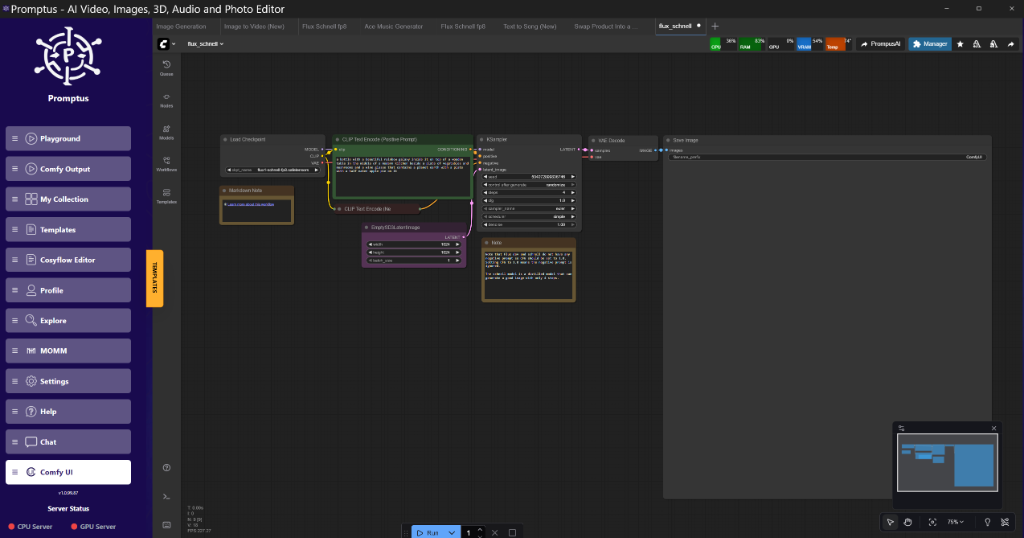
Text-to-image is the core functionality of Stable Diffusion. ComfyUI provides a node-based interface for building custom workflows.
ComfyUI's node-based system allows for granular control over the image generation process. You start with a Load Checkpoint node to load your desired Stable Diffusion model. Then, connect CLIP Text Encode nodes to input your positive and negative prompts. These are then fed into a KSampler node, which performs the iterative denoising process to generate the image. Connect the output of the KSampler to a VAE Decode node to convert the latent representation into a viewable image. Finally, connect the VAE Decode node to a Save Image node to save the generated image.
The KSampler node is where the magic happens. Key parameters include:
seed: Determines the random noise used to initiate the generation process.
steps: The number of denoising steps. Higher values generally lead to better quality but take longer.
cfg scale: Controls how closely the generated image adheres to the prompt.
sampler_name: Specifies the sampling algorithm (e.g., Euler a, DPM++ 2M Karras).
scheduler: Controls the noise schedule.
Technical Analysis
The KSampler node's iterative denoising process leverages the Stable Diffusion model's learned ability to remove noise and generate coherent images based on the provided text prompts. Adjusting parameters like steps and cfg scale allows for fine-tuning the balance between image quality and prompt adherence.
Navigation, Editing, and Shortcuts [21:30]
ComfyUI offers several keyboard shortcuts and navigation features for efficient workflow creation.
Zooming: Use the mouse wheel to zoom in and out.
Panning: Hold the spacebar and drag to pan the canvas.
Adding Nodes: Double-click on the canvas to open the node search menu.
Connecting Nodes: Drag from the output of one node to the input of another.
Deleting Nodes: Select a node and press the Delete key.
Duplicating Nodes: Select a node and press Ctrl+C then Ctrl+V.
Installing ComfyUI Manager [26:15]
The ComfyUI Manager is a crucial plugin for managing custom nodes and models. It simplifies the process of installing and updating extensions.
The ComfyUI Manager is a custom node that simplifies the installation and management of other custom nodes. To install it, first install Git. Then, clone the ComfyUI Manager repository into the custom_nodes directory within your ComfyUI installation. Restart ComfyUI, and the Manager will appear as a node in your workflow. You can then use it to browse, install, and update other custom nodes.
Upscaling [28:43]
Upscaling increases the resolution of an image. ComfyUI supports various upscaling methods, including latent upscaling and traditional image upscaling.
ComfyUI offers several options for upscaling images. Latent upscaling involves increasing the resolution in the latent space before decoding, which can often produce better results than traditional image upscaling. The Latent Upscale node allows you to increase the resolution of the latent representation before passing it to the VAE Decode node. Alternatively, you can use image upscaling nodes like Image Upscale with Model to upscale the final image using a dedicated upscaling model.
Image to Image [37:49]
Image-to-image generation uses an existing image as a starting point. This allows you to modify and transform images while preserving their overall structure.
Image-to-image generation involves using an existing image as a starting point for the diffusion process. Load an image using the Load Image node and connect it to an Encode Image into Latent node. The latent representation of the image is then fed into the KSampler node along with text prompts. This allows you to guide the image generation process based on both the input image and the text prompts.
Tile Upscaling [43:07]
Tile upscaling is a technique for upscaling large images by processing them in smaller tiles. This reduces VRAM usage and allows you to upscale images beyond the limits of your GPU memory.
ControlNet [51:53]
ControlNet allows you to control the image generation process based on various input maps, such as depth maps, edge maps, and segmentation maps.
ControlNet is a powerful technique for controlling the image generation process using various input maps. First, load your ControlNet model using the Load ControlNet Model node. Then, load your control image (e.g., a depth map) using the Load Image node. Connect the output of the Load Image node to a ControlNet preprocessor node (e.g., CannyEdge). The output of the preprocessor and the ControlNet model are then connected to a ControlNet Apply node, which is connected to the KSampler node. This allows you to guide the image generation process based on the control image. The ControlNet Union model from Hugging Face offers a unified solution for various ControlNet tasks.
Faceswap & Installing Other Plugins [1:03:54]
Faceswap allows you to replace faces in an image with other faces. ComfyUI supports faceswap through custom nodes like ComfyUI-InstantID.
Faceswap can be achieved using custom nodes like ComfyUI_InstantID. After installing the custom node, load the necessary models and images. Use the appropriate nodes to detect faces in the source and target images. Then, use the faceswap node to replace the face in the target image with the face from the source image.
Flux, Auraflow, and Newer Models [1:16:08]
ComfyUI is constantly evolving with new models and workflows. Explore community resources and experiment with different techniques to discover new possibilities.
The ComfyUI ecosystem is constantly evolving. New models, workflows, and custom nodes are continuously being developed. Stay up-to-date with the latest developments by exploring community resources and experimenting with different techniques.
Resources & Tech Stack
This guide leverages several key resources:
ComfyUI: The core node-based interface for building AI image generation workflows (https://github.com/comfyanonymous/ComfyUI).
Civitai: A repository for Stable Diffusion models, including checkpoints, VAEs, and LoRAs (https://civitai.com).
Hugging Face: A platform for hosting and sharing AI models, including the ControlNet Union model (https://huggingface.co/xinsir/controlnet-union-sdxl-1.0).
ComfyUI-InstantID: A custom node for faceswap functionality (ComfyUI_InstantID).
Git: Essential for installing the ComfyUI Manager and other custom nodes (https://git-scm.com/downloads).
My Recommended Stack
For efficient ComfyUI workflow development, I've found a combination of tools to be particularly effective. ComfyUI, of course, is the foundation. However, tools like Promptus streamline prototyping these tiled workflows. The visual workflow builder makes testing these configurations more intuitive, and its optimization features can help identify bottlenecks and improve performance.
Technical Analysis
The node-based architecture of ComfyUI provides unparalleled flexibility in designing and customizing image generation workflows. Understanding the function of each node and how they interact is crucial for achieving desired results. Techniques like tile upscaling and ControlNet allow for generating high-resolution images and controlling the image generation process with greater precision.
Scaling and Production Advice
When scaling ComfyUI for production, consider the following:
Hardware: Invest in GPUs with ample VRAM to handle large models and high resolutions.
Optimization: Optimize your workflows to minimize VRAM usage and rendering time. Techniques like tiled VAE decode (using 512px tiles with 64px overlap) can reduce VRAM consumption by 50%.
Automation: Automate your workflows using scripts and APIs to streamline the image generation process.
Monitoring: Monitor your system's performance to identify bottlenecks and ensure stability.
Insightful Q&A
Here's what I've noticed from questions popping up:
"ComfyUI crashes when I try to generate a large image. What can I do?" Try using tile upscaling to reduce VRAM usage. Also, ensure you have sufficient system RAM.
"How do I install custom nodes?" Use the ComfyUI Manager. It simplifies the process significantly.
"My generated images are blurry. How can I improve the quality?" Increase the number of steps in the KSampler node. Also, experiment with different samplers and schedulers.
"I'm getting CUDA out-of-memory errors. What are my options?" Reduce the batch size, use smaller models, or implement VRAM optimization techniques like block swapping or SageAttention.
"How can I use ControlNet with SDXL?" Download the ControlNet Union model and use the appropriate ControlNet preprocessor nodes.
Advanced Implementation
Here's an example of a basic text-to-image workflow JSON:
{
"nodes": [
{
"id": 1,
"type": "Load Checkpoint",
"inputs": {},
"outputs": {
"MODEL": [2, 0],
"CLIP": [3, 0],
"VAE": [4, 0]
},
"properties": {
"ckptname": "sdxlbase1.0.safetensors"
}
},
{
"id": 2,
"type": "CLIP Text Encode",
"inputs": {
"CLIP": [1, 1],
"text": "A beautiful landscape"
},
"outputs": {
"CONDITIONING": [5, 0]
}
},
{
"id": 3,
"type": "CLIP Text Encode",
"inputs": {
"CLIP": [1, 1],
"text": "blurry, ugly"
},
"outputs": {
"CONDITIONING": [5, 1]
}
},
{
"id": 4,
"type": "VAE Decode",
"inputs": {
"samples": [5, 0],
"vae": [1, 2]
},
"outputs": {
"IMAGE": [6, 0]
}
},
{
"id": 5,
"type": "KSampler",
"inputs": {
"model": [1, 0],
"positive": [2, 0],
"negative": [3, 0],
"latent_image": [7, 0]
},
"outputs": {
"LATENT": [4, 0]
},
"properties": {
"seed": 0,
"steps": 20,
"cfg": 8.0,
"samplername": "eulera",
"scheduler": "normal"
}
},
{
"id": 6,
"type": "Save Image",
"inputs": {
"images": [4, 0]
},
"outputs": {},
"properties": {
"filename_prefix": "output"
}
},
{
  "id": 7,
  "type": "Empty Latent Image",
  "inputs": {},
  "outputs": {
    "LATENT": [
      5,
      3
    ]
  },
  "properties": {
    "width": 1024,
    "height": 1024,
    "batch_size": 1
  }
}
Performance Optimization Guide
Here are some tips for optimizing ComfyUI performance:
VRAM Optimization: Use techniques like tile upscaling, SageAttention, and block swapping to reduce VRAM usage.
Batch Size: Adjust the batch size based on your GPU's VRAM capacity. Lowering the batch size can prevent out-of-memory errors.
Tiling and Chunking: For high-resolution outputs, use tiling and chunking to process the image in smaller parts.
Model Selection: Choose models that are optimized for your specific hardware.
Conclusion
ComfyUI provides a powerful and flexible platform for AI image generation. By understanding the fundamentals of ComfyUI and utilizing advanced techniques like tile upscaling, ControlNet, and VRAM optimization, you can generate high-quality images and push the boundaries of AI art.
More Readings
Continue Your Journey (Internal 42.uk Research Resources)
Understanding ComfyUI Workflows for Beginners
Advanced Image Generation Techniques
VRAM Optimization Strategies for RTX Cards
Building Production-Ready AI Pipelines
Prompt Engineering Tips and Tricks
Exploring Different Stable Diffusion Samplers
Technical FAQ
Q: I keep getting "CUDA out of memory" errors. What can I do?
A: This typically happens when your GPU runs out of VRAM. Try reducing the image resolution, lowering the batch size, using smaller models, or enabling VRAM optimization techniques like tiled VAE decode or SageAttention. Consider offloading model layers to CPU using block swapping.
Q: What are the minimum hardware requirements for running ComfyUI?
Q: How do I update ComfyUI to the latest version?
A: Navigate to your ComfyUI directory in the terminal and run git pull. Then, restart ComfyUI. It's also a good idea to update your custom nodes using the ComfyUI Manager.
Q: My generated images have strange artifacts. What could be causing this?
A: Artifacts can be caused by various factors, including incorrect model settings, excessive CFG scale, or issues with custom nodes. Try experimenting with different samplers, schedulers, and CFG scales. Ensure your custom nodes are up-to-date and compatible with your ComfyUI version.
Q: How can I troubleshoot model loading failures?
A: Verify that the model file exists in the correct directory (models/checkpoints). Ensure that the model file is not corrupted. Check the ComfyUI console for error messages. If the model requires specific dependencies, install them using pip. Sometimes restarting ComfyUI also helps.
Created: 23 January 2026