ComfyUI Tiled Diffusion for High-Res Images
This ComfyUI tiled-diffusion guide is an implementation checklist for high-resolution SDXL workflows. It explains tile flow, VAE tiling, overlap controls, node order and seam diagnosis without presenting one setting as universal. For a broader low-memory decision path, use the SDXL low-VRAM troubleshooting guide.
What is Tiled Diffusion?
Tiled Diffusion is a technique for generating high-resolution images by dividing the image into smaller tiles, processing each tile individually, and then stitching them back together. This reduces the VRAM required at any given time, allowing you to generate larger images on your existing hardware.
Tiled Diffusion addresses the VRAM limitation by processing the image in chunks. Instead of loading the entire image into memory at once, it divides the image into tiles, processes each tile individually, and then stitches them back together. This significantly reduces the memory footprint, allowing you to generate images far exceeding your GPU's native capacity.
Implementing Tiled Diffusion in ComfyUI
The basic idea is to use a combination of Tile and Combine nodes to process your image in sections. Here's how:
- Load your base image: Use a
Load Imagenode to bring your starting image into the workflow. - Tile the image: Employ a
Tile Imagenode to split the image into smaller, manageable tiles. Configure thetilewidthandtileheightparameters based on your GPU's VRAM capacity. Smaller tiles mean less VRAM usage, but potentially longer processing times. 512x512 is a good starting point for many cards. - Process each tile: Connect the output of the
Tile Imagenode to your image processing workflow (e.g., KSampler, ControlNet, etc.). This is where the magic happens! Each tile will be processed independently. - Combine the tiles: After processing, use a
Combine Imagenode to stitch the tiles back together into a single, high-resolution image. - VAE Decode: Finally, use a
VAE Decodenode to convert the latent space back into a viewable image.
Technical Analysis
The core concept revolves around reducing the memory footprint during the diffusion process. By processing the image in smaller chunks, the VRAM usage is significantly reduced, allowing even lower-end GPUs to generate high-resolution images. Tools like Promptus can simplify prototyping these tiled workflows.
Node Graph Logic
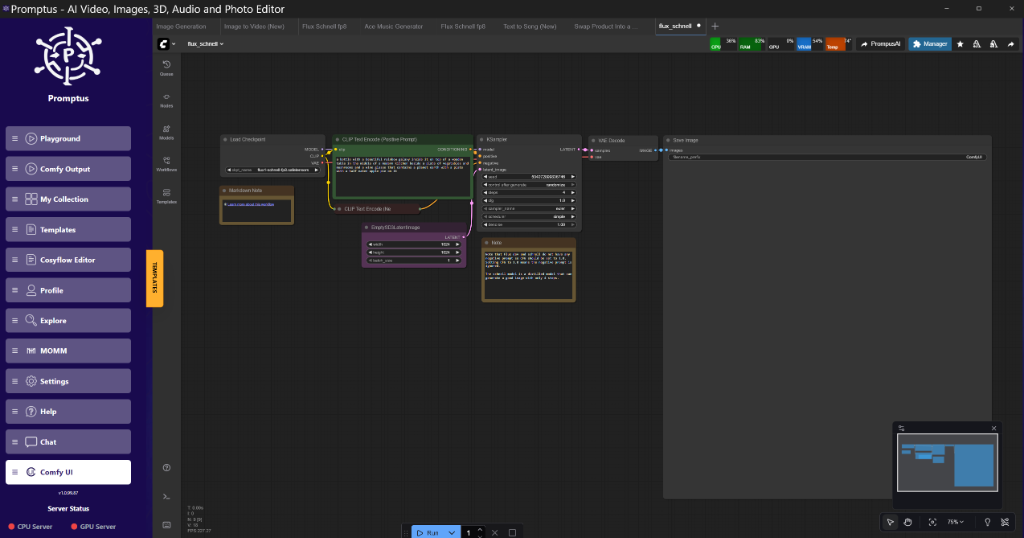
The node graph should look something like this:
Load Image -> Tile Image -> KSampler -> Combine Image -> VAE Decode -> Save Image
Connect the image output of Load Image to the image input of Tile Image. Connect the tile output of Tile Image to the image input of KSampler. Connect the image output of KSampler to the tile input of Combine Image. Connect the image output of Combine Image to the samples input of VAE Decode. Finally, connect the image output of VAE Decode to the image input of Save Image.
Deep Dive: Tiling Parameters
The Tile Image node has a few key parameters you'll need to understand:
tile_width: The width of each tile in pixels.
tile_height: The height of each tile in pixels.
overlap_x: The horizontal overlap between tiles in pixels.
overlap_y: The vertical overlap between tiles in pixels.
Technical Analysis
Overlapping tiles is a simple yet effective way to mitigate edge artifacts. The overlapping regions are blended together, creating a smoother transition between tiles and reducing the visibility of seams.
VRAM Optimization Techniques
Beyond Tiled Diffusion, several other techniques can further reduce VRAM usage in ComfyUI:
Tiled VAE Decode: As mentioned, this can provide significant VRAM savings, especially in complex workflows. Aim for 512px tiles with a 64px overlap.
SageAttention: This memory-efficient attention mechanism can be a drop-in replacement for standard attention in your KSampler workflows. Note that it might introduce subtle texture artifacts at high CFG scales.
Block Swapping: Offload model layers to the CPU during sampling. This allows you to run larger models on cards with limited VRAM. Experiment with swapping the first 3 transformer blocks to the CPU, keeping the rest on the GPU.
LTX-2/Wan 2.2 Low-VRAM Tricks: If you're working with video models, explore techniques like chunk feedforward (processing video in 4-frame chunks) and Hunyuan low-VRAM deployment patterns.
JSON Example: Tiled VAE
{
"class_type": "VAEDecodeTiled",
"inputs": {
"samples": ["KSampler", "samples"],
"vae": ["Load VAE", "vae"],
"tile_size": 512,
"overlap": 64
}
}
My Recommended Stack
For my workflow, I find a combination of ComfyUI and Promptus works best. ComfyUI provides the flexible node-based system, while Promptus streamlines prototyping and workflow iteration.
Here's my go-to setup:
ComfyUI: For the core image generation and workflow management. It's brilliant.
Promptus: For rapid prototyping of complex workflows like Tiled Diffusion. The visual workflow builder makes testing these configurations visual.
4090 (24GB): My primary GPU.
Tiled VAE Decode: Always enabled for VRAM savings.
SageAttention: Enabled by default, but I keep an eye out for artifacts at high CFG scales.
Scaling and Production Advice
Automated Tiling: For large-scale processing, automate the tiling and combining steps using Python scripts.
Error Handling: Implement robust error handling to gracefully handle out-of-memory errors and other issues.
Monitoring: Monitor VRAM usage and render times to identify bottlenecks and optimize your workflow.
Cloud Deployment: Consider deploying your workflow to a cloud platform with more powerful GPUs for faster processing.
Insightful Q&A
Here are a few questions that builders often ask when implementing tiled diffusion.
Q: What's the optimal tile size?
A: It depends on your GPU's VRAM. Start with 512x512 and adjust as needed. Lower tile sizes reduce VRAM usage but increase processing time.
Q: How much overlap should I use?
A: 64 pixels is a good starting point. Experiment with different values to find the optimal balance between seam visibility and processing time.
Q: Can I use Tiled Diffusion with ControlNet?
A: Yes, connect the output of the Tile Image node to your ControlNet workflow.
Q: Are there any downsides to Tiled Diffusion?
A: Yes, it can increase processing time and potentially introduce artifacts at tile boundaries if the overlap is not sufficient.
Q: Can I use this technique with video generation?
A: Yes, but you'll need to adapt the workflow to handle video frames. Explore techniques like chunk feedforward and tiled temporal attention.
Conclusion
Tiled Diffusion is a powerful technique for overcoming VRAM limitations in ComfyUI. By processing images in smaller chunks, you can generate high-resolution images even on lower-end GPUs. Experiment with different tile sizes and overlap values to find the optimal balance between VRAM usage, processing time, and image quality. Cheers!
Advanced Implementation
Here's a more detailed breakdown of the ComfyUI workflow and node connections:
Node-by-Node Breakdown
- Load Image: Loads the initial image to be processed.
image: Input image.
image: Output image.
- Tile Image: Splits the input image into tiles.
image: Input image.
tile_width: Width of each tile.
tile_height: Height of each tile.
overlap_x: Horizontal overlap between tiles.
overlap_y: Vertical overlap between tiles.
tile: Output tile.
- KSampler: Performs the diffusion process on each tile.
model: The Stable Diffusion model.
seed: Random seed for noise generation.
steps: Number of diffusion steps.
cfg: CFG scale.
sampler_name: Sampler type (e.g., Euler, LMS).
scheduler: Scheduler type (e.g., normal, karras).
positive: Positive prompt conditioning.
negative: Negative prompt conditioning.
latent: Input latent.
samples: Output latent samples.
- Combine Image: Combines the processed tiles back into a single image.
tile: Input tiles.
image: Output image.
- VAE Decode: Decodes the latent samples into a viewable image.
samples: Input latent samples.
vae: VAE model.
pixels: Output image pixels.
- Save Image: Saves the final image to disk.
pixels: Input image pixels.
filename_prefix: Filename prefix.
Workflow JSON Structure (Snippet)
{
"nodes": [
{
"id": 1,
"type": "LoadImage",
"inputs": {
"image": "path/to/your/image.png"
}
},
{
"id": 2,
"type": "TileImage",
"inputs": {
"image": [1, 0],
"tile_width": 512,
"tile_height": 512,
"overlap_x": 64,
"overlap_y": 64
}
},
{
"id": 3,
"type": "KSampler",
"inputs": {
"model": [4, 0],
"seed": 12345,
"steps": 20,
"cfg": 8,
"sampler_name": "euler",
"scheduler": "normal",
"positive": [5, 0],
"negative": [6, 0],
"latent": [7,0]
}
},
{
"id": 4,
"type": "CombineImage",
"inputs": {
"tile": [3, 0]
}
},
{
"id": 5,
"type": "VAEDecode",
"inputs": {
"samples": [4, 0],
"vae": [8, 0]
}
},
{
"id": 6,
"type": "SaveImage",
"inputs": {
"pixels": [5, 0],
"filename_prefix": "output"
}
}
Performance Optimization Guide
Optimizing performance is key to speeding up tiled diffusion.
VRAM Optimization Strategies
Lower Tile Size: Reduce tilewidth and tileheight to minimize VRAM usage.
Enable Tiled VAE Decode: This node significantly reduces VRAM requirements.
Use SageAttention: This attention mechanism is more memory-efficient than standard attention.
Offload Layers to CPU: Swap some model layers to the CPU to free up VRAM.
Batch Size Recommendations
8GB Card: Batch size of 1.
12GB Card: Batch size of 2-4.
24GB Card: Batch size of 4-8.
Note: These are just starting points. Experiment to find the optimal batch size for your specific hardware and workflow.
Tiling and Chunking
High-Res Outputs: For extremely high-resolution outputs (e.g., 8K or 16K), consider using smaller tile sizes and more overlap.
Video Generation: For video, explore chunking techniques to process frames in smaller batches.
Code language: HTML
Technical FAQ
Common errors (OOM, CUDA errors, model loading failures)
OOM Error: "CUDA out of memory." Solution: Reduce tile size, enable Tiled VAE Decode, use SageAttention, offload layers to CPU.
CUDA Error: Generic CUDA error. Solution: Update your NVIDIA drivers, check your CUDA installation, restart your computer.
Model Loading Failure: "Failed to load model." Solution: Verify that the model file exists and is not corrupted, check your model path in ComfyUI.
Hardware requirements by GPU tier
Low-End (8GB): Tiled Diffusion is essential. Use small tile sizes (e.g., 256x256), enable Tiled VAE Decode, and consider using SageAttention.
Mid-Range (12-16GB): Tiled Diffusion is still helpful for high-resolution outputs. Experiment with larger tile sizes (e.g., 512x512) and adjust as needed.
High-End (24GB+): Tiled Diffusion may not be necessary for moderate resolutions, but it can still improve performance and reduce VRAM usage for extremely large images.
Troubleshooting steps with specific commands
Check VRAM Usage: Use nvidia-smi in the command line to monitor VRAM usage.
Update NVIDIA Drivers: sudo apt update && sudo apt upgrade nvidia-driver- (Linux). Download from NVIDIA website (Windows).
Clear ComfyUI Cache: Delete the contents of the ComfyUI/temp directory.
Continue Your Journey (Internal 42.uk Resources)
Understanding ComfyUI Workflows for Beginners
Advanced Image Generation Techniques
VRAM Optimization Strategies for RTX Cards
Building Production-Ready AI Pipelines
Mastering Prompt Engineering Techniques
Created: 21 January 2026
More Readings
Essential Tools & Resources
- Promptus AI - ComfyUI workflow builder with VRAM optimization and workflow analysis
- ComfyUI Official Repository - Latest releases and comprehensive documentation
Related Guides on 42.uk