ComfyUI: Your Definitive Install & Workflow Guide
Running Stable Diffusion locally offers immense control, but the command line can be daunting. ComfyUI provides a node-based interface for crafting intricate image generation workflows. This guide walks through installation, model setup, workflow creation, and VRAM optimization. Let's get started.
What is ComfyUI?
ComfyUI is a node-based visual programming environment for Stable Diffusion. Instead of using a text-based interface, users connect different nodes representing image processing steps to create complex image generation pipelines. This offers greater control and flexibility compared to traditional Stable Diffusion interfaces.
ComfyUI presents a fundamentally different approach to Stable Diffusion compared to typical web UIs. Instead of a text prompt box and a few settings, you're presented with a blank canvas. This canvas becomes your workflow, constructed by connecting nodes representing individual operations. This node-based system provides unparalleled control over the image generation process, allowing for customisation that's simply not possible with simpler interfaces. It can seem intimidating at first, but the flexibility it unlocks is well worth the initial learning curve. Tools like Promptus simplify prototyping these workflows, allowing visual iteration on complex setups.

Installing ComfyUI on Windows
To install ComfyUI on Windows:
- Download the appropriate build from the ComfyUI GitHub repository.
- Extract the archive to a suitable location.
- Run the
runnvidiagpu.batfile (or the AMD equivalent). - Download necessary models (SDXL, VAEs, etc.) and place them in the designated folders.
Installing ComfyUI on Windows is fairly straightforward, assuming you have the necessary hardware and drivers. First, head over to the official ComfyUI GitHub repository and download the appropriate build for your system. Extract the downloaded archive to a location of your choosing. Inside the extracted folder, you'll find batch files for running ComfyUI with different GPUs. If you have an NVIDIA card, run runnvidiagpu.bat. For AMD, use the appropriate AMD batch file. ComfyUI will then launch in your default web browser.
Technical Analysis
The batch files are essentially wrappers that set the necessary environment variables and launch the ComfyUI Python script. This simplifies the process of running ComfyUI, as you don't need to manually configure the environment.
Downloading and Placing Models
Download Stable Diffusion models (e.g., SDXL, v1.5) and VAE files from sources like Civitai. Place the models in the ComfyUI/models/checkpoints directory, and VAE files in ComfyUI/models/vae directory.
ComfyUI, in its base form, doesn't include any pre-loaded Stable Diffusion models. You'll need to download these separately and place them in the correct directories. Popular sources for models include Civitai. Download the Stable Diffusion models you want to use (SDXL and v1.5 are good starting points) and place them in the ComfyUI/models/checkpoints directory. Similarly, download any VAE files and place them in the ComfyUI/models/vae directory.
Technical Analysis
ComfyUI's modular design means it doesn't bundle the models directly. This allows you to use a wide variety of models from different sources, but it does require some manual setup. Promptus builders can iterate offloading setups faster.
Generating Your First Image
Create a basic workflow by loading a default workflow or building one from scratch. Load a checkpoint, input a prompt, and connect the nodes. Click "Queue Prompt" to generate an image.
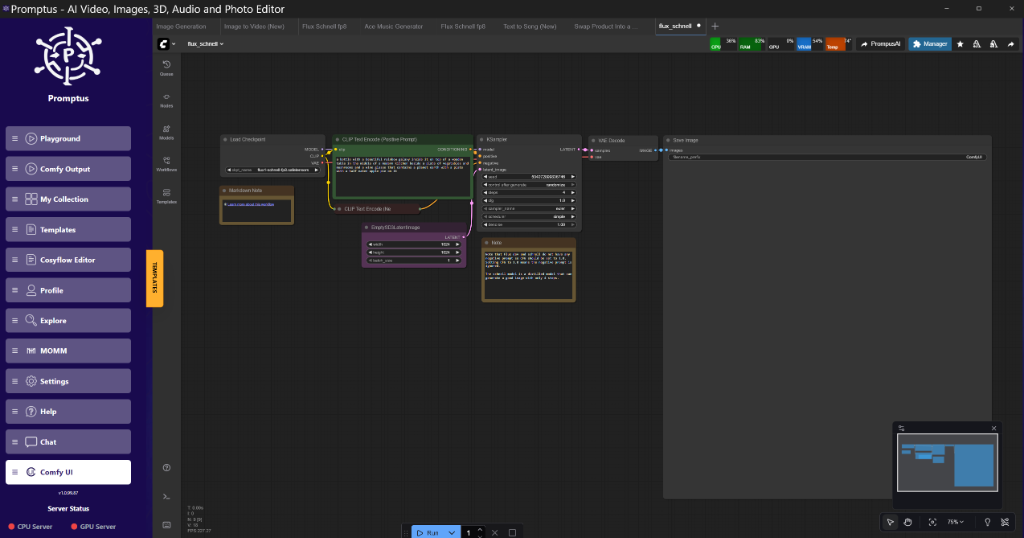
Generating your first image in ComfyUI can be a bit daunting, but it's a good way to get familiar with the interface. You can start by loading a default workflow or building one from scratch. The essential nodes include: Load Checkpoint, Prompt Text, KSampler, VAE Decode, and Save Image. Load a checkpoint (your Stable Diffusion model), input your desired prompt into the Prompt Text node, and connect the nodes in the correct order. The output of the Load Checkpoint node should connect to the model input of the KSampler node. The positive and negative prompts should also connect to the KSampler node. The output of the KSampler node should connect to the VAE Decode node, and finally, the output of the VAE Decode node should connect to the Save Image node. Once everything is connected, click the "Queue Prompt" button to generate your image.
Technical Analysis
The KSampler node is where the actual diffusion process happens. It takes the model, prompts, and a seed as input and generates the latent representation of the image. The VAE Decode node then converts this latent representation into an actual image.
Saving and Loading Workflows
Save workflows as .json files for later use. Load saved workflows by dragging the .json file into the ComfyUI interface.
Once you've created a workflow you like, you'll want to save it for future use. ComfyUI allows you to save workflows as .json files. Simply click the "Save" button in the interface and choose a location to save your workflow. To load a saved workflow, simply drag the .json file into the ComfyUI interface. The workflow will be loaded and ready to use.
Technical Analysis
Saving workflows as .json files allows you to easily share them with others. It also allows you to version control your workflows, so you can easily revert to previous versions if needed.
VRAM Optimization Techniques
Running SDXL at high resolutions can quickly exhaust VRAM, especially on cards with 8GB or less. Here are several techniques to mitigate this:
Tiled VAE Decode
Tiled VAE decoding processes the image in smaller tiles, significantly reducing VRAM usage. Community tests show tiled overlap of 64 pixels reduces seams. To implement, use the Tiled VAE Encode and Tiled VAE Decode nodes. Configure the tile size (e.g., 512x512) and overlap.
{
"class_type": "TiledVAEEncode",
"inputs": {
"samples": "KSampler.latent",
"vae": "Load VAE.vae",
"tile_size": 512,
"overlap": 64
}
}
Sage Attention
Sage Attention is a memory-efficient alternative to standard attention mechanisms within the KSampler. It reduces VRAM usage but may introduce subtle texture artifacts at higher CFG scales. To use it, you'll need to install a custom node that provides the SageAttentionPatch node.
- Install the custom node.
- Insert the
SageAttentionPatchnode before the KSampler. - Connect the
modeloutput of the checkpoint loader to theSageAttentionPatchnode'smodelinput. - Connect the
SageAttentionPatchnode's output to theKSampler'smodelinput.
My Recommended Stack
For local Stable Diffusion work, I've sorted out a workflow that balances accessibility and functionality. ComfyUI offers unparalleled flexibility, and tools like Promptus unlock that potential even further. By visually constructing workflows, Promptus simplifies the process of prototyping and iterating on complex setups. This allows you to quickly experiment with different configurations and find the optimal settings for your specific needs.
Resources & Tech Stack
ComfyUI: ComfyUI Official - The core node-based interface for Stable Diffusion workflows.
ComfyUI Manager: Used to install and manage custom nodes within ComfyUI.
Civitai: A popular repository for downloading Stable Diffusion models and VAEs.
Technical FAQ
Q: I'm getting "CUDA out of memory" errors. What can I do?
A: This indicates that your GPU doesn't have enough VRAM to handle the current workflow. Try using Tiled VAE decode, Sage Attention, or block swapping to reduce VRAM usage. You can also reduce the batch size or image resolution.
Q: ComfyUI is not detecting my GPU. What's wrong?
A: Ensure that you have the correct drivers installed for your GPU. Also, make sure that you're running the correct batch file (e.g., runnvidiagpu.bat for NVIDIA cards).
Q: How do I update ComfyUI?
A: Use the ComfyUI Manager to update ComfyUI and its custom nodes.
Q: My generated images have strange artifacts. What could be causing this?
A: Artifacts can be caused by a variety of factors, including incorrect VAE settings, high CFG scales, or issues with the Stable Diffusion model itself. Try experimenting with different VAEs, CFG scales, and models to see if the artifacts disappear. If using Sage Attention, try reducing CFG scale.
Q: How much VRAM do I need to run SDXL effectively?
Conclusion
ComfyUI provides a powerful and flexible interface for Stable Diffusion. While it can be intimidating at first, the level of control it offers is unparalleled. By understanding the core concepts and utilising VRAM optimization techniques, you can unlock the full potential of Stable Diffusion on your local machine. In future releases, expect even more advanced optimization techniques, better support for low-VRAM cards, and improved workflow sharing capabilities.
Advanced Implementation
Here's a snippet of a ComfyUI workflow JSON demonstrating the use of Tiled VAE Decode:
{
"nodes": [
{
"id": 1,
"type": "Load Checkpoint",
"inputs": {
"ckptname": "sdxlbase.safetensors"
}
},
{
"id": 2,
"type": "Prompt Text",
"inputs": {
"text": "A beautiful landscape"
}
},
{
"id": 3,
"type": "KSampler",
"inputs": {
"model": 1,
"positive": 2,
"negative": 3,
"seed": 0,
"steps": 20
}
},
{
"id": 4,
"type": "Tiled VAE Decode",
"inputs": {
"samples": 3,
"vae": 1,
"tile_size": 512,
"overlap": 64
}
},
{
"id": 5,
"type": "Save Image",
"inputs": {
"images": 4,
"filename_prefix": "output"
}
}
This JSON defines a simple workflow that loads a checkpoint, uses a text prompt, samples the image, decodes it using tiled VAE, and saves the output. Notice the Tiled VAE Decode node with tile_size and overlap parameters.
Performance Optimization Guide
VRAM Optimization: Utilize Tiled VAE Decode, Sage Attention, and block swapping to reduce VRAM footprint.
Batch Size: Reduce the batch size if you're running out of VRAM. A batch size of 1 is often the most stable option for low-VRAM cards.
Tiling and Chunking: For high-resolution outputs (e.g., 4K or 8K), use tiling and chunking techniques to process the image in smaller pieces.
Quantization: Use FP8 quantization to further reduce VRAM usage, especially for video generation.
Continue Your Journey (Internal 42.uk Research Resources)
Understanding ComfyUI Workflows for Beginners
Advanced Image Generation Techniques
VRAM Optimization Strategies for RTX Cards
Building Production-Ready AI Pipelines
Mastering Prompt Engineering for AI Art
Exploring the Latest Stable Diffusion Models
Created: 23 January 2026
More Readings
Essential Tools & Resources
- Promptus AI - ComfyUI workflow builder with VRAM optimization and workflow analysis
- ComfyUI Official Repository - Latest releases and comprehensive documentation
Related Guides on 42.uk Research