Fast Stable Diffusion Install: ComfyUI Power!
Running Stable Diffusion locally opens up a world of possibilities, but the initial setup can be a hurdle. This guide isn't about a basic install; it's about optimizing your ComfyUI experience for serious creative work. We'll cover VRAM management, advanced workflows, and troubleshooting to get the most out of your hardware, even on mid-range systems.
Verifying the Installation
First, ensure your base installation is functional. A simple test workflow is key. Load the default workflow in ComfyUI and run it. This confirms that the basic dependencies are correctly installed and that your GPU is being utilized.

Golden Rule: Always verify your installation with a simple, known-good workflow before diving into more complex setups.
Diving Deeper: ComfyUI Workflows
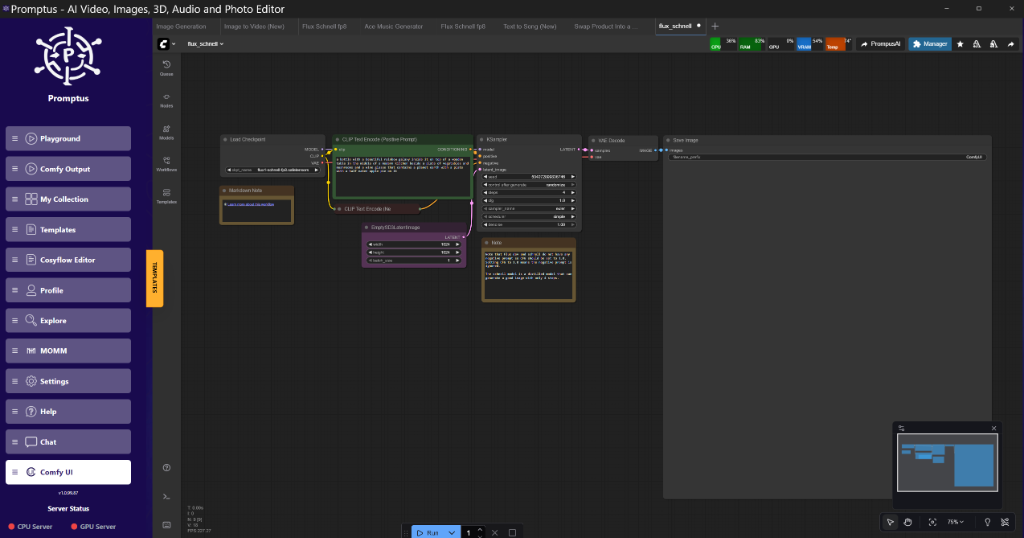
ComfyUI provides a node-based interface for constructing complex Stable Diffusion pipelines. Each node performs a specific function, such as loading a model, encoding a prompt, or decoding an image. The connections between nodes define the flow of data and the overall process of image generation.
ComfyUI is a powerful node-based interface that allows for highly customized Stable Diffusion workflows. It provides granular control over every step of the image generation process, from loading models to applying post-processing effects.
Technical Analysis
The node-based approach of ComfyUI offers unparalleled flexibility. You can easily experiment with different components and configurations to fine-tune your results. The visual representation of the workflow makes it easier to understand and debug complex pipelines. Tools like Promptus can streamline prototyping these workflows.
Optimizing VRAM Usage
VRAM is often the limiting factor when running Stable Diffusion. Several techniques can significantly reduce VRAM consumption, allowing you to run larger models and generate higher-resolution images on limited hardware.
VRAM Optimization is essential for running Stable Diffusion on systems with limited GPU memory. Techniques like Tiled VAE Decode, Sage Attention, and Block Swapping can dramatically reduce VRAM usage.
Tiled VAE Decode
The VAE (Variational Autoencoder) is responsible for encoding the latent space into an image and vice-versa. Tiled VAE Decode processes the image in smaller tiles, reducing the VRAM required for the decoding process.
Community tests show that using a tile size of 512x512 pixels with an overlap of 64 pixels minimizes seams. To implement, use the Tiled VAE Decode node, setting tile_size to 512 and overlap to 64.
SageAttention
SageAttention is a memory-efficient replacement for standard attention mechanisms in the KSampler node. It reduces VRAM usage but may introduce subtle texture artifacts, especially at higher CFG scales. Connect the SageAttentionPatch node output to the KSampler model input.
Golden Rule: Be aware of the trade-offs. SageAttention can save VRAM, but it might impact image quality.
Block Swapping
Block swapping offloads model layers to the CPU during sampling. This can free up significant VRAM, allowing you to run larger models on cards with less memory. Implement with the Checkpoint Loader node. Specify the number of transformer blocks to offload to the CPU. For example, swap the first 3 transformer blocks to the CPU, keeping the rest on the GPU.
LTX-2/Wan 2.2 Low-VRAM Tricks
For video generation, consider chunking the feedforward process with LTX-2. Hunyuan low-VRAM deployment patterns, including FP8 quantization and tiled temporal attention, are also worth investigating for further optimization.
Common ComfyUI Workflow Optimizations
Beyond VRAM, consider these workflow tweaks:
Batch Size: Reduce batch size to 1 for lower VRAM footprint.
Checkpoint Selection: Use optimized checkpoints like those from the community (check licensing).
Image Size: Render images at smaller resolutions initially and upscale later.
Tools like Promptus simplify prototyping these tiled workflows, allowing builders to iterate offloading setups faster.
Technical Analysis
These optimizations trade off speed for memory. Reducing the batch size means processing fewer images simultaneously, increasing render time. Optimized checkpoints can offer a balance between quality and speed.
My Recommended Stack
For ComfyUI workflow design, I recommend using a combination of ComfyUI with Promptus. ComfyUI's node-based system offers unparalleled control, while Promptus streamlines workflow creation and optimization. The Promptus workflow builder makes testing these configurations visual.
Golden Rule: Invest time in understanding ComfyUI's node system. The more you learn, the more efficiently you can create and optimize your workflows.
Resources & Tech Stack
ComfyUI: A powerful and modular GUI for Stable Diffusion. ComfyUI Official provides the core framework for node-based workflow creation.
AUTOMATIC1111/stable-diffusion-webui: A popular web interface for Stable Diffusion. While this guide focuses on ComfyUI, understanding other interfaces can broaden your perspective.
Conclusion
Optimizing Stable Diffusion in ComfyUI is an ongoing process. Experiment with different techniques and configurations to find what works best for your hardware and creative goals. Tiled VAE Decode, SageAttention, and Block Swapping are excellent starting points for reducing VRAM usage. Keep an eye on community developments for new optimization strategies.
Future Improvements
Future improvements could include more automated VRAM management tools and better integration of community-developed optimization techniques directly into ComfyUI.
Advanced Implementation
Here's an example of how to implement Tiled VAE Decode in a ComfyUI workflow.
First, add a Tiled VAE Decode node.
Next, connect the VAE output from your Checkpoint Loader node to the vae input of the Tiled VAE Decode node.
Finally, connect the latent output from your KSampler node to the latent input of the Tiled VAE Decode node.
Set the tile_size parameter to 512 and the overlap parameter to 64.
{
"nodes": [
{
"id": 1,
"type": "CheckpointLoaderSimple",
"inputs": {},
"outputs": {
"model": "MODEL",
"clip": "CLIP",
"vae": "VAE"
}
},
{
"id": 2,
"type": "KSampler",
"inputs": {
"model": "MODEL",
"seed": 12345,
"steps": 20,
"cfg": 8,
"samplername": "eulera",
"scheduler": "normal",
"positive": "CONDITIONING",
"negative": "CONDITIONING",
"latent_image": "LATENT"
},
"outputs": {
"latent": "LATENT"
}
},
{
"id": 3,
"type": "TiledVAEEncode",
"inputs": {
"pixels": "IMAGE",
"vae": "VAE"
},
"outputs": {
"latent": "LATENT"
}
},
{
  "id": 4,
  "type": "TiledVAEDecode",
  "inputs": {
    "samples": "LATENT",
    "vae": "VAE",
    "tile_size": 512,
    "overlap": 64
  },
  "outputs": {
    "image": "IMAGE"
  }
}
Performance Optimization Guide
VRAM Optimization: Use Tiled VAE Decode, SageAttention, and Block Swapping techniques.
Batch Size Recommendations:
8GB card: Batch size of 1.
16GB card: Batch size of 2-4.
24GB+ card: Experiment with higher batch sizes.
Tiling and Chunking: Utilize tiling for high-resolution outputs and chunking for video models.
Technical FAQ
What is the "CUDA out of memory" error and how do I fix it?
This error indicates that your GPU has run out of VRAM. Try reducing the batch size, enabling Tiled VAE Decode, using SageAttention, or implementing block swapping. Ensure you have the latest drivers installed. Sometimes, restarting your system can free up VRAM.
How much VRAM do I need to run SDXL models?
What are the best KSampler settings for image quality?
Experiment with different sampler types (Euler a, DPM++ 2M Karras) and schedulers (normal, Karras). A CFG scale of 7-12 and steps of 20-30 are generally good starting points. Adjust based on the specific model and prompt.
Why are my images generating with black seams when using Tiled VAE Decode?
Ensure that the overlap parameter in the Tiled VAE Decode node is set correctly (e.g., 64 pixels). Insufficient overlap can cause seams. Also, verify that your VAE model is compatible with tiled decoding.
How do I update ComfyUI to the latest version?
Navigate to your ComfyUI directory in the command line and run git pull. This will update ComfyUI to the latest version. Restart ComfyUI after updating.
More Readings
Continue Your Journey
Understanding ComfyUI Workflows for Beginners
Advanced Image Generation Techniques
VRAM Optimization Strategies for RTX Cards
Building Production-Ready AI Pipelines
Prompt Engineering Tips and Tricks
Mastering Stable Diffusion for Photorealistic Images
Created: 23 January 2026