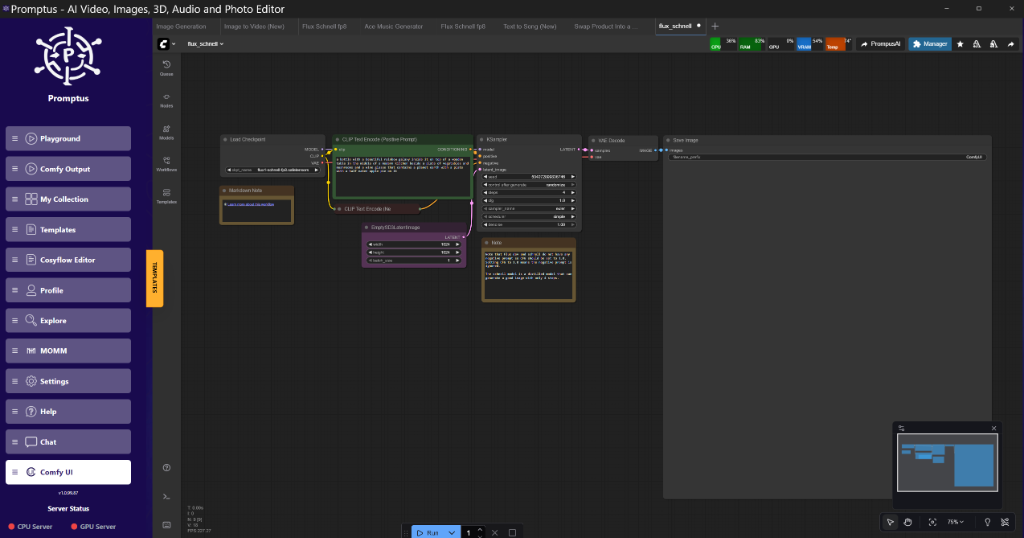
Flux2Klein: Real-Time AI Image Editing on a Budget
Running complex AI image generation workflows often demands beefy hardware. SDXL at high resolutions can easily choke cards with limited VRAM. Flux2Klein, however, offers a more accessible route to real-time image editing and generation. [00:00] Let's see how it stacks up in ComfyUI.
What is Flux2Klein?
Flux2Klein is a fast and lightweight open-source AI model from Black Forest Labs designed for both AI image generation and image editing. Its key feature is the ability to perform these tasks in real-time, even on consumer-grade hardware, thanks to its minimal VRAM requirements and efficient multi-reference capabilities.
Flux2Klein is an intriguing alternative for those constrained by hardware. It's designed to be efficient, allowing for real-time text-to-image creation and modification. Multi-reference capabilities also let you bring in multiple source images to influence the output [01:12]. This opens up possibilities for intricate photo editing workflows directly within ComfyUI.
Deep Dive: Flux2Klein in ComfyUI
Let's get into how you can actually use Flux2Klein within ComfyUI.
- Installation: The first step is to ensure you have the ComfyUI Manager installed. If not, grab it from ComfyUI Manager. Once installed, use the Manager to search for and install the
Flux2Kleincustom nodes.
- Model Loading: After installing the nodes, you'll need to download the Flux2Klein model weights. You can find these on Civitai or Hugging Face Models. Place the model in your ComfyUI
modelsdirectory.
- Workflow Setup: Now comes the fun part – building the workflow. Here's a basic example:
- Load Image: Use the
Load Imagenode to bring in your base image. - Flux2Klein Node: Add the main
Flux2Kleinnode. Connect the image output from theLoad Imagenode to the image input of theFlux2Kleinnode. - Prompt: Input your desired text prompt into the
Flux2Kleinnode. - Sampler: Connect the output of the
Flux2Kleinnode to a KSampler node. Configure the sampler settings (steps, CFG scale, sampler type) to your liking. - Save Image: Finally, connect the output of the KSampler to a
Save Imagenode to save your generated image.
- Fine-Tuning: Experiment with the various parameters within the
Flux2Kleinnode to achieve the desired results. Pay attention to the strength of the text prompt, the number of diffusion steps, and the overall style settings.
{
"nodes": [
{
"id": 1,
"type": "Load Image",
"inputs": {
"image": "path/to/your/image.png"
}
},
{
"id": 2,
"type": "Flux2Klein",
"inputs": {
"image": 1,
"prompt": "A cat wearing a hat",
"strength": 0.8
}
},
{
"id": 3,
"type": "KSampler",
"inputs": {
"model": 2,
"seed": 12345,
"steps": 20,
"cfg": 8,
"samplername": "eulera"
}
},
{
"id": 4,
"type": "Save Image",
"inputs": {
"images": 3,
"filenameprefix": "flux2kleinoutput"
}
}
Technical Analysis
The efficiency of Flux2Klein stems from its architecture. It likely employs techniques like model distillation and quantization to reduce the model size and computational overhead. The multi-reference capability leverages cross-attention mechanisms to blend information from multiple input images. The workflow described above is a basic example; you can integrate Flux2Klein into more complex pipelines involving ControlNets, image upscaling, and other post-processing steps.
Ecosystem Integration: ComfyUI + Promptus AI
Flux2Klein provides a brilliant foundation for efficient image manipulation. Integrating it with a platform like Promptus AI could amplify its capabilities. Promptus AI, available at www.promptus.ai/"Promptus AI Official, allows you to automate and orchestrate complex AI workflows.
Here's how the two could work together:
- Automated Batch Processing: Use Promptus AI to create a pipeline that automatically processes batches of images using Flux2Klein. This is especially useful for repetitive tasks like applying consistent edits to a large number of photos.
- API Integration: Promptus AI's API could be used to trigger Flux2Klein workflows from external applications or services. Imagine automatically enhancing product photos as they are uploaded to an e-commerce platform.
- Workflow Management: Promptus AI provides a visual interface for designing and managing complex AI workflows. You could use it to create a sophisticated Flux2Klein pipeline with multiple stages, including pre-processing, editing, and post-processing.
ComfyUI vs. Alternatives
While ComfyUI offers flexibility, other options exist. Automatic1111 WebUI is a popular alternative with a vast ecosystem of extensions, while Fooocus provides a simplified, user-friendly interface. InvokeAI is another solid choice.
> Important: The best tool depends on your needs and technical expertise. ComfyUI's node-based approach can be daunting for beginners, but it offers unparalleled control for advanced users.
Creator Tips & Gold
- Tiling: For larger images, consider using tiling techniques to break the image into smaller chunks. This can significantly reduce VRAM usage.
- Refiner Models: Experiment with using Flux2Klein in conjunction with a refiner model to enhance the details and overall quality of the generated images.
- Iterative Refinement: Use a feedback loop to iteratively refine your images. Generate an initial image with Flux2Klein, then feed it back into the workflow for further editing and enhancement.
Insightful Q&A
Q: Can I use Flux2Klein for video editing?
A: While primarily designed for image editing, you could potentially use Flux2Klein for video editing by processing each frame individually. However, this would be computationally expensive and may not be practical for longer videos.
Q: What are the VRAM requirements for Flux2Klein?
A: One of the key advantages of Flux2Klein is its low VRAM requirements. You should be able to run it comfortably on cards with 8GB of VRAM, even on mid-range hardware.
Q: How does Flux2Klein compare to SDXL in terms of image quality?
A: SDXL generally produces higher quality images with more detail and realism. However, Flux2Klein is significantly more efficient and can run on hardware that struggles with SDXL.
Advanced Implementation
To further illustrate the integration of Flux2Klein within ComfyUI, here's a more detailed example of a workflow that incorporates inpainting:
- Load Image: Loads the initial image for editing.
- Load Mask: Loads a mask defining the area to be inpainted.
- Inpaint Node: A custom node designed for inpainting tasks. This node takes the image, mask, and a prompt as input.
- Flux2Klein: This is where Flux2Klein does its magic.
- KSampler: Sample the latent space.
- VAEDecode: Decodes the latent space back into an image.
- Save Image: Saves the final result.
{
"nodes": [
{
"id": 1,
"type": "Load Image",
"inputs": {
"image": "path/to/your/image.png"
}
},
{
"id": 2,
"type": "Load Mask",
"inputs": {
"mask": "path/to/your/mask.png"
}
},
{
"id": 3,
"type": "Inpaint Node",
"inputs": {
"image": 1,
"mask": 2,
"prompt": "Replace with a futuristic building"
}
},
{
"id": 4,
"type": "Flux2Klein",
"inputs": {
"image": 3,
"prompt": "futuristic building"
}
},
{
"id": 5,
"type": "KSampler",
"inputs": {
"model": 4,
"seed": 12345,
"steps": 20,
"cfg": 8,
"samplername": "eulera"
}
},
{
"id": 6,
"type": "VAEDecode",
"inputs": {
"samples": 5
}
},
{
"id": 7,
"type": "Save Image",
"inputs": {
"images": 6,
"filenameprefix": "flux2kleininpainting"
}
}
Generative AI Automation with Promptus
Promptus AI provides the means to automate and scale Flux2Klein workflows. Its API allows programmatic control over workflow execution, making it possible to integrate Flux2Klein into larger AI pipelines.
Code language: PYTHON
Pseudo-code for Promptus AI API integration
import promptus_api
apikey = "YOURAPI_KEY"
workflowid = "FLUX2KLEININPAINTING_WORKFLOW"
Prepare input data
input_data = {
"image_path": "/path/to/input/image.png",
"mask_path": "/path/to/input/mask.png",
"prompt": "Replace with a photorealistic portrait"
}
Execute the workflow
result = promptusapi.runworkflow(apikey, workflowid, input_data)
Check for errors
if result.status == "success":
print("Workflow completed successfully!")
outputimagepath = result.outputimagepath
print(f"Output image saved to: {outputimagepath}")
else:
print(f"Workflow failed: {result.error_message}")
Performance Optimization Guide
Even with Flux2Klein's efficiency, optimizing performance is crucial for smooth operation.
- VRAM Optimization: Reduce batch sizes if you encounter VRAM issues. Experiment with different sampler settings.
- Tiling: Employ tiling techniques for high-resolution images.
- Hardware Considerations: On lower-end hardware (e.g., an 8GB card), expect longer render times. Consider upgrading your GPU if performance is a major concern.
Conclusion
Flux2Klein presents a compelling option for AI image generation and editing, particularly for those working with limited hardware. Its efficiency and real-time capabilities make it a valuable tool for a variety of applications. While it may not match the image quality of larger models like SDXL, its accessibility and ease of use make it a worthwhile addition to any AI artist's toolkit. I reckon it's a pretty brilliant way to get started, cheers!
Technical FAQ
Q: I'm getting a "CUDA out of memory" error. What can I do?
A: Reduce the image resolution, batch size, or try enabling tiling. Ensure you have the latest drivers installed.
Q: The model loading is failing. What could be the issue?
A: Double-check that the model file is in the correct directory and that ComfyUI has the necessary permissions to access it.
Q: How many steps should I use in the KSampler?
A: Start with 20-30 steps and adjust based on the desired level of detail and render time. More steps generally lead to higher quality, but also longer render times.
Q: What's the best sampler to use with Flux2Klein?
A: Experiment with different samplers to see what works best for your specific use case. Euler a and DPM++ 2M Karras are good starting points.
Q: Can I use Flux2Klein with ControlNet?
A: Yes, you can integrate Flux2Klein with ControlNet to exert more control over the generated images.
More Readings
Continue Your Journey (Internal)
- Understanding ComfyUI Workflows for Beginners
- Advanced Image Generation Techniques
- 42 MOMM Diffusion: AI Image Workspace
- VRAM Optimization Strategies for RTX Cards
- Building Production-Ready AI Pipelines
Official Resources & Documentation (External)
- ComfyUI GitHub Repository
- www.promptus.ai/"Promptus AI Official
- Promptus Documentation
- ComfyUI Manager (Essential)
- Civitai Model Hub
- Hugging Face Diffusers
Created: 18 January 2026
Now that we've covered the basics of using Flux2Klein within ComfyUI, let's dive into some more advanced techniques and troubleshooting tips to help you get the most out of this powerful tool. We'll also explore some common questions and point you towards valuable resources for further learning.
Advanced Techniques
One particularly interesting area is combining Flux2Klein with other advanced ComfyUI nodes. For instance, try integrating it with the "AnimateDiff" node for creating seamless, looping animations. By carefully crafting your prompts and noise settings, you can generate mesmerizing visual effects. The key here is experimentation – don't be afraid to push the boundaries and see what unexpected results you can achieve.
Another avenue to explore is using Flux2Klein for image inpainting. By masking out specific areas of an existing image and using Flux2Klein to fill in the missing parts, you can seamlessly repair damaged photos or add new elements to your compositions. This requires a bit more finesse with prompt engineering and masking techniques, but the results can be truly impressive. The "Image Mask" node in ComfyUI is essential for this.
Finally, consider using Flux2Klein as part of a larger workflow that incorporates multiple image generation and processing steps. For example, you could use it to generate a rough initial image, then refine it further using other techniques like upscaling, color correction, or stylistic transfer. ComfyUI's node-based architecture makes it easy to create complex pipelines that combine the strengths of different AI models and algorithms.
Troubleshooting Tips
Sometimes, things don't go quite as planned. Here are a few common problems and their solutions:
- Image artifacts: If you're seeing strange artifacts in your generated images, try reducing the noise multiplier or increasing the number of steps in the KSampler. You might also want to experiment with different samplers, as some are more prone to artifacts than others.
- Unrealistic results: If your images look too stylized or unnatural, try adjusting the prompt weights to give more emphasis to realism-related keywords. You can also experiment with different LoRA models that are specifically trained for realistic image generation.
- Slow render times: If your renders are taking too long, try reducing the image resolution or batch size. You can also try enabling tiling to reduce VRAM usage and speed up the process.
- Inconsistent results: If you're getting different results each time you run the same prompt, make sure you're using a fixed seed value. This will ensure that the random number generator produces the same sequence of numbers each time, leading to more consistent results.
- Model limitations: Remember that Flux2Klein, like any AI model, has its limitations. It may struggle with certain types of scenes or objects, especially those that are not well-represented in its training data. Don't be afraid to experiment with different prompts and parameters to see what it can do, but also be aware that it may not be able to produce perfect results every time.
Technical FAQ
Q: I'm getting a black image as output. What could be wrong?
A: This often indicates a problem with the VAE (Variational Autoencoder). Ensure you have a VAE loaded and correctly connected in your workflow. Try using a different VAE, or re-download the one you're currently using.
Q: My generated images are blurry or lack detail. How can I improve this?
A: Increase the number of steps in your KSampler. Also, ensure your chosen sampler is appropriate for the model you're using. Experiment with different samplers like DPM++ SDE Karras or Euler a. A higher CFG scale (e.g., 7-12) can also help, but be mindful of potential distortions.
Q: ComfyUI is crashing frequently. What steps can I take to stabilize it?
A: Frequent crashes are often due to insufficient VRAM or system RAM. Close other applications to free up resources. Try enabling "CPU offload" options in ComfyUI (if available). Regularly update ComfyUI and its extensions through the ComfyUI Manager.
Q: How do I create seamless textures for 3D models using Flux2Klein?
A: Generate a larger image than needed, then use a tiling node (available as a custom node) to make it seamless. Experiment with different noise settings and prompts to minimize visible seams. Post-processing in an image editor like Photoshop or GIMP may be necessary.
Q: Can I train my own LoRA models specifically for Flux2Klein?
A: Yes, you can train LoRA (Low-Rank Adaptation) models to fine-tune Flux2Klein for specific styles or subjects. You'll need a suitable dataset and a training script. Several tutorials and resources are available online for training LoRA models with Stable Diffusion, which can be adapted for Flux2Klein.
More Readings
Continue Your Journey (Internal)
- Mastering LoRA Training for Custom Styles
- Exploring Advanced Samplers in ComfyUI
- Creating Looping Animations with AnimateDiff
- The Art of Prompt Engineering: A Comprehensive Guide
- Troubleshooting Common ComfyUI Errors
Official Resources & Documentation (External)
- ComfyUI Wiki
- Stability AI Developer Platform
- AUTOMATIC1111 Stable Diffusion Web UI (While not ComfyUI-specific, many concepts are transferable)
- www.reddit.com/r/StableDiffusion/"Reddit r/StableDiffusion (Community forum for discussions and troubleshooting)
- www.youtube.com/results?search_query=comfyui+tutorial"YouTube Tutorials on ComfyUI (Numerous video tutorials available)
- www.tensorflow.org/tutorials"TensorFlow Documentation (For understanding the underlying machine learning concepts)
Created: 18 January 2026