Install Stable Diffusion: 60-Second Guide
SDXL chews through VRAM like nobody's business. Running at native 1024x1024 resolution can bring even a 3090 to its knees, and those with 8GB cards are simply out of luck. This guide provides a rapid setup for Stable Diffusion and then dives deep into the tweaks needed to get it running smoothly, even on less beefy hardware. We'll cover everything from basic installation to advanced VRAM optimization techniques.
Rapid Installation with AUTOMATIC1111 page publication date:
AUTOMATIC1111's Stable Diffusion WebUI provides a user-friendly interface for Stable Diffusion. It simplifies the installation process and offers a wide range of features and extensions. This method is still a solid starting point for local installations.
Here's the gist of the "60-second" install (though realistically, it'll take longer depending on your download speeds):
- Clone the Repository: Open your command prompt or terminal and navigate to the directory where you want to install Stable Diffusion. Then, run:
Code language: BASH
git clone https://github.com/AUTOMATIC1111/stable-diffusion-webui
- Run the WebUI: Navigate into the
stable-diffusion-webuidirectory and run thewebui-user.bat(on Windows) orwebui.sh(on Linux/macOS) script. This will automatically download the necessary files and models. - Wait (Patiently): The first run will take a while as it downloads the base Stable Diffusion model and sets up the environment. Grab a cuppa.
- Start Generating: Once the process is complete, the WebUI will launch in your browser. Start generating images!

Technical Analysis
The AUTOMATIC1111 WebUI handles much of the heavy lifting: downloading the required models, setting up the Python environment, and providing a web interface. This makes it an accessible entry point for users unfamiliar with the command line. However, it's not without its limitations – it can be resource-intensive and less flexible than ComfyUI for advanced workflows.
Stepping up to ComfyUI
ComfyUI is a node-based interface for Stable Diffusion, offering greater flexibility and control over the image generation process. It allows you to create complex workflows by connecting different nodes together.
While AUTOMATIC1111 is quick to get started, ComfyUI is where you unlock serious optimization and customization. It's like moving from a point-and-shoot camera to a full-fledged DSLR.
ComfyUI Installation
- Download ComfyUI: Head over to the ComfyUI Official GitHub repository and download the appropriate version for your operating system.
- Extract the Archive: Extract the downloaded archive to a directory of your choice.
- Run ComfyUI: Run the
runcpu.batorrunnvidia_gpu.batscript (depending on your hardware). ComfyUI will launch in your browser. - Download Models: You'll need to download the Stable Diffusion models (e.g., SDXL, SD 1.5) and VAEs separately and place them in the appropriate directories (
models/Stable-diffusionandmodels/VAErespectively).
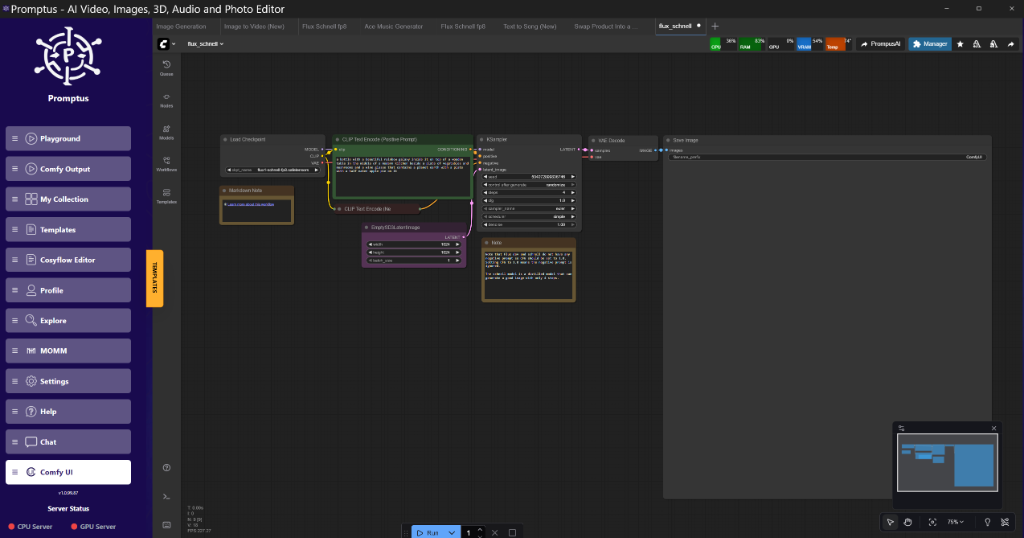
Building a Basic Workflow
Let's create a simple text-to-image workflow in ComfyUI:
- Load Checkpoint: Add a "Load Checkpoint" node and select your desired Stable Diffusion model.
- Load CLIPTextEncode (Prompt): Add two "CLIPTextEncode" nodes – one for the positive prompt and one for the negative prompt. Enter your prompts in the text fields.
- Empty Latent Image: Add an "Empty Latent Image" node and set the desired image size and batch size.
- KSampler: Add a "KSampler" node. This node performs the actual diffusion process. Connect the "model" output from the "Load Checkpoint" node, the "positive" and "negative" outputs from the "CLIPTextEncode" nodes, and the "latent" output from the "Empty Latent Image" node to the corresponding inputs on the "KSampler" node.
- VAE Decode: Add a "VAE Decode" node. Connect the "latent" output from the "KSampler" node to the "latent" input on the "VAE Decode" node, and the "vae" output from the "Load Checkpoint" node to the "vae" input on the "VAE Decode" node.
- Save Image: Add a "Save Image" node. Connect the "image" output from the "VAE Decode" node to the "images" input on the "Save Image" node.
- Run the Workflow: Click the "Queue Prompt" button to start generating the image.
Technical Analysis
ComfyUI's node-based approach allows for granular control over each step of the image generation process. This is particularly useful for experimenting with different samplers, schedulers, and other parameters. It also enables the creation of complex workflows involving multiple models and image processing steps. The initial learning curve is steeper than AUTOMATIC1111, but the payoff in terms of flexibility and performance is significant.
VRAM Optimization Techniques for ComfyUI
VRAM is often the limiting factor when generating high-resolution images with Stable Diffusion. Here are several techniques to reduce VRAM consumption in ComfyUI:
1. Tiled VAE Decode
- Install the appropriate custom node.
- Replace the standard "VAE Decode" node with the tiled version.
- Configure the tile size and overlap parameters. A tile size of 512 with an overlap of 64 is a good starting point.
2. Sage Attention
Sage Attention is a memory-efficient alternative to standard attention mechanisms in KSamplers. It reduces VRAM consumption but may introduce subtle texture artifacts at high CFG scales. To use Sage Attention:
- Install the appropriate custom node.
- Locate the KSampler node in your workflow.
- Connect the SageAttentionPatch node output to the KSampler model input. Ensure you disconnect the original attention module.
3. Block/Layer Swapping
Block/layer swapping offloads model layers to the CPU during sampling, freeing up VRAM on the GPU. This allows you to run larger models on cards with limited VRAM. To implement block swapping:
- Install the appropriate custom node.
- Configure the node to swap the first few transformer blocks to the CPU. A good starting point is to swap the first three blocks. Keep the rest on the GPU for optimal performance.
4. LTX-2/Wan 2.2 Low-VRAM Tricks
LTX-2 and Wan 2.2 offer additional low-VRAM techniques, such as chunk feedforward for video models and Hunyuan low-VRAM deployment patterns.
Chunk Feedforward: Process video in 4-frame chunks.
Hunyuan Low-VRAM: Use FP8 quantization and tiled temporal attention.
Technical Analysis
These VRAM optimization techniques each have their own trade-offs. Tiled VAE decoding can introduce seams if the overlap is not configured correctly. Sage Attention can cause artifacts at high CFG scales. Block swapping can significantly increase render times. The key is to experiment and find the combination of techniques that works best for your specific hardware and workflow.
Workflow Example (ComfyUI JSON)
Here's a snippet of a ComfyUI workflow JSON demonstrating the use of Sage Attention:
{
"nodes": [
{
"id": 1,
"type": "Load Checkpoint",
"inputs": {
"ckptname": "sdxlbase1.0.safetensors"
}
},
{
"id": 2,
"type": "CLIPTextEncode",
"inputs": {
"text": "A beautiful landscape",
"clip": [1, 0]
}
},
{
"id": 3,
"type": "EmptyLatentImage",
"inputs": {
"width": 512,
"height": 512,
"batch_size": 1
}
},
{
"id": 4,
"type": "KSampler",
"inputs": {
"model": [1, "MODEL"],
"positive": [2, "CLIP"],
"negative": [5, "CLIP"],
"latent_image": [3, "LATENT"],
"seed": 12345,
"steps": 20,
"cfg": 8,
"samplername": "eulera",
"scheduler": "normal",
"denoise": 1
}
},
{
"id": 5,
"type": "CLIPTextEncode",
"inputs": {
"text": "ugly, disfigured",
"clip": [1, 0]
}
},
{
"id": 6,
"type": "VAEDecode",
"inputs": {
"samples": [4, "LATENT"],
"vae": [1, "VAE"]
}
},
{
  "id": 7,
  "type": "SaveImage",
  "inputs": {
    "images": [
      6,
      "IMAGE"
    ]
  }
}
My Recommended Stack
For rapid prototyping and workflow iteration, I recommend combining ComfyUI with a visual workflow builder like Promptus. ComfyUI gives you the low-level control, while Promptus allows you to quickly assemble and optimize complex workflows. Builders using Promptus can iterate offloading setups faster.
Golden Rule: Start with a simple workflow and gradually add complexity. Don't try to optimize everything at once.
Insightful Q&A
Q: I'm getting CUDA out-of-memory errors. What can I do?
A: CUDA OOM errors are a common issue. Try the following:
Reduce the image size.
Lower the batch size.
Enable VRAM optimization techniques (tiled VAE, Sage Attention, block swapping).
Update your NVIDIA drivers.
Close other applications that are using GPU resources.
Q: My images have seams when using Tiled VAE. How do I fix this?
A: Increase the tile overlap. A value of 64 pixels is generally sufficient, but you may need to experiment with higher values.
Q: Sage Attention is causing artifacts in my images. What's going on?
A: Reduce the CFG scale. Sage Attention is more prone to artifacts at high CFG scales.
Q: How much VRAM do I need to run SDXL?
Q: Why is ComfyUI so complicated?
A: ComfyUI's node-based interface provides a high degree of flexibility and control, but it comes at the cost of increased complexity. Start with simple workflows and gradually learn the different nodes and their functions. Tools like Promptus simplify prototyping these tiled workflows.
Conclusion
Getting Stable Diffusion up and running is the first step. Optimizing it for your specific hardware and workflow is where the real fun begins. By combining ComfyUI's flexibility with VRAM optimization techniques, you can push the boundaries of AI art generation, even on limited hardware.
Advanced Implementation
To implement Sage Attention in ComfyUI, you'll need to install the appropriate custom node. Once installed, you can replace the standard attention mechanism in the KSampler node with Sage Attention. This involves connecting the SageAttentionPatch node output to the KSampler model input and disconnecting the original attention module.
Performance Optimization Guide
VRAM Optimization Strategies: Tiled VAE Decode, Sage Attention, Block Swapping
Batch Size Recommendations:
8GB Card: Batch size of 1-2
12GB Card: Batch size of 2-4
24GB+ Card: Batch size of 4-8
Tiling and Chunking: Use 512x512 tiles with 64px overlap for high-res outputs.
Continue Your Journey
More Readings
Continue Your Journey (Internal 42.uk Research Resources)
Understanding ComfyUI Workflows for Beginners
Advanced Image Generation Techniques
VRAM Optimization Strategies for RTX Cards
Building Production-Ready AI Pipelines
Prompt Engineering Tips and Tricks
Mastering Stable Diffusion Parameters
Technical FAQ
Created: 23 January 2026