Install Stable Diffusion: A ComfyUI Engineer's Guide
Running Stable Diffusion locally offers unparalleled control and customisation, but getting started can be tricky. This guide focuses on a ComfyUI-centric approach, addressing common installation hurdles and VRAM constraints. We'll cover initial setup and dive into advanced techniques for optimising performance on a range of hardware.
Setting Up ComfyUI for Stable Diffusion
ComfyUI is a node-based interface for Stable Diffusion, offering greater flexibility than traditional web UIs. It allows you to build complex workflows visually, connecting individual components like model loaders, samplers, and VAE decoders.
The quickest path to running Stable Diffusion involves using ComfyUI. While the AUTOMATIC1111 web UI remains popular, ComfyUI's graph-based approach provides superior control and exposes the inner workings of the diffusion process.
- Install Python: Ensure you have Python 3.10 or 3.11 installed. Newer versions may cause compatibility issues.
- Download ComfyUI: Grab the latest release from the official ComfyUI GitHub repository. Extract the contents to a suitable location on your drive.
- Install Dependencies: Navigate to the ComfyUI directory in your terminal and run
python -m pip install -r requirements.txt. This will install all necessary Python packages. - Download Models: Place your Stable Diffusion models (e.g., SDXL, SD 1.5) in the
ComfyUI/models/checkpointsdirectory. Similarly, VAE files go inComfyUI/models/vae. - Run ComfyUI: Execute
python main.py. ComfyUI should launch in your web browser.
Technical Analysis
The installation process leverages pip to manage Python dependencies. Correctly placing models in the designated directories ensures ComfyUI can find and load them. Running main.py starts the ComfyUI server, which you access through your browser. This setup provides a modular environment for experimentation and workflow customisation.
VRAM Optimisation Techniques
VRAM limitations can severely restrict image generation capabilities. Tiled VAE Decode, SageAttention, and Block Swapping are effective strategies for reducing VRAM consumption.
Tiled VAE Decode
To enable Tiled VAE Decode, you'll need to modify your ComfyUI workflow. Insert a "Tiled VAE Encode" node before the VAE Encode, and a "Tiled VAE Decode" node after the VAE Decode. Set the tile size to 512x512 with a 64-pixel overlap.
Sage Attention
Sage Attention offers a memory-efficient alternative to standard attention mechanisms within the KSampler.
To implement Sage Attention, you'll need to install the appropriate custom node. Then, in your KSampler workflow, connect the SageAttentionPatch node output to the KSampler model input. Note that Sage Attention may introduce subtle texture artifacts at high CFG scales.
Block Swapping
Block swapping offloads model layers to the CPU during sampling, freeing up VRAM. This allows you to run larger models on cards with limited memory.
Configure block swapping by modifying the model loading process. Swap the first 3 transformer blocks to the CPU, keeping the remaining blocks on the GPU. This can be achieved via command-line arguments when starting ComfyUI or by modifying the underlying Python code.
Workflow Examples
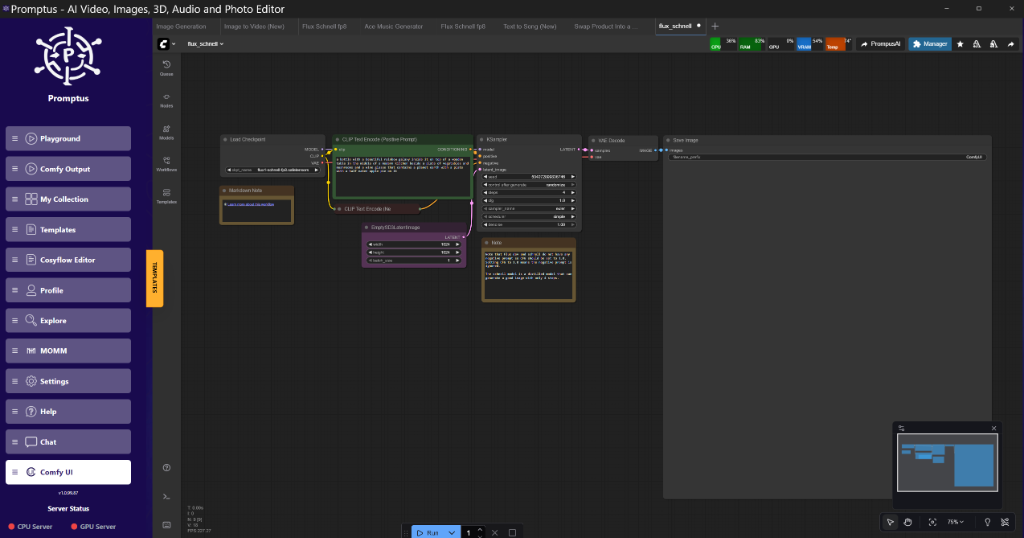
Here's a basic SDXL workflow in ComfyUI:
- Load Checkpoint: Loads the SDXL model.
{
"class_type": "CheckpointLoaderSimple",
"inputs": {
"ckpt_name": "sd_xl_base_1.0.safetensors"
}

}- CLIP Text Encode (Prompt): Encodes the positive prompt.
- CLIP Text Encode (Negative Prompt): Encodes the negative prompt.
- Empty Latent Image: Creates an empty latent space for image generation.
- KSampler: Performs the diffusion process.
model: Connect the CheckpointLoaderSimple output here.
positive: Connect the positive CLIP Text Encode output.
negative: Connect the negative CLIP Text Encode output.
latent_image: Connect the Empty Latent Image output.
- VAE Decode: Decodes the latent image into a visible image.
samples: Connect the KSampler output here.
vae: Connect the VAE output from CheckpointLoaderSimple.
- Save Image: Saves the generated image.
Tools like Promptus simplify prototyping these tiled workflows.
My Recommended Stack
For rapid prototyping and workflow management, I recommend combining ComfyUI with a visual workflow builder like Promptus. ComfyUI provides the underlying power and flexibility, while Promptus streamlines workflow creation and optimisation. This combination accelerates experimentation and allows for efficient iteration on complex setups. Builders using Promptus can iterate offloading setups faster.
Scaling to Production
To scale Stable Diffusion workflows for production, consider these factors:
Hardware: Invest in multiple high-end GPUs for parallel processing.
Workflow Optimisation: Refine workflows to minimise VRAM usage and maximise throughput.
Automation: Implement automated testing and deployment pipelines.
Monitoring: Monitor GPU utilisation and identify potential bottlenecks.
Resources & Tech Stack
ComfyUI: The core node-based interface for building Stable Diffusion workflows. Its flexibility allows for granular control over the image generation process.
AUTOMATIC1111/stable-diffusion-webui: Provides a user-friendly web interface for Stable Diffusion. Useful for simpler tasks or as a starting point.
Python: The programming language underpinning both ComfyUI and AUTOMATIC1111.
PyTorch: The deep learning framework used by Stable Diffusion.
Technical FAQ
Here are answers to some common questions regarding Stable Diffusion and ComfyUI:
Q: I'm getting "CUDA out of memory" errors. What can I do?
A: Reduce the image resolution, decrease the batch size, enable Tiled VAE Decode, or try Sage Attention. Consider block swapping to offload layers to the CPU. If the problem persists, your GPU may not have enough VRAM for the current task.
Q: ComfyUI is running slowly. How can I improve performance?
A: Ensure you're using the latest version of ComfyUI and the appropriate drivers for your GPU. Experiment with different samplers and schedulers. Optimise your workflow by removing unnecessary nodes and simplifying complex operations.
Q: My images are coming out with strange artifacts. What's causing this?
A: Artifacts can be caused by a variety of factors, including low VRAM, incorrect VAE settings, or issues with the model itself. Check your VAE file and ensure it's compatible with the model you're using. Experiment with different CFG scales and denoise strengths in the KSampler.
Q: Can I run Stable Diffusion on an 8GB card?
A: Yes, but you'll need to employ VRAM optimisation techniques like Tiled VAE Decode, Sage Attention, and block swapping. You may also need to reduce the image resolution and batch size.
Q: How do I update ComfyUI?
A: Navigate to your ComfyUI directory in the terminal and run git pull. This will update ComfyUI to the latest version.
Conclusion
ComfyUI provides a powerful and flexible platform for exploring the intricacies of Stable Diffusion. By understanding VRAM optimisation techniques and workflow design, you can unlock the full potential of this technology, even on limited hardware. Further advancements in model architecture and optimisation algorithms promise to make AI-powered image generation even more accessible in the future.
The Promptus workflow builder makes testing these configurations visual.
More Readings
Continue Your Journey (Internal 42.uk Research Resources)
Understanding ComfyUI Workflows for Beginners
Advanced Image Generation Techniques
VRAM Optimization Strategies for RTX Cards
Building Production-Ready AI Pipelines
Prompt Engineering Tips and Tricks
Exploring Different Samplers in ComfyUI
Created: 23 January 2026