Mastering ComfyUI for AI Image Generation
Running Stable Diffusion locally offers unparalleled control over the image generation process. However, the default UIs often abstract away crucial parameters, limiting experimentation and optimization. ComfyUI, with its node-based workflow, provides the granular control needed for advanced techniques, but can seem daunting at first. This guide will demystify ComfyUI, covering installation, core workflows, and advanced optimization strategies to squeeze the most out of your hardware.
Installation [1:48]
ComfyUI installation involves cloning the repository, installing dependencies, and downloading necessary models. It supports both CPU and GPU, with GPU acceleration being significantly faster. The ComfyUI Manager simplifies plugin and model management.
First, you'll need to clone the ComfyUI repository from GitHub:
Code language: BASH
git clone https://github.com/comfyanonymous/ComfyUI
cd ComfyUI
Next, install the required dependencies. It's recommended to use a virtual environment to avoid conflicts with other Python packages.
Code language: BASH
python -m venv .venv
source .venv/bin/activate # On Linux/macOS
.venv\Scripts\activate # On Windows
pip install -r requirements.txt
For GPU support, ensure you have the correct drivers installed. CUDA toolkit is required for NVIDIA GPUs.
After installation, download the necessary models (Stable Diffusion checkpoints, VAEs, etc.) and place them in the appropriate directories within the ComfyUI folder (e.g., models/Stable-diffusion, models/VAE).

Downloading Models [4:00]
Models are the core of Stable Diffusion. Different models produce different styles and results. Civitai and Hugging Face are popular sources for finding models. Place downloaded models in the correct ComfyUI directories.
Numerous models are available online, each trained on different datasets and offering unique stylistic outputs. Civitai is a popular repository for community-created models, while Hugging Face hosts a wide range of pre-trained models and datasets. When downloading models, pay attention to the file type (e.g., .ckpt, .safetensors) and place them in the corresponding directories within the ComfyUI folder. Specifically, place Stable Diffusion checkpoints in the models/Stable-diffusion directory, VAE files in the models/VAE directory, and ControlNet models in the models/controlnet directory.
Golden Rule: Always verify the source of your models and ensure they are safe before using them.
Text to Image Workflow [7:25]
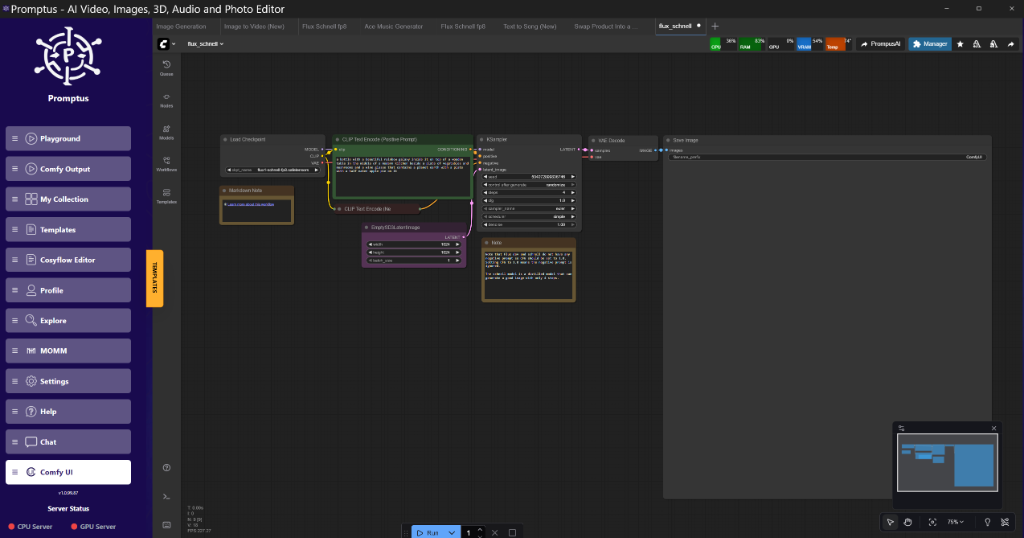
The basic text-to-image workflow involves loading a model, encoding a prompt, sampling, decoding, and saving the image. ComfyUI's node-based system allows for customization and control over each step.
The standard text-to-image workflow in ComfyUI consists of several key nodes:
- Load Checkpoint: Loads the Stable Diffusion model.
- CLIP Text Encode (Prompt): Encodes the positive and negative prompts into CLIP embeddings.
- Empty Latent Image: Creates an empty latent space image with specified dimensions.
- KSampler: Performs the diffusion sampling process.
- VAE Decode: Decodes the latent image into a pixel-space image.
- Save Image: Saves the generated image.
Connect these nodes in the following order:
Load Checkpoint model output to KSampler model input.
Load Checkpoint clip output to CLIP Text Encode (Prompt) clip input.
CLIP Text Encode (Prompt) conditioning output to KSampler positive input.
CLIP Text Encode (Prompt) conditioning output to KSampler negative input.
Empty Latent Image latent output to KSampler latent_image input.
KSampler latent output to VAE Decode samples input.
Load Checkpoint vae output to VAE Decode vae input.
VAE Decode image output to Save Image images input.
This setup provides a basic text-to-image pipeline. Experiment with different prompts, samplers, and model settings to achieve desired results.
Technical Analysis
This workflow represents the core steps of the Stable Diffusion process. The CLIP Text Encode nodes translate human-readable text into a format the model can understand. The KSampler iteratively refines the latent image based on the prompt and the model's knowledge. The VAE Decode node converts the latent representation into a viewable image.
Navigation, Editing, and Shortcuts [21:30]
ComfyUI offers a variety of navigation and editing tools, including zooming, panning, and node manipulation. Keyboard shortcuts enhance workflow efficiency.
ComfyUI's interface provides several ways to navigate and edit workflows:
Zooming: Use the mouse wheel to zoom in and out.
Panning: Click and drag the background to pan the workflow.
Node Manipulation: Click and drag nodes to move them. Double-click to edit node parameters.
Connecting Nodes: Drag from the output of one node to the input of another to create a connection.
Deleting Nodes: Select a node and press the Delete key.
Keyboard shortcuts can significantly speed up workflow creation:
Ctrl+C, Ctrl+V: Copy and paste nodes.
Ctrl+Z: Undo.
Ctrl+Shift+Z: Redo.
Shift+Click: Add a node to a workflow by clicking on an existing connection line.
Installing ComfyUI Manager and Git [26:15, 27:00]
The ComfyUI Manager simplifies the installation of custom nodes and models. Git is required for managing and updating custom nodes.
The ComfyUI Manager is a valuable tool for managing custom nodes and models. To install it, follow these steps:
- Clone the ComfyUI Manager repository into the
custom_nodesdirectory within your ComfyUI installation:
Code language: BASH
cd ComfyUI/custom_nodes
git clone https://github.com/ltdrdata/ComfyUI-Manager
- Restart ComfyUI. The ComfyUI Manager will now be available in the interface.
Git is often required for installing and updating custom nodes. If you don't have Git installed, download it from https://git-scm.com/downloads and follow the installation instructions.
Upscaling [28:43]
Upscaling increases the resolution of an image. ComfyUI supports various upscaling methods, including latent upscaling and traditional image upscaling.
Upscaling is a crucial step for improving the quality of generated images. ComfyUI offers several upscaling options:
- Latent Upscaling: Upscales the latent representation of the image before decoding. This method can produce sharper results than traditional image upscaling.
- Image Upscaling: Upscales the pixel-space image using various algorithms (e.g., Lanczos, Nearest Neighbor).
- Tile Upscaling: Divides the image into tiles, upscales each tile separately, and then merges the tiles back together. This method can reduce VRAM usage and improve performance.
For latent upscaling, use the Latent Upscale node. For image upscaling, use the Image Upscale node. For tile upscaling, use the Tile Image node followed by an Image Upscale node.
Image to Image Workflow [37:49]
Image-to-image allows generating new images based on existing images. Control over the process is key to achieving desired results.
The image-to-image workflow starts with an existing image and uses it as a base for generating a new image. This process involves encoding the input image into a latent representation, adding noise, and then sampling from the noisy latent image based on a prompt.
The core nodes for image-to-image are:
- Load Image: Loads the input image.
- VAE Encode: Encodes the image into a latent representation.
- Add Noise: Adds noise to the latent image.
- KSampler: Performs the diffusion sampling process.
- VAE Decode: Decodes the latent image into a pixel-space image.
- Save Image: Saves the generated image.
Connect the nodes as follows:
Load Image image output to VAE Encode image input.
VAE Encode latent output to Add Noise latent input.
Add Noise latent output to KSampler latent_image input.
(Rest of the connections are the same as in the text-to-image workflow)
Adjust the noise level to control the degree of change from the original image. Lower noise levels will result in images that are more similar to the original, while higher noise levels will result in more significant changes.
Tile Upscaling [43:07]
Tile upscaling is a memory-efficient technique for upscaling large images. It divides the image into smaller tiles, processes each tile separately, and then merges them back together.
Tile upscaling is a valuable technique for upscaling large images on systems with limited VRAM. It divides the image into smaller tiles, upscales each tile separately, and then merges the tiles back together. This reduces the VRAM required to upscale the entire image at once.
To implement tile upscaling in ComfyUI:
- Use the
Tile Imagenode to divide the image into tiles. - Upscale each tile using an
Image Upscalenode. - Use the
Merge Tilesnode to merge the upscaled tiles back together.
ControlNet [51:53]
ControlNet provides precise control over image generation by using control images (e.g., edge maps, depth maps) to guide the diffusion process.
ControlNet allows you to guide the image generation process using control images, such as edge maps, depth maps, or segmentation maps. This provides precise control over the structure and composition of the generated image.
To use ControlNet in ComfyUI:
- Load the ControlNet model using the
Load Checkpointnode. - Load the control image using the
Load Imagenode. - Use a ControlNet preprocessor (e.g.,
Canny Edge Detection,Depth Map Estimation) to process the control image. - Connect the ControlNet model and the preprocessed control image to the
ControlNet Applynode. - Connect the
ControlNet Applynode to the KSampler.
The ControlNet preprocessor will generate a feature map from the control image, which is then used by the ControlNet model to guide the diffusion process.
Faceswap & Installing Other Plugins [1:03:54]
Faceswap allows swapping faces in images. ComfyUI's plugin ecosystem extends its functionality with custom nodes and features.
Faceswap enables swapping faces in images using specialized models and nodes. To perform faceswap in ComfyUI, you'll need to install the ComfyUI_InstantID plugin. This plugin provides the necessary nodes for face detection, face alignment, and face swapping.
To install the plugin:
- Clone the
ComfyUIInstantIDrepository into thecustomnodesdirectory within your ComfyUI installation:
Code language: BASH
cd ComfyUI/custom_nodes
git clone https://github.com/cubiq/ComfyUI_InstantID
- Restart ComfyUI.
After installation, you can use the InstantID nodes to perform faceswap.
ComfyUI's plugin ecosystem is constantly growing, with new custom nodes and features being added regularly. The ComfyUI Manager makes it easy to discover and install these plugins.
Flux, Auraflow, and Newer Models [1:16:08]
Flux and Auraflow are examples of advanced workflows and models that demonstrate ComfyUI's flexibility. Staying up-to-date with new developments is crucial.
ComfyUI's flexibility allows for the creation of complex workflows like Flux and Auraflow, which combine multiple techniques and models to achieve specific artistic effects. These workflows often involve custom nodes and require a deeper understanding of the underlying diffusion process.
Staying up-to-date with the latest models and techniques is crucial for maximizing the potential of ComfyUI. Follow community forums, GitHub repositories, and research papers to stay informed about new developments.
Resources & Tech Stack
This guide leverages several key resources:
ComfyUI Official: https://github.com/comfyanonymous/ComfyUI - The core node-based interface for Stable Diffusion workflows.
Civitai: https://civitai.com - A community repository for Stable Diffusion models and resources.
Hugging Face: https://huggingface.co/xinsir/controlnet-union-sdxl-1.0 - Hosts models, datasets, and preprocessors for ControlNet and other tasks.
ComfyUIInstantID: https://github.com/cubiq/ComfyUIInstantID - A plugin for performing faceswap in ComfyUI.
Promptus AI: www.promptus.ai/"https://www.promptus.ai/ - A ComfyUI workflow builder and optimization platform that streamlines prototyping.
These resources, combined with a powerful GPU (like my 4090), provide the foundation for advanced AI image generation. Tools like Promptus simplify prototyping these tiled workflows.
My Recommended Stack
For building complex ComfyUI workflows, I've found a combination of tools to be particularly effective:
ComfyUI: The base for node-based workflow creation. Its flexibility is unmatched.
Promptus AI: For rapid prototyping and workflow optimization. The visual builder saves a lot of time.
ComfyUI Manager: Essential for managing custom nodes and keeping your installation up-to-date.
This stack allows me to quickly iterate on ideas and optimize workflows for performance and quality. Builders using Promptus can iterate offloading setups faster.
VRAM Optimization Techniques
Running SDXL and other large models can quickly exhaust VRAM, especially on cards with 8GB or less. Here are some techniques to mitigate this:
Tiled VAE Decode: Reduces VRAM usage by decoding the latent image in tiles. Use 512x512 tiles with 64px overlap.
SageAttention: A memory-efficient attention mechanism that can replace the standard attention in KSampler workflows. Trade-off: may introduce subtle texture artifacts at high CFG.
Block Swapping: Offloads model layers to CPU during sampling. Example: Swap first 3 transformer blocks to CPU, keep rest on GPU.
LTX-2 Chunk Feedforward: Process video in 4-frame chunks to reduce memory footprint.
Scaling and Production Advice
Scaling ComfyUI workflows for production requires careful consideration of hardware, software, and workflow design. Here are some tips:
Hardware: Invest in high-end GPUs with ample VRAM. Multiple GPUs can be used to parallelize the image generation process.
Software: Use a containerization technology like Docker to ensure consistent environments across different machines.
Workflow Design: Optimize workflows for performance by using efficient nodes and minimizing memory usage. The Promptus workflow builder makes testing these configurations visual.
Automation: Automate the image generation process using scripts and APIs.
Insightful Q&A
Q: How do I use different checkpoints in the same workflow?
A: Use multiple Load Checkpoint nodes, each loading a different checkpoint. Connect them to separate KSamplers or use a Switch node to select between them.
Q: Can I use ControlNet with image-to-image?
A: Yes, you can combine ControlNet with image-to-image by loading your base image, encoding it, and then using a ControlNet preprocessor and ControlNet Apply node before the KSampler.
Q: How do I create seamless textures with tile upscaling?
A: Ensure sufficient overlap between tiles during upscaling. An overlap of 64 pixels is often sufficient. Also, consider using a blending technique to smooth the seams.
Conclusion
ComfyUI is a powerful and flexible tool for AI image generation, offering unparalleled control over the diffusion process. By mastering the core workflows, optimization techniques, and available plugins, you can unlock its full potential and create stunning visuals. Experimentation and continuous learning are key to staying ahead in this rapidly evolving field.
Advanced Implementation
Here's an example of a ComfyUI workflow using SageAttention:
First, install the appropriate custom node:
Code language: BASH
cd ComfyUI/custom_nodes
git clone https://github.com/ltdrdata/ComfyUI-Manager
Then use the manager inside comfy to find and install the "SageAttention" nodes.
Next, modify your KSampler node graph:
- Add a
SageAttentionPatchernode. Connect themodeloutput of yourLoad Checkpointnode to themodelinput of theSageAttentionPatchernode. - Connect the
patched_modeloutput of theSageAttentionPatchernode to themodelinput of yourKSamplernode.
This will replace the standard attention mechanism with SageAttention, potentially reducing VRAM usage.
Performance Optimization Guide
To optimize ComfyUI performance:
VRAM Optimization: Use Tiled VAE Decode, SageAttention, and Block Swapping to reduce VRAM usage.
Batch Size: Increase the batch size to process multiple images simultaneously. However, this will increase VRAM usage. Experiment to find the optimal balance for your hardware.
Tiling and Chunking: For high-resolution outputs, use tile upscaling or chunking to process the image in smaller parts.
Technical FAQ
Q: I'm getting "CUDA out of memory" errors. What can I do?
A: Reduce the batch size, use VRAM optimization techniques (Tiled VAE, SageAttention, Block Swapping), or upgrade your GPU.
Q: ComfyUI is not recognizing my GPU. How do I fix this?
A: Ensure you have the correct drivers installed for your GPU. Also, check that CUDA is properly configured. You may need to set the CUDAVISIBLEDEVICES environment variable.
Q: My models are not loading. What could be the problem?
A: Verify that the model files are in the correct directories within the ComfyUI folder. Also, check the console output for any error messages related to model loading. Ensure the model isn't corrupted.
Q: What are the minimum hardware requirements for running ComfyUI?
Q: How do I update ComfyUI to the latest version?
A: Navigate to your ComfyUI directory in the command line and run git pull. Then, restart ComfyUI.
Continue Your Journey (Internal 42.uk Research Resources)
Understanding ComfyUI Workflows for Beginners
Advanced Image Generation Techniques
VRAM Optimization Strategies for RTX Cards
Building Production-Ready AI Pipelines
Mastering Prompt Engineering for AI Art
Exploring the Latest Stable Diffusion Models
Created: 23 January 2026
More Readings
Essential Tools & Resources
- Promptus AI - ComfyUI workflow builder with VRAM optimization and workflow analysis
- ComfyUI Official Repository - Latest releases and comprehensive documentation
Related Guides on 42.uk Research