Code language: MARKDOWN
ComfyUI in Promptus: Install → Generate → SAVE Workflows (Full Tutorial)
Unleash the full potential of AI image and video generation with ComfyUI, now seamlessly integrated into Promptus, the all-in-one AI creation environment. Forget complex installations and endless configurations! With Promptus, you can dive headfirst into the world of node-based AI workflows with a single click. This comprehensive guide will walk you through everything you need to know, from installing ComfyUI in Promptus to designing, saving, and even sharing your custom workflows to earn credits on the Promptus Distributed Compute Network. Get ready to transform your creative vision into stunning AI-generated realities, sweet as!
Why ComfyUI and Promptus? A Powerful Combination
ComfyUI has revolutionised the AI art scene by offering granular control over the image generation process. Unlike simpler interfaces, ComfyUI allows you to build complex workflows using a node-based system, manipulating every step from prompt processing to denoising. This level of control is invaluable for achieving specific artistic styles, experimenting with advanced techniques, and truly understanding the inner workings of Stable Diffusion and other AI models. Choice!
Yeah nah, setting up ComfyUI can be a bit of a hurdle. It often involves intricate installations, managing dependencies, and troubleshooting potential compatibility issues. This is where Promptus steps in.
Promptus simplifies the entire process, sweet as, by providing a pre-configured environment where ComfyUI runs flawlessly. It handles the complexities behind the scenes, allowing you to focus on what truly matters: creating amazing AI art. Kia ora! Furthermore, Promptus offers a distributed compute network, enabling you to leverage powerful GPUs for faster generation times and more complex workflows. This means you can create stunning visuals without needing to invest in expensive hardware, leaving more kai money in your pocket.
This tutorial will cover:
- Effortless Installation: How to install and run ComfyUI in Promptus with a single click.
- Instant Creativity: How to use CosyFlows for ready-made AI image and video pipelines.
- Workflow Mastery: How to design, save, and reuse your own ComfyUI workflows.
- Earning Potential: How to share your workflows and earn credits through the distributed compute network.
- Troubleshooting Tips: How to troubleshoot ports, reinstall, or refresh environments with ease.
Ready to dive in, whānau? Let's get started!
1. Installing ComfyUI in Promptus: One-Click Setup
The beauty of Promptus is sweet as, chur! Installing ComfyUI is incredibly straightforward:
- Launch Promptus: Open the Promptus application on your computer. If you haven't already, download and install Promptus from the official website (www.promptus.ai"https://www.promptus.ai).
- Navigate to the ComfyUI Tab: Within the Promptus interface, locate the "ComfyUI" tab. This tab is specifically designed to manage your ComfyUI instance.
- Click "Install": You'll find a prominent "Install" button. Click it, and Promptus will automatically handle the entire installation process. This includes downloading the necessary files, configuring dependencies, and setting up the environment.
- Wait for Completion: The installation process may take a few minutes, depending on your internet connection. Promptus will display a progress indicator to keep you informed.
That's it, sweet as! Once the installation is complete, you're ready to run ComfyUI.
2. Running ComfyUI for the First Time
After the installation is complete, running ComfyUI is just as easy:
- Click "Run": In the ComfyUI tab, you'll now see a "Run" button. Click it to launch ComfyUI.
- ComfyUI Interface Opens: Promptus will automatically open a new browser tab or window, displaying the ComfyUI interface.
Chur! You're now inside ComfyUI, ready to start creating. Choice!
3. Understanding the ComfyUI Interface: A Quick Tour
The ComfyUI interface can seem a bit daunting at first, yeah nah, but it's surprisingly intuitive once you understand the basic elements.
3.1 The ComfyUI Canvas: Your Digital Workshop
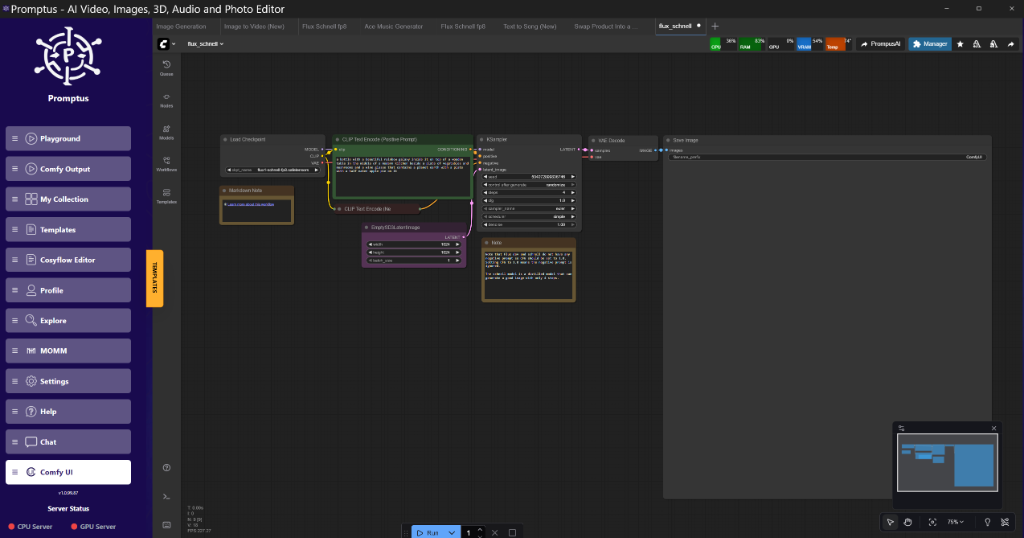
The main area of the ComfyUI interface is the canvas. This is where you'll build your workflows by connecting nodes. Think of it as a visual programming environment where each node represents a specific task or component in the image generation process.
- Panning: You can pan around the canvas by clicking and dragging with your mouse.
- Zooming: Use your mouse wheel to zoom in and out of the canvas for a better view of your workflow.
3.2 The Nodes: Building Blocks of AI Art
Nodes are the fundamental building blocks of ComfyUI workflows. Each node performs a specific function, such as:
- Loading a Checkpoint (Model): This node loads a Stable Diffusion model, which determines the overall style and capabilities of your image generation.
- Prompt Encoding: This node converts your text prompt into a format that the Stable Diffusion model can understand.
- Sampling: This node generates the image based on the encoded prompt and the chosen sampling method.
- Image Decoding: This node converts the generated image data into a viewable format.
- Saving the Image: This node saves the generated image to your computer.
Nodes have inputs and outputs, represented by coloured circles. You connect these circles to create a flow of data through your workflow, sweet as.
- Connecting Nodes: Click and drag from an output circle to an input circle to create a connection.
- Disconnecting Nodes: Right-click on a connection to disconnect it.
- Moving Nodes: Click and drag a node to reposition it on the canvas.
3.3 The Sidebar: Controls and Configuration
The sidebar on the left side of the ComfyUI interface provides access to various controls and configuration options:
- Queue Prompt: This button executes your workflow and starts the image generation process.
- Clear: This button clears the entire canvas, allowing you to start a new workflow from scratch.
- Load: This button allows you to load a previously saved workflow.
- Save: This button saves your current workflow to a file.
- Settings: This section allows you to customise various ComfyUI settings, such as the sampling method and the number of steps.
4. Your First Workflow: Text-to-Image Generation
Let's create a simple text-to-image workflow to illustrate the basic concepts:
- Load a Checkpoint (Model): Drag a "Load Checkpoint" node onto the canvas. In the node's settings, select a Stable Diffusion model. Popular choices include "sdxlbase1.00.9vae.safetensors" or "realisticVision_v51.safetensors".
- Create Prompt Nodes: Drag two "CLIP Text Encode (Prompt)" nodes onto the canvas. One will be for the positive prompt, and the other for the negative prompt.
- Enter Prompts: In the positive prompt node, enter a descriptive prompt for the image you want to generate. For example: "A majestic dragon flying over a snow-capped mountain, epic fantasy, vibrant colours." In the negative prompt node, enter terms to avoid. For example: "blurry, deformed, low quality."
- Create a Sampler Node: Drag a "K Sampler" node onto the canvas. This node will perform the actual image generation.
- Create an Empty Latent Image Node: Drag an "Empty Latent Image" node onto the canvas. This provides the initial canvas for the image. Set the width and height to your desired resolution (e.g., 512x512).
- Create a VAEDecode Node: Drag a "VAEDecode" node onto the canvas. This node converts the latent image into a viewable image.
- Create a Save Image Node: Drag a "Save Image" node onto the canvas. This node saves the generated image to your computer.
- Connect the Nodes: Now, connect the nodes in the following order:
- Connect the "model" output of the "Load Checkpoint" node to the "model" input of the "K Sampler" node.
- Connect the "clip" output of the "Load Checkpoint" node to the "clip" inputs of both the positive and negative prompt nodes.
- Connect the "positive" output of the positive prompt node and the "negative" output of the negative prompt node to the "positive" and "negative" inputs of the "K Sampler" node, respectively.
- Connect the "latent" output of the "Empty Latent Image" node to the "latent_image" input of the "K Sampler" node.
- Connect the "samples" output of the "K Sampler" node to the "latent_image" input of the "VAEDecode" node.
- Connect the "image" output of the "VAEDecode" node to the "images" input of the "Save Image" node.
- Configure the K Sampler: Adjust the settings of the "K Sampler" node:
- seed: Enter a seed value (e.g., 12345). This will allow you to reproduce the same image if you use the same seed and settings.
- steps: Increase the number of steps for higher quality images (e.g., 20-30).
- cfg: Adjust the CFG scale to control how closely the image follows your prompt (e.g., 7-12).
- sampler_name: Choose a sampler algorithm (e.g., "Euler a," "DPM++ 2M Karras").
- Queue the Prompt: Click the "Queue Prompt" button to start the image generation process.
ComfyUI will now execute your workflow, generating an image based on your prompt and settings. The generated image will be displayed in the "Save Image" node, and it will also be saved to your computer.
5. Exploring ComfyUI Nodes: A Deeper Dive
ComfyUI's power lies in its extensive library of nodes. Understanding these nodes is crucial for creating complex and customised workflows. Here are some of the most commonly used nodes:
- Load Checkpoint: Loads a Stable Diffusion model.
- CLIP Text Encode (Prompt): Encodes text prompts for the Stable Diffusion model.
- K Sampler: Generates the image based on the encoded prompt and the chosen sampling method.
- VAEDecode: Decodes the latent image into a viewable image.
- VAEEncode: Encodes an image into a latent representation.
- Image Scale: Resizes an image.
- Image Crop: Crops an image.
- Image Mask: Creates a mask for selective image processing.
- ControlNet: Allows you to guide the image generation process using control images (e.g., depth maps, edge detection).
- Upscale (Latent): Upscales the latent image, resulting in a higher resolution output.
- Latent Composite: Combines multiple latent images.
- Loop Context: Creates loops within your workflow for iterative processing.
Experimentation is Key: The best way to learn about ComfyUI nodes is to experiment with them. Try adding different nodes to your workflow and see how they affect the generated image. Chur!
6. Using CosyFlows Inside ComfyUI: Ready-Made AI Pipelines
CosyFlows are pre-built ComfyUI workflows that you can easily import and use. They provide a quick and convenient way to generate images and videos without having to build a workflow from scratch.
- Accessing CosyFlows: Promptus typically integrates CosyFlows directly into the ComfyUI interface. You might find a dedicated "CosyFlows" section or a button to browse available workflows. Check the Promptus documentation or interface for the exact location.
- Browsing and Selecting a CosyFlow: Browse the available CosyFlows and choose one that suits your needs. CosyFlows are often categorised by type (e.g., text-to-image, image-to-image, video generation) and style (e.g., realistic, anime, abstract).
- Importing a CosyFlow: Once you've selected a CosyFlow, click the "Import" or "Load" button to load it into your ComfyUI canvas.
- Customising the CosyFlow: After importing the CosyFlow, you can customise it to your liking. Change the prompts, adjust the settings, or even add or remove nodes.
- Running the CosyFlow: Click the "Queue Prompt" button to run the CosyFlow and generate your image or video.
Benefits of Using CosyFlows:
- Save Time: CosyFlows provide a quick and easy way to get started with ComfyUI.
- Learn from Experts: CosyFlows are often created by experienced ComfyUI users, so you can learn from their expertise.
- Explore New Techniques: CosyFlows can introduce you to new techniques and workflows that you might not have discovered on your own.
7. Creating and Saving Your Own Workflows: Unleash Your Creativity
One of the most powerful features of ComfyUI is the ability to create and save your own custom workflows. This allows you to build complex and specialised AI pipelines that perfectly match your creative vision.
- Design Your Workflow: Start by designing your workflow on the ComfyUI canvas. Add the necessary nodes, connect them in the correct order, and configure the settings to your liking.
- Test Your Workflow: Before saving your workflow, make sure to test it thoroughly. Run the workflow multiple times with different prompts and settings to ensure that it produces the desired results.
- Save Your Workflow: Once you're satisfied with your workflow, click the "Save" button in the ComfyUI interface. Choose a descriptive name for your workflow and save it to a file. ComfyUI workflows are typically saved as
.jsonfiles.
- Loading Your Workflow: To load a saved workflow, click the "Load" button and select the
.jsonfile containing your workflow.
Tips for Creating Effective Workflows:
- Start Simple: Begin with a basic workflow and gradually add complexity as you gain experience.
- Use Comments: Add comments to your nodes to explain their purpose and functionality. This will make it easier to understand and maintain your workflow.
- Organise Your Nodes: Arrange your nodes in a logical and visually appealing manner. This will make it easier to navigate and troubleshoot your workflow.
- Experiment and Iterate: Don't be afraid to experiment with different nodes and settings. The best way to learn is to try things out and see what happens, chur!
8. Sharing Your Workflows and Earning Credits: The Promptus Distributed Compute Network
Promptus offers a unique opportunity to share your ComfyUI workflows and earn credits through its distributed compute network. This allows you to contribute to the whānau, help others learn, and even monetise your expertise.
- Prepare Your Workflow for Sharing: Before sharing your workflow, make sure that it is well-documented and easy to understand. Include comments and explanations to help others use your workflow effectively. Also, ensure that your workflow doesn't rely on any private or proprietary resources.
- Upload Your Workflow: Promptus provides a platform for sharing ComfyUI workflows. The exact process for uploading workflows may vary, but it typically involves creating an account on the Promptus website and submitting your workflow through a dedicated interface.
- Set a Price (Optional): You may have the option to set a price for your workflow. This allows you to earn credits each time someone uses your workflow on the Promptus Distributed Compute Network.
- Earn Credits: When other users run your workflow on the Promptus Distributed Compute Network, you will earn credits based on the computational resources used.
- Redeem Your Credits: You can redeem your credits for various benefits, such as:
- Access to Premium Features: Unlock premium features within Promptus.
- Faster Compute Time: Prioritise your jobs on the Distributed Compute Network.
- Cash Payouts: Redeem your credits for cash (subject to Promptus's terms and conditions).
Benefits of Sharing Your Workflows:
- Contribute to the Community: Share your knowledge and aroha with other ComfyUI users.
- Earn Credits: Monetise your workflows and earn credits through the Promptus Distributed Compute Network.
- Gain Recognition: Showcase your skills and build a reputation within the AI art community.
9. Troubleshooting Common Issues
Yeah nah, while Promptus simplifies the ComfyUI experience, you might still encounter occasional issues. Here are some common problems and their solutions:
- Ports in Use: If you encounter an error message indicating that a port is already in use, try restarting Promptus or your computer. You can also try changing the port that ComfyUI uses in the Promptus settings.
- ComfyUI Not Starting: If ComfyUI fails to start, try reinstalling it through the Promptus interface. Sometimes, a corrupted installation can cause issues.
- Workflow Errors: If your workflow produces errors, carefully examine the error messages and try to identify the source of the problem. Double-check your node connections and settings.
- Out of Memory Errors: If you encounter out of memory errors, try reducing the image resolution or the number of steps in your workflow. You can also try using a more powerful GPU on the Promptus Distributed Compute Network.
- Slow Generation Times: Slow generation times can be caused by a number of factors, including a slow GPU, a complex workflow, or a high image resolution. Try optimising your workflow, using a faster GPU, or reducing the image resolution.
- Model Not Found: If a model is not found, ensure it is correctly installed in the ComfyUI models directory within the Promptus environment. You might need to manually download and place the model file in the appropriate folder.
Refreshing the Environment: If you're still experiencing problems, try refreshing the ComfyUI environment in Promptus. This will reset the environment to its default state, which can often resolve compatibility issues. The option to refresh the environment is typically found within the Promptus settings or ComfyUI tab.
Conclusion: Kia ora! Your Journey into AI Art Begins Now!
You've now completed a comprehensive journey into the world of ComfyUI within Promptus. From effortless installation to crafting intricate workflows and even earning credits through the distributed compute network, you're equipped to explore the boundless possibilities of AI-generated art.
Promptus provides the perfect environment to unleash your creativity, offering a seamless and powerful platform for ComfyUI development. The combination of ComfyUI's granular control and Promptus's simplified environment and distributed compute network makes creating stunning AI visuals more accessible than ever before. Sweet as!
Don't hesitate to experiment, explore, and share your creations with the world. The AI art revolution is here, and you're now ready to be a part of it, whānau!
Ready to Get Started?
- Download Promptus: Visit www.promptus.ai"https://www.promptus.ai to download Promptus and begin your AI art journey today.
- Explore CosyFlows: Dive into the world of ready-made AI pipelines and discover new creative possibilities.
- Create and Share: Design your own custom workflows and share them with the Promptus community to earn credits and recognition.
The future of AI art is in your hands. Go create something amazing, choice!