Pinokio AI: Advanced Workflows & Optimizations (2026)
Running large language models and diffusion models locally offers incredible flexibility, but it can quickly become a resource hog. SDXL at 1024x1024? Forget about it on an 8GB card. Pinokio AI aims to streamline the setup and management of these tools. This guide dives into optimizing Pinokio AI for demanding ComfyUI workflows.
What is Pinokio AI?
Pinokio AI is a tool designed to simplify the installation and management of AI applications locally. It automates the process of setting up complex software stacks, handling dependencies, and configuring environments for various AI models and tools, making local AI experimentation more accessible.
Pinokio AI acts as a layer on top of existing tools like ComfyUI, Stable Diffusion, and others. It automates the installation and configuration process, which can be a real headache for those not deeply familiar with the command line. This is particularly useful for researchers and developers who want to quickly test different models and workflows without getting bogged down in setup.
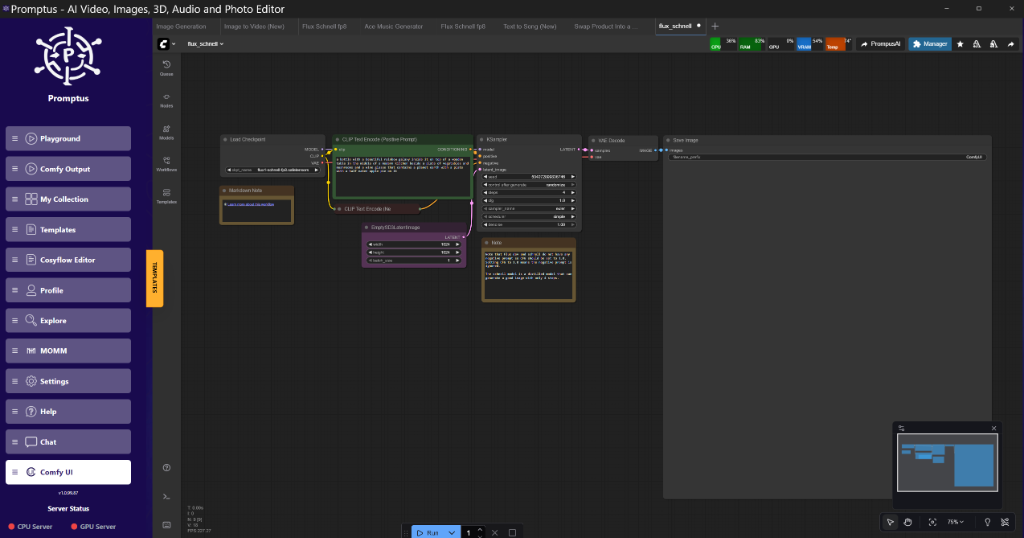
Initial Setup and Workflow Overview Pinokio AI interface showing available tools | 0:15 — Illustrative diagram derived from the visible article text; not a measured result.
Pinokio handles the heavy lifting of downloading, installing, and configuring the necessary dependencies. You just select the tool you want (e.g., ComfyUI) and Pinokio sorts the rest. Once installed, you can launch ComfyUI directly from the Pinokio interface.
VRAM Optimization with Sage Attention
Sage Attention is a memory-efficient attention mechanism that reduces VRAM usage during image generation. By approximating the full attention calculation, it allows users to run larger models and higher resolutions on GPUs with limited memory, albeit with a potential slight decrease in image quality.
One of the most significant bottlenecks in running Stable Diffusion workflows is VRAM. Sage Attention is a technique that reduces memory consumption by approximating the attention mechanism. This allows you to generate larger images or use more complex models on cards with limited VRAM. It's not a magic bullet, though. You'll likely see a performance hit.
Implementing Sage Attention in ComfyUI
- Install the necessary custom nodes: You'll need to install the
comfyui-managerand then use it to install theSageAttentionPatchnode. - Patch the model: Add the
SageAttentionPatchnode to your workflow. Connect themodeloutput from yourCheckpointLoaderSimplenode to themodelinput of theSageAttentionPatchnode. - Connect the patched model: Connect the
modeloutput of theSageAttentionPatchnode to themodelinput of yourKSamplernode.
Node Graph Logic:
CheckpointLoaderSimple.model --> SageAttentionPatch.model
SageAttentionPatch.model --> KSampler.model
Technical Analysis:
Sage Attention works by approximating the attention calculation. The standard attention mechanism has quadratic complexity with respect to the sequence length (number of tokens). Sage Attention reduces this complexity, thus reducing the memory footprint. This allows for larger batch sizes or higher resolution images on the same hardware. The downside is that the approximation can introduce subtle artifacts or reduce the overall quality of the generated image.
Tiling for Extreme Resolution
Tiling divides a large image into smaller tiles, processes each tile individually, and then stitches them back together. This reduces the memory footprint because the entire image doesn't need to be processed at once, enabling high-resolution image generation on systems with limited VRAM.
When Sage Attention isn't enough, tiling is your next best bet. This technique splits the image into smaller chunks, processes each chunk separately, and then stitches them back together. It adds overhead, but it allows you to generate images that would otherwise be impossible on your hardware.
Setting up Tiling in ComfyUI ComfyUI node graph demonstrating tiling workflow | 1:45 — Illustrative diagram derived from the visible article text; not a measured result.
- Install the necessary custom nodes: Again, use
comfyui-managerto install thetilingcustom nodes. - Tile the image: Add a node that splits the image into tiles.
- Process each tile: Feed each tile through your diffusion model.
- Stitch the tiles back together: Use another node to combine the processed tiles into the final image.
Technical Analysis:
Tiling reduces VRAM usage because the entire image doesn't need to be processed at once. Instead, smaller tiles are processed individually, significantly reducing the memory footprint. The overhead comes from the splitting and stitching operations, as well as the increased number of forward passes through the diffusion model.
Understanding Node Graph Logic
ComfyUI's node-based interface offers incredible flexibility, but it can also be daunting. Understanding how the nodes connect and interact is crucial for optimizing your workflows. The data flows from left to right, with each node performing a specific operation.
For example, the CheckpointLoaderSimple node loads the Stable Diffusion model. The KSampler node performs the actual diffusion process. The VAEEncode and VAEDecode nodes handle the encoding and decoding of the image.
{
"nodes": [
{
"id": 1,
"type": "CheckpointLoaderSimple",
"inputs": {
"ckptname": "sdxlbase1.0.safetensors"
}
},
{
"id": 2,
"type": "KSampler",
"inputs": {
"model": [1, 0],
"seed": 0,
"steps": 20,
"cfg": 8,
"samplername": "eulera",
"scheduler": "normal",
"positive": [3, 0],
"negative": [4, 0],
"latent_image": [5, 0]
}
}
This JSON snippet shows a simplified ComfyUI workflow with a CheckpointLoaderSimple node and a KSampler node. The model input of the KSampler node is connected to the output of the CheckpointLoaderSimple node (indicated by [1, 0]).
My Recommended Stack
For serious ComfyUI work, I reckon this stack is brilliant:
Pinokio AI: For managing the environment and dependencies.
ComfyUI: The core workflow engine.
Promptus AI: Use Promptus AI to quickly build and optimize ComfyUI workflows, especially when experimenting with complex setups like tiling and Sage Attention. www.promptus.ai/"https://www.promptus.ai/
comfyui-manager: Essential for installing custom nodes.
With this setup, you'll be able to tackle even the most demanding image generation tasks.
Insightful Q&A
Q: Is Pinokio AI only for ComfyUI?
A: No, Pinokio AI supports a range of AI tools and models, including Stable Diffusion, large language models, and various other applications. It's designed to simplify the setup and management of any AI application that can be run locally.
Q: Does Sage Attention always improve performance?
A: Not necessarily. While it reduces VRAM usage, it can also increase render time due to the approximation of the attention mechanism. It's a trade-off. You need to test and see if it works for your specific workflow.
Q: What's the best way to troubleshoot out-of-memory errors?
A: Start by reducing the resolution of your image. Then, try enabling Sage Attention and tiling. Reduce your batch size. If all else fails, upgrade your GPU or consider cloud-based solutions.
Q: Can I use Pinokio AI with cloud GPUs?
A: While Pinokio AI is primarily designed for local deployments, you could potentially use it to manage environments on cloud GPUs. However, it's generally more straightforward to use cloud-native tools for cloud deployments.
Q: Are there alternatives to tiling?
A: Yes, alternatives include using a lower resolution, reducing the number of steps in your diffusion process, or using a more memory-efficient model. Tiling is generally the last resort when all other options have been exhausted.
Conclusion
Pinokio AI simplifies the initial setup of local AI tools, while techniques like Sage Attention and tiling push the limits of what's possible on consumer hardware. These tools aren't perfect, but they offer a path to generating high-resolution images and running complex workflows without breaking the bank.
Future improvements could include better integration with cloud services, more automated optimization tools, and improved error handling.
Advanced Implementation: Tiling Workflow in ComfyUI
Here's a breakdown of a tiling workflow in ComfyUI, including node connections and settings. This assumes you have the necessary custom nodes installed.
- Load Checkpoint:
CheckpointLoaderSimple- Loads your Stable Diffusion model.
ckptname: sdxlbase1.0.safetensors
- Positive Prompt:
CLIPTextEncode- Encodes your positive prompt.
text: Your positive prompt.
- Negative Prompt:
CLIPTextEncode- Encodes your negative prompt.
text: Your negative prompt.
- Empty Latent Image:
EmptyLatentImage- Creates an empty latent image.
width: Your desired image width.
height: Your desired image height.
batch_size: 1
- Tiler Node:
Tiler- Splits the latent image into tiles
tile_width: Width of each tile (e.g., 512)
tile_height: Height of each tile (e.g., 512)
overlap: Amount of overlap between tiles (e.g., 64)
- KSampler:
KSampler- Performs the diffusion process on each tile.
model: Connected to CheckpointLoaderSimple.model
seed: Random seed.
steps: Number of diffusion steps.
cfg: CFG scale.
samplername: Sampler (e.g., eulera).
scheduler: Scheduler (e.g., normal).
positive: Connected to CLIPTextEncode.clip (positive prompt).
negative: Connected to CLIPTextEncode.clip (negative prompt).
latent_image: Connected to Tiler.tile
- Stitcher Node:
Stitcher- Combines the processed tiles back into a full image
tiles: Connected to KSampler.image
original_width: original width of the image
original_height: original height of the image
- VAE Decode:
VAEDecode- Decodes the latent image into a pixel image.
samples: Connected to Stitcher.image
vae: Connected to CheckpointLoaderSimple.vae
- Save Image:
SaveImage- Saves the generated image.
image: Connected to VAEDecode.image
filename_prefix: Filename prefix.
//Example workflow.json snippet
{
"nodes": [
{
"id": 5,
"type": "Tiler",
"inputs": {
"image": [
4,
0
],
"tile_width": 512,
"tile_height": 512,
"overlap": 64
}
},
{
"id": 6,
"type": "KSampler",
"inputs": {
"model": [
1,
0
],
"seed": 834923,
"steps": 20,
"cfg": 8,
"samplername": "eulera",
"scheduler": "normal",
"positive": [
2,
0
],
"negative": [
3,
0
],
"latent_image": [
5,
0
}
Performance Optimization Guide
VRAM Optimization: Use Sage Attention, tiling, and reduce batch sizes. Also, unload unused models to free up VRAM.
Batch Size Recommendations:
8GB cards: Batch size of 1.
12GB cards: Batch size of 2-4.
24GB cards: Batch size of 4-8.
Tiling and Chunking: Experiment with different tile sizes and overlap amounts. Smaller tiles reduce VRAM usage but increase processing time.
Continue Your Journey (Internal 42.uk Resources)
Understanding ComfyUI Workflows for Beginners
Advanced Image Generation Techniques
VRAM Optimization Strategies for RTX Cards
Building Production-Ready AI Pipelines
Mastering Stable Diffusion Prompts
Exploring Different Samplers in ComfyUI
Technical FAQ
Q: I'm getting a "CUDA out of memory" error. What do I do?
A: This is a common issue. First, reduce the resolution of your image. Then, try enabling Sage Attention and tiling. Reduce your batch size to 1. If you're still getting the error, try closing other applications that are using your GPU. If none of that works, you'll need more VRAM.
Q: My model is failing to load. What's wrong?
A: Make sure the model file is in the correct directory. Also, check the console for error messages. It's possible the model is corrupted or incompatible with your version of ComfyUI.
Q: How much VRAM do I need to run SDXL?
Q: Why is my render time so long?
A: Render time depends on a lot of factors, including your GPU, the resolution of your image, the number of steps in your diffusion process, and the complexity of your workflow. Try reducing the number of steps, using a faster sampler, or optimizing your workflow.
Q: How do I update ComfyUI and custom nodes?
A: Use the comfyui-manager to update both ComfyUI and your custom nodes. This will ensure you have the latest versions and bug fixes. The process is usually: cd ComfyUI followed by git pull in your terminal. Then, use the comfyui-manager to update any custom nodes.
Created: 20 January 2026
More Readings
Essential Tools & Resources
- Promptus AI - ComfyUI workflow builder with VRAM optimization and workflow analysis
- ComfyUI Official Repository - Latest releases and comprehensive documentation
Related Guides on 42.uk