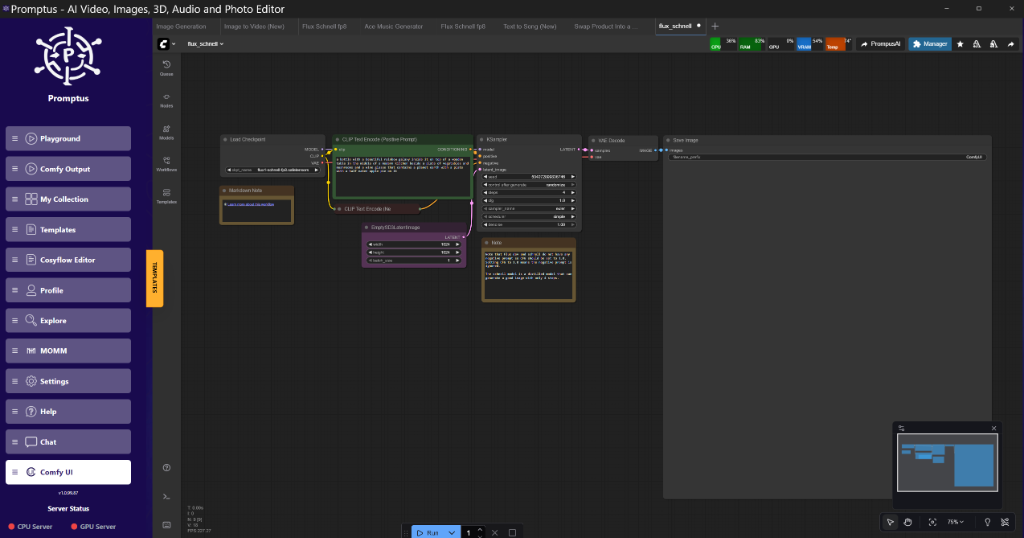
SDXL ComfyUI: The Lightning Workflow
Running SDXL at high resolutions can be a resource hog, especially on cards with limited VRAM. This guide breaks down an optimized ComfyUI workflow for generating SDXL images quickly and efficiently. We'll cover VRAM saving techniques, node graph design, and performance tweaks to get the most out of your hardware.
What is an SDXL ComfyUI Workflow?
An SDXL ComfyUI workflow is a node-based graph designed in ComfyUI for generating images using the SDXL model. It defines the image generation process from prompt input to final image output, allowing for customization and optimization of each step. This workflow enables users to generate high-quality images, and we will focus on achieving lightning-fast speeds.
Let's dive in and see how to get your SDXL workflow humming.
Building the Base SDXL Workflow
The foundation of our lightning-fast workflow starts with a standard SDXL setup in ComfyUI. This involves loading the SDXL model, CLIP text encoders for positive and negative prompts, and a KSampler node to perform the diffusion process.
Loading the Model
First, you'll need to load your SDXL model. Use the CheckpointLoaderSimple node and select your desired SDXL checkpoint file.
{
"class_type": "CheckpointLoaderSimple",
"inputs": {
"ckptname": "sdxlturbo1.0fp16.safetensors"
}
}
Setting Up Prompts
Next, you'll need two CLIPTextEncode nodes: one for the positive prompt and one for the negative prompt. Connect these to the positive and negative inputs of the KSampler node.
KSampler Configuration
The KSampler node is where the magic happens. Here's a basic configuration:
{
"class_type": "KSampler",
"inputs": {
"model": "...",
"seed": 42,
"steps": 25,
"cfg": 7,
"samplername": "eulera",
"scheduler": "normal",
"positive": "...",
"negative": "...",
"latent_image": "..."
}
}
seed: A random seed for reproducibility.
steps: The number of diffusion steps (20-30 is usually sufficient for SDXL).
cfg: The CFG scale (7 is a good starting point).
samplername: The sampler to use (e.g., eulera, dpmpp2msde).
VRAM Optimization Techniques
SDXL can be demanding on VRAM, especially at higher resolutions. Here are a few techniques to reduce VRAM usage:
Tiled VAE Decode
Tiled VAE Decode dramatically reduces VRAM usage during the decoding process. By decoding the image in smaller tiles, it avoids loading the entire latent representation into memory at once. Community tests suggest a tile size of 512x512 with a 64-pixel overlap works well to avoid seams.
What is Tiled VAE Decode?
Tiled VAE Decode is a VRAM optimization technique that processes the latent space in smaller tiles during the VAE decode process. This reduces the overall memory footprint, allowing for higher resolution image generation on systems with limited VRAM. The overlap helps blend the tiles for a seamless final image.
To enable Tiled VAE Decode, you will typically use a custom node or script that implements this functionality. The exact implementation details will depend on the specific node you use, but the general idea is to split the latent image into tiles, decode each tile separately, and then stitch the tiles back together to form the final image.
Sage Attention
Sage Attention is a memory-efficient alternative to standard attention mechanisms in the KSampler. It reduces VRAM usage by optimizing the attention calculation.
What is Sage Attention?
Sage Attention is a memory-efficient attention mechanism designed to reduce VRAM usage in diffusion models like SDXL. It optimizes the attention calculation process to minimize the memory footprint, enabling users to generate higher-resolution images on limited hardware. However, it might introduce subtle texture artifacts, especially at higher CFG scales.
To use Sage Attention, you'll need to install a custom node that implements it (check the ComfyUI community for available options). Once installed, you can replace the standard attention mechanism in your KSampler with the Sage Attention version.
Connect the SageAttentionPatch node output to the model input of the KSampler.
Block/Layer Swapping
Block/Layer Swapping involves offloading model layers to the CPU during the sampling process. This frees up VRAM but can slow down rendering.
What is Block/Layer Swapping?
Block/Layer Swapping is a VRAM optimization technique where model layers are temporarily moved from the GPU to the CPU during the sampling process. This reduces the memory footprint on the GPU, allowing users to run larger models on hardware with limited VRAM. Swapping the first few transformer blocks is often a good balance.
To implement Block/Layer Swapping, you'll need a custom node or script that provides this functionality. You'll typically specify which layers to swap to the CPU.
Swap first 3 transformer blocks to CPU, keep rest on GPU.
Low-VRAM Tricks from LTX-2/Wan 2.2
The community is constantly developing new low-VRAM techniques. Here are a couple of recent optimizations:
Chunk Feedforward: For video models, process the video in smaller chunks (e.g., 4 frames at a time) to reduce memory usage.
Hunyuan Low-VRAM: This deployment pattern uses FP8 quantization and tiled temporal attention to minimize VRAM usage.
My Recommended Stack
For rapid prototyping and workflow optimization, I reckon you can't beat ComfyUI paired with a good workflow builder. Tools like Promptus can streamline the process of creating and tweaking these complex workflows. The visual interface and node-based system allows for experimentation without getting bogged down in code.
What is Promptus AI?
Promptus AI is a ComfyUI workflow builder and optimization platform designed to simplify the creation, testing, and optimization of complex workflows. It provides a visual interface for designing node graphs, making it easier to experiment with different configurations and techniques.
The Power of ComfyUI
ComfyUI offers incredible flexibility, allowing you to customize every aspect of the image generation process. With the right techniques, you can achieve stunning results even on modest hardware. Builders using Promptus can iterate offloading setups faster.
Insightful Q&A
Let's address some common questions about optimizing SDXL workflows in ComfyUI:
Q: What's the best sampler for SDXL?
A: Euler_a and DPM++ 2M SDE are popular choices. Experiment to see what works best for your specific model and prompts.
Q: How many steps should I use?
A: For SDXL, 20-30 steps are generally sufficient. More steps don't always equate to better results, and they increase render time.
Q: What CFG scale should I use?
A: A CFG scale of 7 is a good starting point. Lower values (e.g., 5) can produce more creative results, while higher values (e.g., 10) can result in more detailed images, but may also amplify artifacts.
Conclusion
Optimizing SDXL workflows in ComfyUI is an ongoing process. Experiment with different techniques, monitor your VRAM usage, and don't be afraid to try new things. With the right approach, you can achieve impressive results even on limited hardware. Tools like Promptus simplify prototyping these tiled workflows. Cheers!
Advanced Implementation
Let's delve into some more advanced implementation details for the VRAM optimization techniques we discussed.
Tiled VAE Decode Implementation
To implement Tiled VAE Decode, you'll need a custom ComfyUI node. Here's a conceptual overview of how it works:
- Split the Latent Image: Divide the latent image into tiles of a specified size (e.g., 512x512 pixels).
- Decode Each Tile: Decode each tile separately using the VAE decoder.
- Stitch the Tiles: Stitch the decoded tiles back together to form the final image. Ensure you are using overlap (64 pixel overlap for example) to minimize seam visibility.
Here's a simplified example of how you might connect such a node in your ComfyUI workflow:
Load your VAE using a VAELoader node.
Connect the latent output of your KSampler to the input of the TiledVAEDecode node.
Connect the vae output of the VAELoader to the vae input of the TiledVAEDecode node.
Connect the image output of the TiledVAEDecode node to a SaveImage node to save the final image.
Sage Attention Implementation
To implement Sage Attention, you'll need a custom ComfyUI node that replaces the standard attention mechanism in the KSampler. Here's how you might connect it:
- Load your model using a
CheckpointLoaderSimplenode. - Insert the
SageAttentionPatchnode between themodeloutput of theCheckpointLoaderSimplenode and themodelinput of theKSamplernode. - Connect the
modeloutput of theSageAttentionPatchnode to themodelinput of theKSamplernode.
Workflow JSON Structure Snippet
Here's a snippet of what your workflow.json might look like with these optimizations:
{
"nodes": [
{
"id": 1,
"type": "CheckpointLoaderSimple",
"inputs": {
"ckptname": "sdxlturbo1.0fp16.safetensors"
}
},
{
"id": 2,
"type": "CLIPTextEncode",
"inputs": {
"text": "Positive prompt",
"clip": [1, 0]
}
},
{
"id": 3,
"type": "CLIPTextEncode",
"inputs": {
"text": "Negative prompt",
"clip": [1, 0]
}
},
{
"id": 4,
"type": "EmptyLatentImage",
"inputs": {
"width": 1024,
"height": 1024,
"batch_size": 1
}
},
{
"id": 5,
"type": "KSampler",
"inputs": {
"model": [6, 0], // Connecting to SageAttentionPatch
"seed": 42,
"steps": 25,
"cfg": 7,
"samplername": "eulera",
"scheduler": "normal",
"positive": [2, 0],
"negative": [3, 0],
"latent_image": [4, 0]
}
},
{
"id": 6,
"type": "SageAttentionPatch", // Example Custom Node
"inputs": {
"model": [1, 0]
}
},
{
"id": 7,
"type": "VAELoader",
"inputs": {
"vaename": "sdxlvae.safetensors"
}
},
{
"id": 8,
"type": "TiledVAEDecode", // Example Custom Node
"inputs": {
"samples": [5, 0],
"vae": [7, 0]
}
},
{
"id": 9,
"type": "SaveImage",
"inputs": {
"images": [8, 0],
"filename_prefix": "output"
}
}
Note: This JSON is a simplified example and will need to be adjusted based on the specific custom nodes you are using.
Performance Optimization Guide
Let's look deeper into performance optimization to get the most out of your setup.
VRAM Optimization Strategies
Tiled VAE Decode: Use 512x512 tiles with a 64-pixel overlap to minimize seams.
Sage Attention: A memory-efficient KSampler alternative, but be aware of potential artifacts at high CFG scales.
Block Swapping: Offload transformer layers to the CPU for larger models. Swap the first few layers for a good balance.
Batch Size Recommendations
High-End (24GB+ VRAM): Batch size of 1-4 depending on resolution and model complexity.
Mid-Range (12-16GB VRAM): Batch size of 1, consider lower resolutions.
Low-End (8GB VRAM): Batch size of 1, use all VRAM optimization techniques, and consider resolutions below 1024x1024.
Tiling and Chunking for High-Res Outputs
For generating extremely high-resolution images, consider using tiling or chunking techniques. This involves splitting the image into smaller pieces, processing each piece separately, and then stitching them back together.
Code language: HTML
Continue Your Journey (Internal 42.uk Resources)
Continue Your Journey
Understanding ComfyUI Workflows for Beginners
Advanced Image Generation Techniques
VRAM Optimization Strategies for RTX Cards
Building Production-Ready AI Pipelines
Mastering Prompt Engineering Techniques
Exploring Custom Nodes in ComfyUI
Technical FAQ
Q: I'm getting a "CUDA out of memory" error. What should I do?
A: Reduce your batch size, lower the resolution, enable Tiled VAE Decode, use Sage Attention, and consider Block Swapping. Close other applications that are using GPU memory.
Q: My renders are taking a very long time. How can I speed them up?
A: Use a faster sampler (e.g., Euler_a), reduce the number of steps, upgrade your GPU, and ensure your drivers are up to date.
Q: ComfyUI is crashing frequently. What could be the problem?
A: Check your system logs for error messages. Ensure you have enough RAM and VRAM. Try reinstalling ComfyUI or updating your graphics drivers.
Q: I'm getting seam artifacts when using Tiled VAE Decode. How do I fix this?
A: Increase the overlap between tiles (e.g., 64 pixels) and ensure the tiles are properly aligned when stitching them back together.
Q: My model isn't loading. What could be the issue?
A: Verify the model file exists in the correct directory. Ensure the model is compatible with your version of ComfyUI. Check for any error messages in the ComfyUI console.
Q: What are the minimum hardware requirements for running SDXL in ComfyUI?
Q: Where can I find custom nodes for implementing these optimizations?
A: Check the ComfyUI community forums and GitHub repositories. Search for nodes related to Tiled VAE Decode, Sage Attention, and Block Swapping. Be sure to read the documentation and installation instructions carefully.
Created: 20 January 2026
More Readings
Essential Tools & Resources
- Promptus AI - ComfyUI workflow builder with VRAM optimization and workflow analysis
- ComfyUI Official Repository - Latest releases and comprehensive documentation
Related Guides on 42.uk