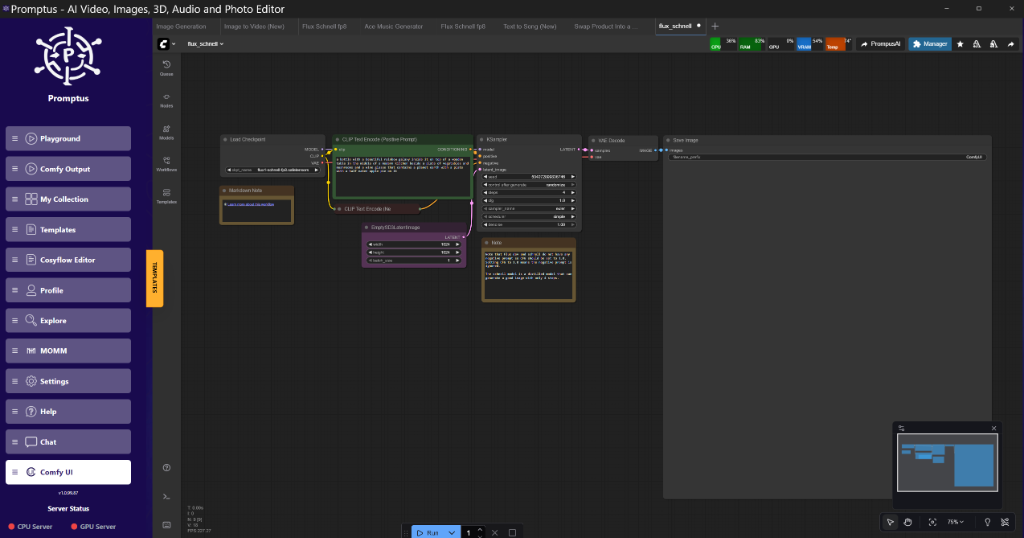
SDXL Easy Workflow: ComfyUI in 2026
Running SDXL at high resolutions can quickly overwhelm even powerful GPUs. This guide provides a practical, optimised "Easy Workflow" for SDXL in ComfyUI, focusing on speed and VRAM efficiency. We'll explore techniques to get the most out of your hardware, regardless of your VRAM capacity.
What is the "Easy Workflow" for SDXL?
The "Easy Workflow" is a streamlined ComfyUI setup for generating high-quality SDXL images quickly and efficiently. It prioritizes ease of use while incorporating advanced VRAM optimization techniques like tiled VAE decoding and SageAttention. This allows users to generate larger images on lower-end hardware without sacrificing quality.
Let's dive straight in.
Core Components of the Easy Workflow
We'll break down the workflow into its essential parts:
- Loader: Loads the SDXL model.
- Prompting: Positive and negative prompt setup.
- Sampler: The KSampler node for iterative denoising.
- VAE Decode: Decoding the latent space into a viewable image.
- Saving: Saving the final image.
SDXL Model Loader
The first step is loading your chosen SDXL model. ComfyUI supports various model formats, but we'll assume you're using a standard .safetensors file.
Node Graph Logic:
Add a "Load Checkpoint" node.
Select your SDXL model from the dropdown.
Prompt Engineering for SDXL
Effective prompting is crucial for achieving desired results. SDXL benefits from detailed and descriptive prompts.
Node Graph Logic:
Add two "CLIP Text Encode (Prompt)" nodes: one for the positive prompt and one for the negative prompt.
Connect the "CLIP" output from the "Load Checkpoint" node to both "CLIP Text Encode (Prompt)" nodes.
Enter your positive and negative prompts.
Golden Rule: Keep your negative prompts concise and focused on unwanted elements (e.g., "blurry", "artifacts", "low quality").
KSampler Configuration
The KSampler node performs the iterative denoising process that generates the image. This is where the magic happens, and also where VRAM usage can skyrocket.
Node Graph Logic:
Add a "KSampler" node.
Connect the "model" output from the "Load Checkpoint" node to the "model" input of the "KSampler" node.
Connect the "positive" output from the positive "CLIP Text Encode (Prompt)" node to the "positive" input of the "KSampler" node.
Connect the "negative" output from the negative "CLIP Text Encode (Prompt)" node to the "negative" input of the "KSampler" node.
Set your desired sampling parameters (seed, steps, CFG scale, sampler name, scheduler).
Technical Analysis: The KSampler iteratively refines the image based on the prompt and the model's understanding of the world. Steps control how many refinement passes are made, CFG scale determines how closely the image adheres to the prompt, and the sampler and scheduler influence the denoising process.
Tiled VAE Decode: A VRAM Lifesaver
The VAE (Variational Autoencoder) decodes the latent space representation generated by the KSampler into a viewable image. This process can be VRAM-intensive, especially at higher resolutions. Tiled VAE Decode breaks the image into smaller tiles, decodes them individually, and then stitches them back together. This significantly reduces VRAM usage.
Node Graph Logic:
Add a "VAE Decode" node.
Add a "Tiled VAE Decode" node.
Connect the "latent" output from the "KSampler" node to the "samples" input of the "Tiled VAE Decode" node.
Connect the "VAE" output from the "Load Checkpoint" node to the "VAE" input of the "Tiled VAE Decode" node.
Connect the "image" output of the "Tiled VAE Decode" node to the "VAE Decode" node.
Connect the "VAE" output from the "Load Checkpoint" node to the "VAE" input of the "VAE Decode" node.
Add a "Save Image" node and connect the "image" output of the "VAE Decode" node to the "Save Image" node.
Technical Analysis: Tiled VAE decoding addresses the VRAM bottleneck by processing the image in manageable chunks. Community tests suggest a tile size of 512 with an overlap of 64 pixels minimizes seams.
SageAttention: Another VRAM Booster
SageAttention is a memory-efficient alternative to standard attention mechanisms within the KSampler. It reduces VRAM usage, particularly at higher resolutions, but can sometimes introduce minor artifacts, especially at high CFG scales. It's a trade-off, but often a worthwhile one for those on limited VRAM.
Node Graph Logic:
- Add a "SageAttentionPatch" node.
- Connect the SageAttentionPatch node's output to the KSampler's "model" input instead of directly connecting the "Load Checkpoint" node's model output to the KSampler.
Saving the Generated Image
The final step is saving the generated image to your hard drive.
Node Graph Logic:
Add a "Save Image" node.
Connect the "image" output from the "VAE Decode" node to the "image" input of the "Save Image" node.
Configure the filename prefix and image format.
My Recommended Stack
For my workflow, I've settled on a combination that balances performance and ease of use:
ComfyUI: The core node-based interface provides unparalleled flexibility.
Promptus AI: This workflow builder simplifies prototyping and optimizing complex node graphs. Tools like Promptus simplify prototyping these tiled workflows.
Tiled VAE Decode: Essential for managing VRAM at high resolutions.
SageAttention: A valuable option for further VRAM reduction, especially on cards with 12GB or less.
Example ComfyUI Workflow JSON
Here's a snippet of a ComfyUI workflow JSON demonstrating the core nodes and connections:
{
"nodes": [
{
"id": 1,
"type": "Load Checkpoint",
"inputs": {}
},
{
"id": 2,
"type": "CLIP Text Encode (Prompt)",
"inputs": {
"clip": [1, 0]
}
},
{
"id": 3,
"type": "CLIP Text Encode (Prompt)",
"inputs": {
"clip": [1, 0]
}
},
{
"id": 4,
"type": "KSampler",
"inputs": {
"model": [1, 0],
"positive": [2, 0],
"negative": [3, 0]
}
},
{
"id": 5,
"type": "Tiled VAE Decode",
"inputs": {
"samples": [4, 0],
"vae": [1, 2]
}
},
{
"id": 6,
"type": "VAE Decode",
"inputs": {
"samples": [5, 0],
"vae": [1, 2]
}
},
{
  "id": 7,
  "type": "Save Image",
  "inputs": {
    "image": [
      6,
      0
    ]
  }
}
Scaling and Production Considerations
For production environments, consider these additional techniques:
Block/Layer Swapping: Offload model layers to CPU during sampling to further reduce VRAM. Swap the first 3 transformer blocks to the CPU, keep the rest on the GPU.
LTX-2 Chunk Feedforward: For video models, process in 4-frame chunks to minimize VRAM.
Hunyuan Low-VRAM Deployment: Use FP8 quantization and tiled temporal attention.
Conclusion
This "Easy Workflow" provides a solid foundation for SDXL image generation in ComfyUI. By incorporating VRAM optimization techniques like tiled VAE decoding and SageAttention, you can generate high-quality images even on mid-range hardware. Builders using Promptus can iterate offloading setups faster. Cheers!
Technical FAQ
Q: I'm getting an "Out of Memory" (OOM) error. What should I do?
A: First, try enabling Tiled VAE Decode. If that doesn't solve it, experiment with SageAttention. For extreme cases, consider block swapping. Ensure your ComfyUI install is up-to-date and that you have the latest drivers for your GPU.
Q: I'm seeing seam artifacts when using Tiled VAE Decode. How can I fix this?
A: Increase the tile overlap. A value of 64 pixels generally works well. Also, ensure your VAE is compatible with the model you're using.
Q: My renders are taking a very long time. How can I speed them up?
A: Reduce the number of steps in the KSampler. Experiment with different samplers and schedulers. Ensure your GPU is properly configured and that you're not running other VRAM-intensive applications in the background.
Q: ComfyUI is crashing with a CUDA error. What does that mean?
A: This usually indicates a problem with your CUDA installation or GPU drivers. Reinstall the latest drivers from NVIDIA. Ensure your CUDA toolkit is compatible with your PyTorch installation.
Q: How much VRAM do I need to run SDXL at 1024x1024?
A: As a rough guide: 8GB cards can struggle without significant optimization, 12GB cards can run it with Tiled VAE Decode and possibly SageAttention, and 16GB+ cards should handle it comfortably with standard settings. 24GB+ cards will allow for higher batch sizes and faster iteration.
Continue Your Journey (Internal 42.uk Resources)
Understanding ComfyUI Workflows for Beginners
Advanced Image Generation Techniques
VRAM Optimization Strategies for RTX Cards
Building Production-Ready AI Pipelines
Prompt Engineering Tips and Tricks
Created: 20 January 2026
More Readings
Essential Tools & Resources
- Promptus AI - ComfyUI workflow builder with VRAM optimization and workflow analysis
- ComfyUI Official Repository - Latest releases and comprehensive documentation
Related Guides on 42.uk