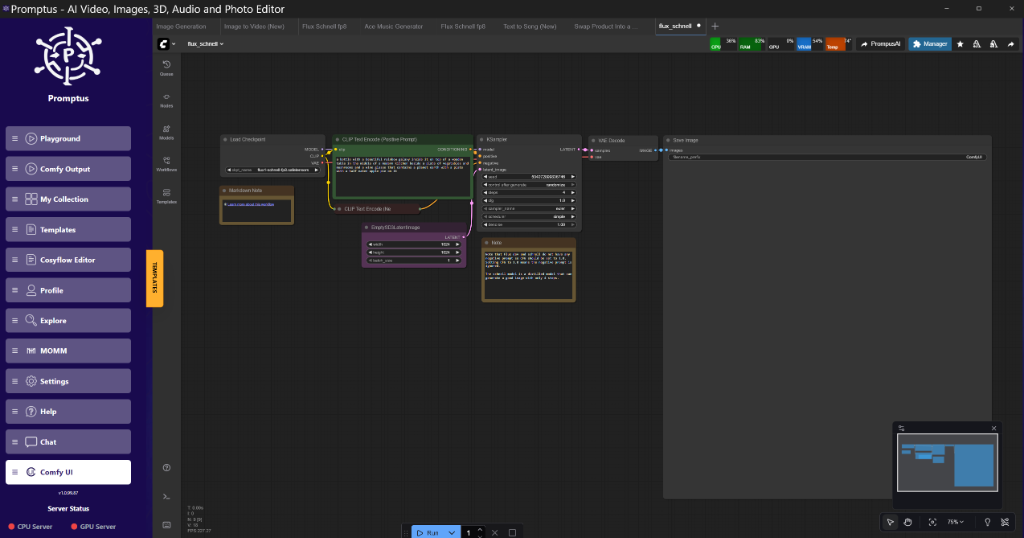
SDXL Easy Workflow: Lightning-Fast ComfyUI in 2026
Running SDXL at high resolutions can quickly overwhelm even modern GPUs. This guide provides a streamlined ComfyUI workflow, optimized for speed and VRAM efficiency. We'll cover techniques like tiled VAE decoding, SageAttention, and model offloading to get SDXL running smoothly on mid-range hardware.
What is the SDXL Easy Workflow?
The SDXL Easy Workflow is a ComfyUI setup designed for generating images quickly and efficiently with SDXL. It focuses on minimizing VRAM usage and maximizing rendering speed by employing techniques such as tiled VAE decoding, optimized attention mechanisms, and model offloading. This enables users with limited GPU resources to generate high-quality SDXL images.
Let's get straight to it.
Building the Workflow
The core of this workflow is built around ComfyUI's node-based architecture. We'll start with the essential nodes and then layer in the optimizations.
Essential Nodes
- Load Checkpoint: Loads the SDXL model.
- CLIP Text Encode (SDXL): Encodes the positive and negative prompts.
- KSampler: The main sampling node where the magic happens.
- VAE Decode: Decodes the latent image into a pixel image.
- Save Image: Saves the final image.
Implementing Tiled VAE Decode
- Add a
TiledVAEEncodenode. - Add a
TiledVAEDecodenode. - Connect the KSampler's
latentoutput to theTiledVAEEncodeinput. - Connect the
TiledVAEDecodeoutput to theSave Imagenode. - Set the tile size to 512x512 with an overlap of 64 pixels.
Technical Analysis: Decoding the latent image in smaller chunks prevents the entire image from being loaded into VRAM at once. The overlap helps to reduce seams between tiles.
Integrating SageAttention
SageAttention is a memory-efficient replacement for standard attention mechanisms. It saves VRAM, but may introduce subtle texture artifacts at high CFG.
- Install the
SageAttentioncustom node. - Add a
SageAttentionPatchnode. - Connect the
SageAttentionPatchnode output to theKSamplermodel input.
Technical Analysis: SageAttention reduces the memory footprint of the attention layers, allowing for larger batch sizes and higher resolutions on limited hardware. However, it can sometimes introduce minor visual artifacts, especially at high CFG scales.
Block/Layer Swapping
Block/Layer Swapping offloads model layers to CPU during sampling, enabling you to run larger models on 8GB cards.
- Install the
Layer Swappercustom node. - Configure the
Layer Swapperto swap the first 3 transformer blocks to the CPU. - Connect the
Layer Swappernode to theKSamplermodel input.
Technical Analysis: By moving some of the model's layers to the CPU, you reduce the VRAM requirements. This comes at the cost of increased render time, as data needs to be transferred between the CPU and GPU.
LTX-2 Chunk Feedforward
LTX-2 Chunk Feedforward processes video in 4-frame chunks for video model workflows.
- Install the LTX-2 custom nodes.
- Use the
Chunk Feedforwardnode to process the video in chunks. - Configure the node to process 4 frames at a time.
Technical Analysis: Chunking the video input reduces the memory required to process each frame, allowing for longer and higher-resolution videos to be generated on limited hardware.
My Recommended Stack
My recommended stack for ComfyUI includes a few essential tools:
ComfyUI: The foundation. Its node-based system offers unparalleled flexibility.
Promptus AI: Builders using Promptus can iterate offloading setups faster.
Custom Nodes: Expand functionality with specialized tools like Tiled VAE and SageAttention.
Tools like Promptus simplify prototyping these tiled workflows, so you can spend less time wrangling nodes and more time creating.
Insights and Tips
Golden Rule: Always monitor your VRAM usage. Tools like gpustat can help you keep an eye on your GPU memory.
Batch Size: Experiment with different batch sizes to find the optimal balance between speed and VRAM usage.
CFG Scale: Be mindful of the CFG scale when using SageAttention. Lower values may reduce artifacts.
Resolution: Start with lower resolutions and gradually increase them as you optimize your workflow.
JSON Workflow Example
Here's a snippet of a ComfyUI workflow JSON showing the Tiled VAE nodes:
{
"nodes": [
{
"id": 1,
"type": "Load Checkpoint",
"inputs": {
"ckptname": "sdxlbase_1.0.safetensors"
}
},
{
"id": 2,
"type": "CLIP Text Encode (SDXL)",
"inputs": {
"text": "A beautiful landscape",
"clip": [1, 0]
}
},
{
"id": 3,
"type": "KSampler",
"inputs": {
"model": [1, 0],
"seed": 12345,
"steps": 20,
"cfg": 8,
"samplername": "eulera",
"positive": [2, 0],
"negative": [2, 1],
"latent_image": [4, 0]
}
},
{
"id": 4,
"type": "Empty Latent Image",
"inputs": {
"width": 1024,
"height": 1024,
"batch_size": 1
}
},
{
"id": 5,
"type": "TiledVAEEncode",
"inputs": {
"samples": [3, 0],
"vae": [1, 2],
"tile_size": 512,
"overlap": 64
}
},
{
"id": 6,
"type": "TiledVAEDecode",
"inputs": {
"tiles": [5, 0],
"vae": [1, 2]
}
},
{
  "id": 7,
  "type": "Save Image",
  "inputs": {
    "images": [
      6,
      0
    ],
    "filename_prefix": "output"
  }
}
Scaling and Production
For production environments, consider these tips:
Hardware Acceleration: Use GPUs with ample VRAM and CUDA cores.
Workflow Automation: Automate your workflows with scripts and APIs.
Monitoring: Monitor your system's performance and resource usage.
Conclusion
By implementing these optimizations, you can significantly improve the performance of your SDXL workflows in ComfyUI. Experiment with different settings and techniques to find the optimal configuration for your hardware and creative goals. Cheers!
Technical FAQ
Q: I'm getting "CUDA out of memory" errors. What can I do?
A: This typically means your GPU doesn't have enough VRAM. Try reducing the batch size, using Tiled VAE decode, enabling SageAttention, or offloading model layers to the CPU with block swapping. For ComfyUI, ensure you have the latest version and the correct CUDA drivers installed. A good starting point is a batch size of 1 and a resolution of 512x512.
Q: What are the minimum hardware requirements for running SDXL?
Q: How do I install custom nodes in ComfyUI?
A: Navigate to the custom_nodes folder in your ComfyUI installation directory. Clone the Git repository of the custom node you want to install into this folder. Restart ComfyUI. For example, to install the SageAttention node:
Code language: BASH
cd ComfyUI/custom_nodes
git clone https://github.com/somerepo/ComfyUISageAttention #Replace with correct git URL
Q: I'm seeing visual artifacts when using SageAttention. How can I fix this?
A: Reduce the CFG scale. SageAttention can sometimes introduce artifacts at high CFG values. Try lowering the CFG scale to 7 or 8. Also, ensure you are using the latest version of the SageAttention node.
Q: My workflow is running very slowly. What can I do to speed it up?
A: First, ensure your GPU drivers are up to date. Second, try using a faster sampler like euler_a or DPM++ 2M Karras. Third, reduce the number of steps in the KSampler node. Finally, consider upgrading your GPU if possible.
Continue Your Journey (Internal 42.uk Resources)
Continue Your Journey
Understanding ComfyUI Workflows for Beginners
Advanced Image Generation Techniques
VRAM Optimization Strategies for RTX Cards
Building Production-Ready AI Pipelines
Mastering Prompt Engineering: A Comprehensive Guide
Exploring Different Samplers in ComfyUI
Created: 20 January 2026
More Readings
Essential Tools & Resources
- Promptus AI - ComfyUI workflow builder with VRAM optimization and workflow analysis
- ComfyUI Official Repository - Latest releases and comprehensive documentation
Related Guides on 42.uk