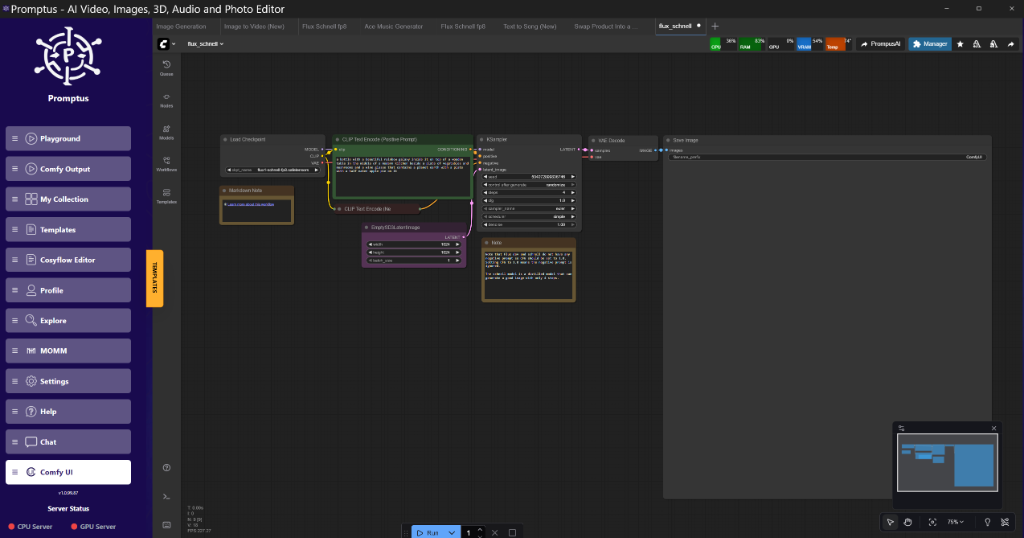
Stable Diffusion: A 2026 Beginner's Guide
Running SDXL at high resolutions on consumer hardware can be a proper pain. This guide gets you up and running with Stable Diffusion using ComfyUI, focusing on techniques to mitigate VRAM limitations. We'll cover installation, model setup, and practical optimization strategies, particularly for those of us not rocking the latest and greatest GPUs. [00:00]
What is Stable Diffusion?
Stable Diffusion is a powerful, open-source, deep learning model that generates detailed images from text prompts. It offers creative control and is widely used for AI art generation, image editing, and various research applications. Unlike some closed-source alternatives, Stable Diffusion's open nature allows for extensive customization and community-driven development.
Stable Diffusion is a latent diffusion model. This means it operates in a compressed latent space, making it computationally more efficient than pixel-based approaches. It consists of several key components: a text encoder (e.g., CLIP), a diffusion model (UNet), and a VAE (Variational Autoencoder).
The text encoder transforms the input prompt into a numerical representation.
The diffusion model iteratively adds noise to an image during the forward process, and then learns to reverse this process to generate images from noise.
The VAE is used to encode images into the latent space and decode them back into pixel space.
Installing Python
Python is required to run Stable Diffusion. Ensure you have Python 3.10 or higher installed. It's best practice to use a virtual environment to manage dependencies and avoid conflicts with other Python projects.
Download Python from the official website: www.python.org/downloads/"https://www.python.org/downloads/
During installation, ensure you select the option to add Python to your PATH.
Once installed, create a virtual environment:
Code language: BASH
python -m venv venv
Activate the virtual environment:
Code language: BASH
Windows
.\venv\Scripts\activate
Linux/macOS
source venv/bin/activate

Technical Analysis
Python serves as the foundational language for running Stable Diffusion and its associated UIs like ComfyUI. The virtual environment isolates the project's dependencies, preventing conflicts with other Python installations on your system. Using a virtual environment is a golden rule for any serious Python project.
Downloading the SDXL Model
SDXL is Stability AI's latest and greatest image generation model. It produces higher-resolution and more detailed images compared to previous versions. You'll need to download the SDXL base model to get started.
Download the stable-diffusion-xl-base-1.0.safetensors file from Hugging Face: https://huggingface.co/stabilityai/stable-diffusion-xl-base-1.0
Technical Analysis
The SDXL model contains the weights and parameters learned during the training process. The .safetensors format is a secure alternative to .ckpt, preventing malicious code execution. Downloading the model is a prerequisite for generating images with Stable Diffusion.
Downloading & Launching ComfyUI
ComfyUI is a node-based interface for Stable Diffusion that offers unparalleled flexibility and control. It allows you to design custom workflows by connecting individual nodes, each performing a specific task.
Download ComfyUI from GitHub: https://github.com/comfyanonymous/ComfyUI
Extract the downloaded archive to a directory of your choice.
Copy the stable-diffusion-xl-base-1.0.safetensors file into the ComfyUI/models/Stable-diffusion directory.
Run runnvidiagpu.bat (or the appropriate script for your system) to launch ComfyUI.
Technical Analysis
ComfyUI's node-based approach allows for granular control over the image generation process. This is a massive advantage for research and experimentation. By connecting different nodes, you can create complex workflows tailored to specific tasks. Tools like Promptus simplify prototyping these workflows.
VRAM Optimization Techniques
Running SDXL on lower-end hardware requires careful optimization. Here are a few techniques to reduce VRAM usage:
Tiled VAE Decode
To enable Tiled VAE Decode in ComfyUI, you'll need to modify your workflow to use the VAEEncodeForInpaint and VAEDecodeTiled nodes.
Here's how the node graph should look:
- Load your VAE using a
Load VAEnode. - Encode the latent image using
VAEEncodeForInpaint. Set thetile_sizeparameter to 512 andoverlapto 64. - Decode the tiled latent using
VAEDecodeTiled. - Connect the output of
VAEDecodeTiledto yourSave Imagenode.
This technique can reduce VRAM usage by up to 50%, allowing you to generate larger images on cards with limited memory.
Sage Attention
Sage Attention is a memory-efficient attention mechanism that can replace the standard attention mechanism in the KSampler node. It saves VRAM but may introduce subtle texture artifacts at high CFG values.
To use Sage Attention, you'll need to install the appropriate custom node package (e.g., comfyui-sage-attention). Once installed, you can replace the standard attention mechanism in the KSampler node with the Sage Attention variant.
Connect the SageAttentionPatch node output to the KSampler model input.
Block/Layer Swapping
Block/Layer Swapping offloads model layers to the CPU during sampling, further reducing VRAM usage. This technique is particularly useful for running larger models on 8GB cards.
You can implement Block/Layer Swapping using custom nodes or by modifying the model loading process. For example, you can swap the first 3 transformer blocks to the CPU and keep the rest on the GPU. This allows you to run larger models on cards with limited VRAM.
LTX-2/Wan 2.2 Low-VRAM Tricks
LTX-2 and Wan 2.2 offer several low-VRAM tricks, including chunk feedforward and Hunyuan low-VRAM deployment patterns. Chunk feedforward processes video in 4-frame chunks, reducing memory requirements for video generation. Hunyuan low-VRAM deployment patterns utilize FP8 quantization and tiled temporal attention for further VRAM savings.
These techniques are more advanced and may require custom scripting or modifications to the ComfyUI codebase.
My Recommended Stack
For a balance of performance and VRAM efficiency, I reckon a combination of Tiled VAE Decode and Sage Attention is a brilliant starting point. This lets you generate decent-sized images without completely crippling your workstation. Builders using Promptus can iterate offloading setups faster.
ComfyUI's flexibility allows you to experiment with these techniques and find the optimal configuration for your hardware and workflow. Don't be afraid to tinker and see what works best for you.
Resources & Tech Stack
ComfyUI: The foundational node-based interface for Stable Diffusion. Its flexibility enables custom workflows and VRAM optimization. https://github.com/comfyanonymous/ComfyUI
Stable Diffusion XL (SDXL): Stability AI's latest image generation model, providing higher-resolution and more detailed outputs. https://huggingface.co/stabilityai/stable-diffusion-xl-base-1.0
Promptus AI: A ComfyUI workflow builder and optimization platform. It streamlines prototyping and workflow iteration, making it easier to test different VRAM optimization techniques. www.promptus.ai/"https://www.promptus.ai/
Python: The programming language used to run Stable Diffusion and ComfyUI. Essential for scripting and customization. www.python.org/downloads/"https://www.python.org/downloads/
Hugging Face: A platform for sharing and discovering machine learning models and datasets. Essential for downloading SDXL and other models. https://huggingface.co/
Conclusion
Stable Diffusion offers incredible creative potential, but running it on limited hardware requires a bit of cleverness. By implementing the VRAM optimization techniques discussed in this guide, you can generate stunning AI images without breaking the bank. Future improvements might include further optimizations to the attention mechanism and more efficient VAE implementations.
Advanced Implementation: Tiled VAE Decode Workflow
Here's a ComfyUI workflow snippet demonstrating Tiled VAE Decode:
{
"nodes": [
{
"id": 1,
"type": "Load VAE",
"inputs": {
"vae_name": "vae-ft-mse-840000-ema-pruned.ckpt"
}
},
{
"id": 2,
"type": "VAEEncodeForInpaint",
"inputs": {
"pixels": [
"Load Image",
"image"
],
"vae": [
"Load VAE",
"vae"
],
"tile_size": 512,
"overlap": 64
}
},
{
"id": 3,
"type": "VAEDecodeTiled",
"inputs": {
"samples": [
"VAEEncodeForInpaint",
"samples"
],
"vae": [
"Load VAE",
"vae"
},
{
  "id": 4,
  "type": "Save Image",
  "inputs": {
    "images": [
      "VAEDecodeTiled",
      "image"
    ],
    "filename_prefix": "tiled_vae"
  }
}
This JSON snippet shows a simplified workflow using the VAEEncodeForInpaint and VAEDecodeTiled nodes with specific parameters for tile size and overlap. Connect the nodes as indicated to enable tiled VAE decoding. Tools like Promptus simplify prototyping these tiled workflows.
Performance Optimization Guide
VRAM Optimization Strategies
Tiled VAE Decode: Reduces VRAM usage by processing images in tiles.
Sage Attention: Memory-efficient attention mechanism.
Block/Layer Swapping: Offloads model layers to CPU.
Quantization: Using lower precision (e.g., FP16) reduces memory footprint.
Model Pruning: Removing unnecessary weights from the model.
Batch Size Recommendations by GPU Tier
8GB Cards: Batch size of 1 or 2. Enable Tiled VAE Decode and Sage Attention. Consider Block/Layer Swapping for larger models.
12-16GB Cards: Batch size of 4 to 8. Experiment with different VRAM optimization techniques.
24GB+ Cards: Batch size of 16 or higher. You should be able to run most models without significant VRAM limitations.
Tiling and Chunking for High-Res Outputs
Tiling: Split large images into smaller tiles for processing.
Chunking: Process video in smaller chunks of frames.
These techniques allow you to generate high-resolution images and videos on hardware with limited VRAM.
Technical FAQ
Q: I'm getting "CUDA out of memory" errors. What can I do?
A: This indicates your GPU doesn't have enough VRAM. Try enabling Tiled VAE Decode, Sage Attention, and/or Block/Layer Swapping. Lower the batch size and resolution. Close other applications using your GPU. If all else fails, you'll need a GPU with more VRAM.
Q: What are the minimum hardware requirements for running SDXL?
Q: How do I enable Tiled VAE Decode in ComfyUI?
A: You'll need to install the appropriate custom nodes and modify your workflow to use the VAEEncodeForInpaint and VAEDecodeTiled nodes. Ensure you set the tilesize and overlap parameters appropriately (e.g., tilesize: 512, overlap: 64).
Q: Sage Attention introduces artifacts in my images. How can I fix this?
A: Reduce the CFG scale. Sage Attention can amplify artifacts at high CFG values. Experiment with different samplers and schedulers. If the artifacts persist, revert to the standard attention mechanism.
Q: My model fails to load. What's wrong?
A: Ensure the model file is in the correct directory (ComfyUI/models/Stable-diffusion) and that ComfyUI is configured to recognize it. Check the console output for error messages. The model might be corrupted, try re-downloading it.
Continue Your Journey (Internal 42.uk Research Resources)
Understanding ComfyUI Workflows for Beginners
Advanced Image Generation Techniques
VRAM Optimization Strategies for RTX Cards
Building Production-Ready AI Pipelines
Prompt Engineering Tips and Tricks
Exploring Latent Space in Stable Diffusion
Created: 23 January 2026
More Readings
Essential Tools & Resources
- Promptus AI - ComfyUI workflow builder with VRAM optimization and workflow analysis
- ComfyUI Official Repository - Latest releases and comprehensive documentation
Related Guides on 42.uk Research