ComfyUI: Install & Optimize Stable Diffusion
SDXL at 1024x1024 can be a resource hog. This guide provides a practical, no-nonsense approach to installing and optimizing ComfyUI for Stable Diffusion, focusing on memory-saving techniques. We'll cover installation, basic usage, and advanced optimizations to get the most out of your hardware.
Installing ComfyUI
ComfyUI is a node-based interface for Stable Diffusion. It's installed by cloning the GitHub repository, installing dependencies, and optionally, downloading models. This provides a modular and customizable workflow for image generation.**
First, you'll need to clone the ComfyUI repository from GitHub:
Code language: BASH
git clone https://github.com/comfyanonymous/ComfyUI
cd ComfyUI
Next, install the required dependencies. It's highly recommended to create a virtual environment to avoid conflicts with other Python packages:
Code language: BASH
python -m venv venv
source venv/bin/activate # On Linux/macOS
venv\Scripts\activate.bat # On Windows
pip install -r requirements.txt
Optionally, if you have an NVIDIA GPU, install the CUDA toolkit for accelerated performance. This typically involves downloading and installing the appropriate CUDA version from NVIDIA's website and ensuring your CUDA_PATH environment variable is set correctly.

Technical Analysis
The base installation provides a functional environment, but its VRAM consumption can be problematic. Tiled VAE decoding reduces VRAM load by processing the image in smaller chunks, but introduces minor overhead. Sage Attention offers substantial VRAM savings with a slight performance hit and potential artifacts.
Basic ComfyUI Usage
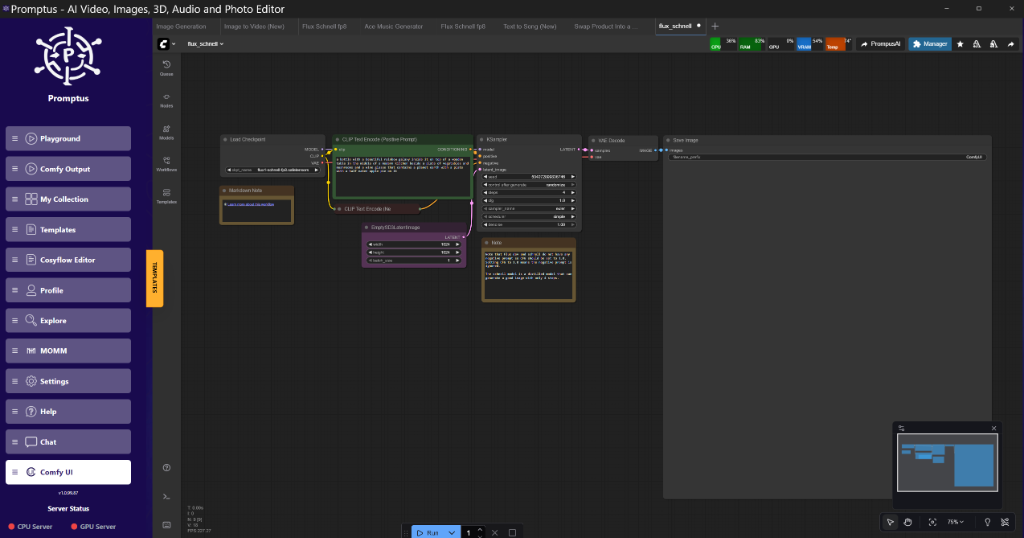
ComfyUI operates using a node graph. Each node performs a specific function, such as loading a model, sampling, or encoding/decoding the VAE. Connecting these nodes creates a workflow for image generation.**
ComfyUI works by connecting nodes together to form a workflow. You start with loading a model (e.g., SDXL), then you'll need nodes for:
Prompt Encoding:** Text to conditioning
Sampler:** KSampler is a common choice
VAE Decode:** Convert latent space back to an image
Save Image:** Output the final result
Connect the nodes logically: Load Checkpoint -> Prompt Encode -> KSampler -> VAE Decode -> Save Image. Experiment with different samplers (Euler, LMS, DPM++ 2M Karras) and adjust the CFG Scale and Steps in the KSampler for different effects.
Optimizing VRAM Usage
VRAM optimization is crucial for running larger models and resolutions on limited hardware. Techniques like Tiled VAE Decode, Sage Attention, and Block Swapping can significantly reduce VRAM consumption.**
Running out of VRAM is a common problem. Here are a few tricks to mitigate it:
Sage Attention:** Replace the standard attention mechanism in the KSampler with Sage Attention. This saves VRAM but may introduce subtle texture artifacts at high CFG scales. You'll need to install the SageAttention custom node. Then, insert a SageAttentionPatch node before the KSampler. Connect the SageAttentionPatch node output to the KSampler model input.
Block Swapping:** Offload model layers to CPU during sampling. This is a more aggressive approach for really tight VRAM situations. Experiment with swapping the first 3 transformer blocks to CPU, keeping the rest on the GPU.
Model Quantization:** Using FP16 or even FP8 versions of models can reduce VRAM footprint, though it might slightly impact quality.
Technical Analysis
Tiled VAE Decode and Sage Attention reduce peak VRAM usage, allowing for higher resolutions or more complex workflows. Block swapping is the most aggressive approach, trading off processing speed for reduced VRAM footprint. Model quantization offers a balance between VRAM usage and image quality.
Advanced Techniques for Video Generation
For video generation, techniques like Chunk Feedforward and Hunyuan Low-VRAM deployment can help manage VRAM and improve performance. These methods break down the video processing into smaller chunks, allowing for more efficient memory utilization.**
For video models, memory management becomes even more critical. Here are a couple of techniques:
LTX-2 Chunk Feedforward:** Process the video in 4-frame chunks. This involves modifying the model to process frames in smaller batches.
Hunyuan Low-VRAM Deployment:** This combines FP8 quantization with tiled temporal attention.
Workflow Examples
Let's look at an example of integrating SageAttention into a standard SDXL workflow. First, install the custom node that provides SageAttention. After installing the custom node, your ComfyUI install needs to be restarted. You can install custom nodes using the ComfyUI Manager.
{
"nodes": [
{
"id": 1,
"type": "Load Checkpoint",
"inputs": {
"ckptname": "sdxlbase_1.0.safetensors"
}
},
{
"id": 2,
"type": "Prompt Encode",
"inputs": {
"text": "A futuristic cityscape",
"conditioning": 1
}
},
{
"id": 3,
"type": "KSampler",
"inputs": {
"model": 1,
"seed": 12345,
"steps": 20,
"cfg": 8,
"samplername": "eulera",
"positive": 2,
"negative": 3,
"latent_image": 4
}
},
{
"id": 4,
"type": "VAE Decode",
"inputs": {