ComfyUI: Master AI Image Generation
Running SDXL at high resolutions often pushes even high-end GPUs to their limits. This guide dives into optimizing ComfyUI workflows for demanding tasks like text-to-image, image-to-image, and upscaling, covering installation, advanced techniques, and troubleshooting tips. This isn't a beginner's guide; we're assuming you're already familiar with the basics of ComfyUI and Stable Diffusion.
What is ComfyUI?
ComfyUI is a graph-based user interface for Stable Diffusion. It provides a modular and flexible environment for creating complex image generation workflows. Unlike simpler interfaces, ComfyUI allows for fine-grained control over every step of the process, from loading models to applying custom nodes and scripts.**
ComfyUI offers unparalleled control over the image generation pipeline. Its node-based system allows you to visualize and modify each step, making it ideal for experimentation and advanced workflows. This flexibility, however, comes with a steeper learning curve compared to simpler interfaces.

Installation
The first step is getting ComfyUI up and running. Installation is straightforward, but requires Git and Python. The ComfyUI GitHub repository (ComfyUI Official) provides detailed instructions for different operating systems [1:48].
Golden Rule: Always ensure you have the latest drivers for your GPU. Outdated drivers can cause performance issues and errors.
Once installed, you'll need to download the necessary models.
Downloading Models
Downloading models is essential to creating images in ComfyUI. Models are downloaded from sites like Civitai and Hugging Face. These models are then put in the correct folder inside ComfyUI for access within the node graph.**
ComfyUI doesn't come with pre-loaded models. You'll need to download them separately from sources like Civitai and Hugging Face [4:00]. Place the downloaded model files (typically .ckpt or .safetensors) in the ComfyUI/models/checkpoints directory. Similarly, VAE files go in ComfyUI/models/vae, and LoRA models go in ComfyUI/models/loras.
Text to Image
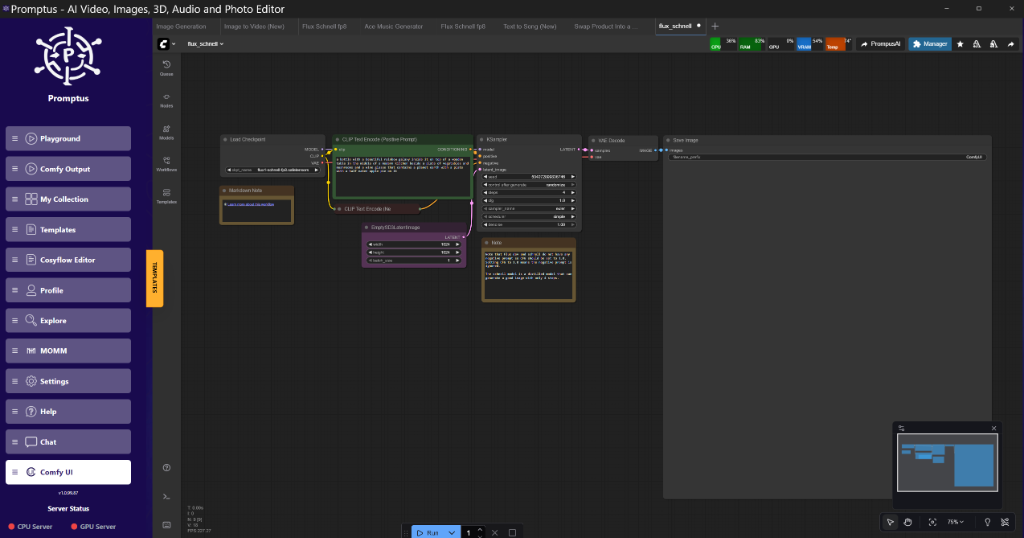
Text-to-image is a fundamental workflow in ComfyUI. It involves connecting nodes for loading a checkpoint, entering a prompt, sampling, decoding the image, and saving the output. By adjusting the parameters of each node, you can control the generation process.**
The basic text-to-image workflow involves several key nodes [7:25]:
- Load Checkpoint: Loads the Stable Diffusion model.
- CLIP Text Encode (Prompt): Encodes the positive and negative prompts.
- Empty Latent Image: Creates an empty latent space for the image.
- KSampler: Performs the sampling process, generating the latent image.
- VAE Decode: Decodes the latent image into a pixel image.
- Save Image: Saves the generated image.
Connect these nodes in the correct sequence, adjusting parameters like the sampler, scheduler, and CFG scale in the KSampler node. Experiment with different prompts and model checkpoints to see how they affect the output.
Navigation, Editing, and Shortcuts
Navigating and editing workflows in ComfyUI is made easier using shortcuts. These shortcuts will increase the speed of workflow development, and efficiency.**
ComfyUI offers several keyboard shortcuts to streamline workflow creation [21:30]:
Ctrl+C, Ctrl+V: Copy and paste nodes.
Ctrl+Shift+K: Queue prompt.
Ctrl+B: Bypass a node.
Double-click: Open node properties.
Drag and drop: Connect nodes.
Familiarize yourself with these shortcuts to improve your workflow efficiency.
Installing ComfyUI Manager & Git
Installing ComfyUI manager and Git is necessary for managing plugins and dependencies. The ComfyUI manager simplifies the process of installing, updating, and removing custom nodes and extensions. Git is required for downloading and managing the manager itself.**
The ComfyUI Manager simplifies the installation and management of custom nodes and extensions [26:15]. To install it, you'll need Git. Download Git from the official website and follow the installation instructions. Then, clone the ComfyUI Manager repository into the ComfyUI/custom_nodes directory.
Upscaling
Upscaling is the process of increasing the resolution of an image. In ComfyUI, you can upscale images using various techniques and models. Tiled upscaling is a commonly used technique to reduce VRAM usage when upscaling to extreme resolutions.**
Upscaling is crucial for enhancing the resolution and detail of generated images [28:43]. ComfyUI offers several upscaling methods, including:
Latent Upscale:** Upscales the latent image before decoding.
Image Upscale:** Upscales the decoded image.
Tile Upscaling:** Splits the image into tiles, upscales each tile separately, and then stitches them back together. This reduces VRAM usage.
For high-resolution upscaling, tile upscaling is generally preferred.
Image to Image
Image-to-image is a workflow that uses an existing image as a base for generating a new image. It involves encoding the input image into latent space, adding noise, and then guiding the denoising process with a prompt.**
Image-to-image allows you to transform existing images using Stable Diffusion [37:49]. The basic workflow involves:
- Load Image: Loads the input image.
- VAE Encode: Encodes the image into latent space.
- Add Noise: Adds noise to the latent image.
- KSampler: Performs the sampling process, guided by a prompt.
- VAE Decode: Decodes the latent image into a pixel image.
- Save Image: Saves the generated image.
Adjust the amount of noise added to control the degree of transformation.
Tile Upscaling
Tiled upscaling is a technique for upscaling images in smaller chunks, or tiles, to reduce memory usage. This allows you to upscale images to very high resolutions without running out of VRAM. The overlap between tiles helps to reduce seams.**
ControlNet
ControlNet is a neural network structure that adds extra control to diffusion models. It allows you to guide the image generation process based on various inputs, such as edge maps, depth maps, and pose estimations. In ComfyUI, ControlNet is implemented through custom nodes that can be integrated into your workflows.**
ControlNet provides additional control over the image generation process, allowing you to guide the output based on various inputs [51:53]. Common ControlNet applications include:
Canny Edge Detection:** Generates images based on the edges in an input image.
Depth to Image:** Generates images based on the depth map of an input image.
Pose Estimation:** Generates images based on the pose of a person in an input image.
To use ControlNet, you'll need to download the appropriate ControlNet models and load them into the ControlNet nodes.
Faceswap & Installing Other Plugins
Faceswap involves replacing the face in an image with another face. In ComfyUI, this can be achieved using custom nodes and models. You can also install a variety of other plugins to add new functionality to ComfyUI.**
Faceswap allows you to