Code language: MARKDOWN
Unleash AI Video Magic: Install Wan 2.1 Locally on Your PC with Promptus (8GB VRAM Guide)
The world of AI is rapidly evolving, and one of the most exciting advancements is the ability to generate high-quality videos from text, images, and even audio. Imagine turning your creative ideas into stunning visuals without needing expensive equipment or a team of video editors. That dream is now a reality with Wan 2.1, a powerful AI video model, and Promptus, a user-friendly platform designed to make AI video generation accessible to everyone.
This comprehensive guide will walk you through the process of installing and running Wan 2.1 locally on your PC using Promptus, even with a modest 8GB VRAM GPU. We'll cover everything from downloading and setting up Promptus to configuring ComfyUI and utilizing custom nodes to achieve breathtaking results. Get ready to transform your ideas into captivating AI videos!
Why Wan 2.1 and Promptus are Game Changers
Before diving into the installation process, let's understand why Wan 2.1 and Promptus are making waves in the AI video generation space.
Wan 2.1: Democratizing AI Video Creation
Wan 2.1 represents a significant leap forward in AI video models. It's designed to be more accessible, allowing users with consumer-grade GPUs to generate impressive videos. Here's what makes it stand out:
- Text-to-Video: Simply provide a text prompt, and Wan 2.1 will generate a video that matches your description.
- Image-to-Video: Use an existing image as a starting point and guide the AI to create a dynamic video based on the image's content and style.
- Audio-to-Video: Generate videos that are synchronized with audio input, opening up possibilities for music videos, animations, and more.
- Optimized for Consumer GPUs: While powerful AI models often require expensive, high-end hardware, Wan 2.1 is designed to run effectively on PCs with 8GB VRAM, making it accessible to a wider audience.
Promptus: The User-Friendly Interface for AI Video Generation
While Wan 2.1 provides the AI power, Promptus provides the user-friendly interface that makes it easy to harness that power. Think of it as the bridge between complex AI algorithms and your creative vision. Here's why Promptus is essential:
- Simplified Workflow: Promptus streamlines the entire AI video generation process, from setting up the environment to configuring the model and generating the final video.
- ComfyUI Integration: Promptus seamlessly integrates with ComfyUI, a powerful node-based interface for creating complex AI workflows. This allows you to customize and fine-tune your video generation process to achieve specific results.
- Custom Node Support: Promptus supports custom nodes, allowing you to extend its functionality and integrate with other AI tools and models.
- Beginner-Friendly: Even if you're new to AI video generation, Promptus provides a clear and intuitive interface that makes it easy to get started.
System Requirements and Preparation
Before you begin the installation process, ensure your system meets the following requirements:
- Operating System: Windows (Recommended)
- Storage: At least 50GB of free disk space (for models, dependencies, and output videos)
- Python: Python 3.10 or higher installed.
- Internet Connection: Required for downloading Promptus, models, and dependencies.
Preparing Your System:
- Install Python: If you don't have Python installed, download it from the official Python website (https://www.python.org/downloads/). Make sure to select the option to add Python to your PATH during installation. This is crucial for running many of the scripts later.
- Update GPU Drivers: Ensure you have the latest NVIDIA drivers installed for your GPU. You can download them from the NVIDIA website (https://www.nvidia.com/Download/index.aspx). Outdated drivers can lead to performance issues and errors.
- Create a Dedicated Folder: Create a folder on your hard drive where you will install Promptus and store your AI video projects. This will help keep your files organized. For example,
C:\AI_Video.
Step-by-Step Installation Guide: Wan 2.1 with Promptus
Now, let's dive into the detailed installation process. Follow these steps carefully to ensure a smooth setup.
Step 1: Downloading and Installing Promptus
- Download Promptus: Visit the Promptus website (https://www.promptus.ai/download) and download the latest version of Promptus. Choose the version compatible with your operating system.
- Extract the Archive: Once the download is complete, extract the contents of the downloaded archive (usually a .zip or .rar file) to the dedicated folder you created earlier (e.g.,
C:\AI_Video). - Run the Installer: Inside the extracted folder, you should find an executable file (e.g.,
PromptusInstaller.exeor similar). Run this file to start the Promptus installation process. - Follow the On-Screen Instructions: The installer will guide you through the installation process. Accept the license agreement and choose the installation directory (it's recommended to use the default location).
- Launch Promptus: Once the installation is complete, launch Promptus from the desktop shortcut or the Start Menu.
Step 2: Configuring Promptus and Installing Dependencies
- Initial Setup: The first time you launch Promptus, it may prompt you to configure certain settings or install necessary dependencies. Follow the on-screen instructions to complete these initial steps. This might include setting the path to your Python installation.
- Dependency Installation: Promptus will likely need to install several Python packages and libraries required for running Wan 2.1 and ComfyUI. This process can take some time, depending on your internet connection speed. Be patient and allow the installation to complete. Pay attention to the console output for any errors. If you encounter errors, try running Promptus as administrator.
- ComfyUI Integration: Promptus is built around ComfyUI. Verify that ComfyUI is properly integrated within the Promptus environment. You should be able to access ComfyUI directly from the Promptus interface.
Step 3: Downloading the Wan 2.1 Model
- Locate the Wan 2.1 Model: The Wan 2.1 model is not typically included directly in the Promptus installation due to its large size. You'll need to download it separately. Refer to the Promptus documentation (www.promptus.ai/blog/wan-2-1-locally-on-pc) for the specific download links and instructions. The documentation will provide the most up-to-date information.
- Download the Model Files: Download all the necessary model files from the provided links. These files are usually in a
.ckptor.safetensorsformat. - Place the Model Files in the Correct Directory: Promptus will have a specific directory where it expects to find the Wan 2.1 model files. This directory is typically within the Promptus installation folder, often under a "models" or "checkpoints" subdirectory. The Promptus documentation (www.promptus.ai/blog/wan-2-1-locally-on-pc) will specify the exact location. Place the downloaded model files in this directory.
Step 4: Configuring ComfyUI for Wan 2.1
- Launch ComfyUI from Promptus: Open ComfyUI through the Promptus interface. This ensures that ComfyUI is running within the Promptus environment and has access to the necessary dependencies.
- Load the Wan 2.1 Workflow: Promptus may provide a pre-configured ComfyUI workflow specifically designed for Wan 2.1. Look for a workflow file (usually a
.jsonfile) in the Promptus installation folder or on the Promptus website. Load this workflow into ComfyUI. If a workflow is not provided, you may need to build one yourself (see the section on "Building a Simple Wan 2.1 Workflow in ComfyUI" below). - Adjust Settings: Once the workflow is loaded, you may need to adjust certain settings to optimize performance and image quality. Pay attention to the following settings:
- Batch Size: Reduce the batch size to 1 if you have limited VRAM (8GB). Increasing the batch size can improve performance but requires more VRAM.
- Resolution: Start with a lower resolution (e.g., 512x512) and gradually increase it as needed. Higher resolutions require more VRAM.
- Number of Steps: The number of steps determines how much detail is generated in the video. A higher number of steps generally results in better quality but takes longer to generate.
- Scheduler: Experiment with different schedulers (e.g., DDIM, PNDM) to find the one that works best for your GPU and desired output.
- Checkpoint: Ensure that the Wan 2.1 model you downloaded is selected as the checkpoint in the workflow.
Step 5: Installing and Using Custom Nodes (Optional but Recommended)
Custom nodes can significantly enhance the functionality of ComfyUI and allow you to achieve more complex and creative results.
- Identify Useful Custom Nodes: Research and identify custom nodes that are relevant to AI video generation and Wan 2.1. Some popular custom nodes include:
- ControlNet: For precise control over the generated video based on input images or sketches.
- Reactor: For face swapping and identity manipulation.
- AnimateDiff: For creating smooth animations and video transitions.
- Video Helper Suite: For video editing and processing tasks within ComfyUI.
- Install Custom Nodes: The installation process for custom nodes varies depending on the node. Most custom nodes are available on GitHub. Typically, you'll need to clone the GitHub repository for the node into the
custom_nodesdirectory within your ComfyUI installation folder. Promptus may have a dedicated interface for installing custom nodes, so check the documentation. - Restart ComfyUI: After installing custom nodes, restart ComfyUI to ensure they are properly loaded.
- Integrate Custom Nodes into Your Workflow: Once the custom nodes are installed, you can add them to your ComfyUI workflow and connect them to other nodes to create complex and customized video generation pipelines.
Step 6: Generating Your First AI Video
- Enter Your Prompt: In the ComfyUI workflow, locate the text prompt node and enter your desired text prompt. Be as specific as possible to guide the AI in generating the desired video. For example, "A futuristic cityscape with flying cars and neon lights."
- Configure Input Images (Optional): If you want to use an image as a starting point, load it into the appropriate image input node in the workflow.
- Run the Workflow: Click the "Queue Prompt" button in ComfyUI to start the video generation process.
- Monitor Progress: ComfyUI will display the progress of the video generation process. This can take anywhere from a few minutes to several hours, depending on the complexity of the workflow, the resolution of the video, and the speed of your GPU.
- View the Output Video: Once the video generation is complete, the output video will be saved to the output directory specified in the workflow. You can then view the video and share it with others.
Practical Examples and Tips
To help you get started, here are some practical examples and tips for generating amazing AI videos with Wan 2.1 and Promptus:
Example 1: Creating a Looping Animation of a Cat
- Prompt: "A cute cartoon cat walking in a park, looping animation."
- Workflow: Use a basic text-to-video workflow with a relatively low resolution (e.g., 512x512) and a moderate number of steps (e.g., 50).
- Custom Nodes (Optional): Consider using the AnimateDiff custom node to create a smoother and more seamless looping animation.
- Tips: Experiment with different cat breeds and park settings to create variations of the animation.
Example 2: Turning a Photo into a Dynamic Video
- Image Input: Upload a photo of a landscape (e.g., a mountain range).
- Prompt: "Make the clouds move faster and add a subtle breeze to the trees, cinematic."
- Workflow: Use an image-to-video workflow with ControlNet to guide the animation based on the input image.
- Tips: Use ControlNet to specify which areas of the image should be animated (e.g., clouds, trees).
Example 3: Generating a Music Video Based on an Audio Track
- Audio Input: Upload an audio track of your favorite song.
- Prompt: "Abstract visuals synchronized with the music, vibrant colors, psychedelic."
- Workflow: Use an audio-to-video workflow that analyzes the audio and generates visuals that are synchronized with the music's rhythm and intensity.
- Custom Nodes (Optional): Explore custom nodes that specialize in audio-reactive visual effects.
- Tips: Experiment with different visual styles and colors to create a unique and captivating music video.
Tips for Optimizing Performance with 8GB VRAM:
- Lower Resolution: Start with a lower resolution (e.g., 512x512) and gradually increase it as needed.
- Reduce Batch Size: Set the batch size to 1.
- Optimize VRAM Usage: Monitor your VRAM usage and close any unnecessary applications that may be consuming VRAM.
- Use Efficient Schedulers: Experiment with different schedulers to find the one that uses VRAM most efficiently.
- Enable xFormers: xFormers is a library that can significantly improve the performance of Stable Diffusion and other AI models. Check the Promptus documentation for instructions on how to enable xFormers.
- Use a Virtual Environment: Using a virtual environment for your Python dependencies can help prevent conflicts and improve performance.
- Consider Cloud GPUs: If local performance is consistently poor, consider using cloud-based GPU services like Google Colab or RunPod for faster processing. These services offer powerful GPUs for a fee.
Building a Simple Wan 2.1 Workflow in ComfyUI (If a Pre-Built Workflow Isn't Available)
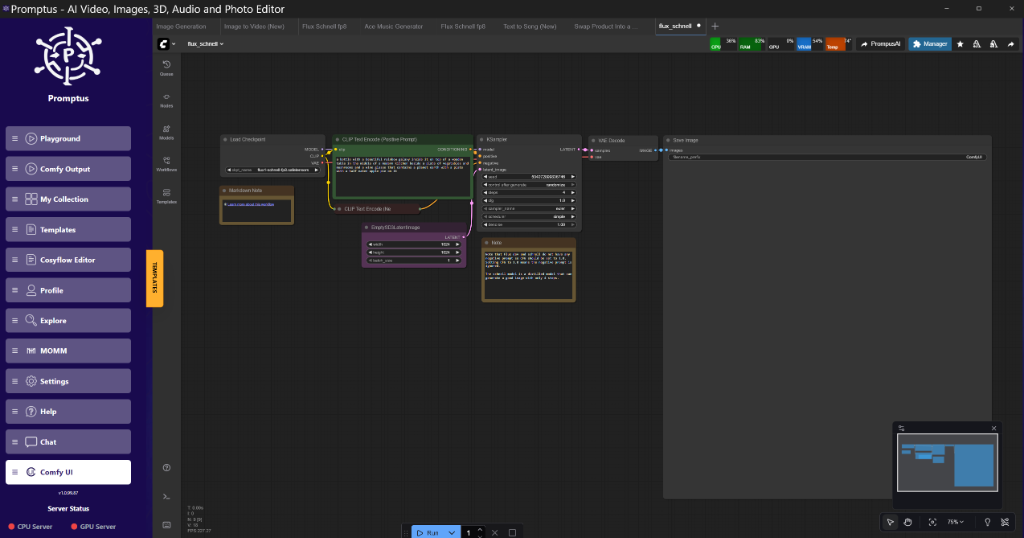
If Promptus doesn't provide a pre-built workflow for Wan 2.1, you'll need to create one yourself in ComfyUI. Here's a basic workflow you can use as a starting point:
- Load Checkpoint: Add a "Load Checkpoint" node and select the Wan 2.1 model file you downloaded.
- Text Prompt: Add two "CLIP Text Encode (SD1.5)" nodes. One for the positive prompt and one for the negative prompt. Connect the CLIP output from the "Load Checkpoint" node to the CLIP input of both text prompt nodes.
- Sampler: Add a "KSampler" node. Connect the model output from the "Load Checkpoint" node to the MODEL input of the KSampler. Connect the positive and negative CLIP outputs from the text prompt nodes to the POSITIVE and NEGATIVE inputs of the KSampler, respectively.
- Empty Latent Image: Add an "Empty Latent Image" node. Configure the width, height, and batch size. Connect the LATENT output of this node to the LATENT input of the KSampler.
- VAE Decode: Add a "VAE Decode" node. Connect the SAMPLES output of the KSampler to the SAMPLES input of the VAE Decode node. Connect the VAE output from the "Load Checkpoint" node to the VAE input of the VAE Decode node.
- Save Image: Add a "Save Image" node. Connect the IMAGE output of the VAE Decode node to the IMAGE input of the Save Image node.
- Configure the KSampler: In the KSampler node, configure the following settings:
steps: Number of diffusion steps.cfg: Classifier-Free Guidance scale.sampler_name: Choose a sampler (e.g., Euler a, DPM++ 2M Karras).scheduler: Choose a scheduler (e.g., normal, karras).denoise: Denoising strength.
This is a very basic workflow. You can expand upon it by adding custom nodes, ControlNet, and other features to create more complex and customized video generation pipelines.
Troubleshooting Common Issues
Even with careful setup, you might encounter some issues. Here are some common problems and their solutions:
- CUDA Out of Memory Error: This error indicates that your GPU is running out of VRAM. Try reducing the resolution, batch size, or number of steps. Also, make sure you've closed any unnecessary applications that are consuming VRAM.
- Missing Dependencies: If you encounter errors related to missing Python packages, try running
pip install -r requirements.txtin the Promptus or ComfyUI directory. Check the Promptus documentation for arequirements.txtfile or a list of required dependencies. - Model Not Found: Double-check that you have downloaded the Wan 2.1 model files and placed them in the correct directory. Verify that the path to the model is correctly configured in the ComfyUI workflow.
- Slow Performance: AI video generation is computationally intensive. If you're experiencing slow performance, try optimizing your workflow, reducing the resolution, or upgrading your GPU.
- Black or Glitched Output: This can be caused by various factors, including incorrect settings, corrupted model files, or driver issues. Try adjusting the settings in the ComfyUI workflow, re-downloading the model files, or updating your GPU drivers.
Staying Updated and Expanding Your Knowledge
The field of AI video generation is constantly evolving. To stay updated and expand your knowledge, consider the following:
- Follow Promptus on Social Media: Follow Promptus on Twitter (https://x.com/promptus_ai) and Instagram (https://www.instagram.com/promptus.ai/) for the latest news, updates, and tutorials.
- Subscribe to Relevant YouTube Channels: Subscribe to YouTube channels like the one mentioned in the original content (https://www.youtube.com/@ClaudiaIbetPerez) that provide tutorials and insights on AI video generation.
- Join AI Communities: Join online communities and forums dedicated to AI art and video generation. These communities are a great place to ask questions, share your work, and learn from others.
- Read Research Papers: If you want to delve deeper into the technical aspects of AI video generation, read research papers on the latest advancements in the field.
Conclusion: Embrace the Future of AI Video Creation
Congratulations! You've successfully installed Wan 2.1 locally on your PC using Promptus and are now ready to embark on your AI video creation journey. While the initial setup may seem daunting, the power and creative possibilities that Wan 2.1 and Promptus unlock are truly remarkable. With a little experimentation and practice, you'll be able to generate stunning AI videos that bring your ideas to life.
Remember to leverage the resources provided by Promptus, explore custom nodes, and stay updated with the latest advancements in the field. Don't be afraid to experiment and push the boundaries of what's possible.
Ready to start creating amazing AI videos?
- Download Promptus: https://www.promptus.ai/download
- Visit the Wan 2.1 Documentation: www.promptus.ai/blog/wan-2-1-locally-on-pc
- Hit like, subscribe, and ring the bell on the tutorial channel to stay updated with the latest AI video tips and tricks!
Let's create something amazing together!
📚 Explore More Articles
Discover more AI tutorials, ComfyUI workflows, and research insights
Browse All Articles →