Code language: MARKDOWN
What ComfyUI Is Really Used For: Unleashing AI Creation with Workflows
The world of Artificial Intelligence (AI) is rapidly evolving, and with it, the tools that empower creators are becoming more accessible and powerful. Among these tools, ComfyUI stands out as a node-based visual programming interface that's revolutionizing how we approach AI-driven content creation. But what is ComfyUI really used for? It's more than just another Stable Diffusion interface; it's a versatile platform that opens doors to generating images, editing them with inpainting, crafting compelling videos, and even venturing into the realm of 3D modeling. This comprehensive guide will delve deep into the capabilities of ComfyUI, exploring its core functionalities, popular workflows, and how platforms like Promptus are making it easier than ever to get started.
The Power of Node-Based AI: Understanding ComfyUI's Core
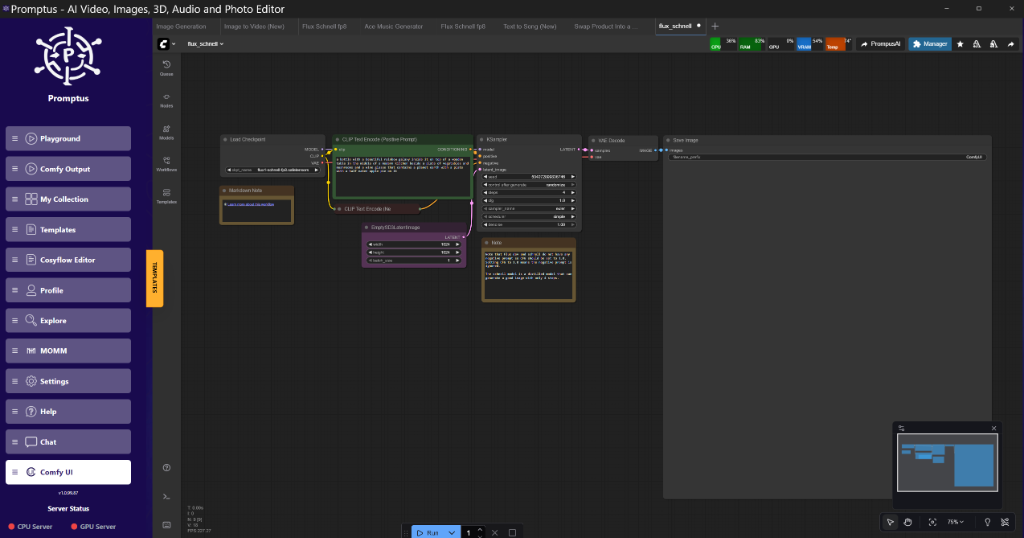
ComfyUI operates on a node-based system. Think of it like a visual programming language where each node represents a specific function or operation. These nodes are connected to form workflows, which are essentially recipes or blueprints for AI creation. This modular approach provides unparalleled flexibility and control compared to traditional, monolithic AI interfaces. Instead of being limited to pre-defined options, you can customize and combine different AI models, image processing techniques, and parameters to achieve precisely the results you desire.
Imagine building with Lego blocks. Each block is a node, and you connect them in different ways to create various structures. ComfyUI works similarly. One node might load a Stable Diffusion model, another might handle text prompts, a third might apply a specific upscaling algorithm, and a fourth might save the resulting image. By connecting these nodes in a specific sequence, you define the entire AI creation process.
This node-based approach offers several key advantages:
- Flexibility: Adapt and customize workflows to suit your specific needs. Experiment with different models, parameters, and techniques without being constrained by rigid interfaces.
- Control: Fine-tune every aspect of the AI creation process, from the initial prompt to the final output.
- Transparency: Understand exactly how the AI is generating content by visualizing the flow of data through the nodes.
- Extensibility: Easily integrate new models, functionalities, and custom nodes to expand ComfyUI's capabilities.
- Reproducibility: Share and reproduce workflows with others, ensuring consistent results.
ComfyUI in Action: Popular Workflows and Practical Examples
ComfyUI's versatility makes it suitable for a wide range of applications. Here are some of the most popular workflows and practical examples of how ComfyUI is being used:
1. High-Quality Text-to-Image Generation with ComfyUI SDXL
Text-to-image generation is arguably the most popular application of AI, and ComfyUI shines in this area. The ComfyUI SDXL workflow leverages the power of Stable Diffusion XL (SDXL), a state-of-the-art text-to-image model, to produce stunningly detailed and realistic images from text prompts.
How it works:
This workflow typically involves several key nodes:
- Load Checkpoint: Loads the SDXL model.
- Text Prompt (Positive): Defines the desired content of the image (e.g., "A futuristic cityscape at sunset, highly detailed, cyberpunk").
- Text Prompt (Negative): Specifies elements to avoid in the image (e.g., "blurry, distorted, low quality").
- Sampler: Generates the image based on the prompt, model, and other parameters like CFG scale and sampling steps.
- VAE Decode: Decodes the latent image representation into a visible image.
- Save Image: Saves the generated image to your computer.
Practical Example:
Let's say you want to create an image of a "majestic dragon soaring through a stormy sky." You would enter this prompt into the "Text Prompt (Positive)" node. You might also add "blurry, cartoonish" to the "Text Prompt (Negative)" node to ensure a realistic and detailed dragon. By adjusting the parameters of the Sampler node, such as the number of sampling steps and the CFG scale (which controls how closely the image adheres to the prompt), you can fine-tune the final result.
Why ComfyUI SDXL is powerful:
ComfyUI SDXL allows for granular control over the image generation process, enabling you to achieve results that are difficult or impossible to obtain with simpler AI interfaces. You can experiment with different samplers, schedulers, and noise settings to create unique and visually appealing images.
2. Upscaling Workflows for Sharper Details
Often, AI-generated images can lack sharpness and detail, especially when generating at lower resolutions. Upscaling workflows in ComfyUI address this issue by increasing the resolution of an image while preserving or even enhancing its details.
How it works:
Upscaling workflows typically involve these nodes:
- Load Image: Loads the image you want to upscale.
- Upscale Model: Loads an upscaling model, such as RealESRGAN or SwinIR, which are specifically trained to enhance image details during upscaling.
- Upscale: Applies the upscaling model to the image, increasing its resolution.
- Save Image: Saves the upscaled image.
Practical Example:
Imagine you've generated a beautiful landscape image with SDXL, but it looks a bit blurry at its original resolution of 512x512 pixels. You can load this image into an upscaling workflow and use a model like RealESRGAN to upscale it to 2048x2048 pixels. The upscaling model will analyze the image and add realistic details, making it sharper and more visually appealing.
Benefits of ComfyUI Upscaling:
ComfyUI allows you to choose from a variety of upscaling models and adjust their parameters to achieve the desired level of detail enhancement. You can also chain multiple upscaling nodes together to further refine the image.
3. Inpainting & Outpainting for Targeted Edits
Inpainting and outpainting are powerful techniques that allow you to selectively edit or extend existing images. Inpainting involves filling in missing or unwanted parts of an image, while outpainting expands the image beyond its original boundaries.
How it works:
These workflows typically include:
- Load Image: Loads the image you want to edit.
- Masking: Defines the area you want to inpaint or outpaint. This can be done manually or using AI-powered masking tools.
- Text Prompt: Provides a description of what you want to fill in or extend the masked area with.
- Inpaint/Outpaint Node: Uses a Stable Diffusion model to generate the content for the masked area, blending it seamlessly with the rest of the image.
- Save Image: Saves the edited image.
Practical Example:
Let's say you have a photo of a room, and you want to replace an old sofa with a modern one. You would load the image into ComfyUI, create a mask around the existing sofa, and then use a text prompt like "modern minimalist sofa, leather, grey" to describe the new sofa. The inpainting node will then generate a realistic-looking sofa that seamlessly integrates into the room.
For outpainting, imagine you have a portrait photograph, and you want to extend the background to create a wider scene. You would load the image, create a mask around the edges of the image, and then use a text prompt like "a lush forest, dappled sunlight" to describe the new background. The outpainting node will then generate a realistic-looking forest that extends the original image.
Advantages of ComfyUI Inpainting/Outpainting:
ComfyUI provides precise control over the inpainting and outpainting process, allowing you to achieve seamless and realistic edits. You can experiment with different prompts, masking techniques, and blending options to create the perfect result.
4. Video Generation with AnimateDiff and Wan 2.2
While ComfyUI is primarily known for image generation, it can also be used to create compelling videos using tools like AnimateDiff and Wan 2.2. These tools leverage Stable Diffusion to generate individual frames and then stitch them together to create animations.
How it works:
Video generation workflows typically involve:
- Load Checkpoint: Loads a Stable Diffusion model.
- Text Prompt: Defines the content of the video.
- AnimateDiff/Wan 2.2 Nodes: Generates a sequence of images based on the prompt and a motion model. These nodes control the animation style and movement within the video.
- Video Encoder: Encodes the sequence of images into a video file.
Practical Example:
Let's say you want to create a video of a "robot dancing in a futuristic city." You would enter this prompt into the "Text Prompt" node. The AnimateDiff or Wan 2.2 nodes would then generate a series of images, each depicting the robot in a slightly different pose, creating the illusion of movement. The video encoder would then stitch these images together to create a video.
Challenges and Opportunities:
Video generation with ComfyUI is still a relatively new and evolving area, and it can be computationally intensive. However, it offers exciting possibilities for creating unique and personalized animations. As AI models and hardware continue to improve, video generation with ComfyUI is likely to become even more accessible and powerful.
5. Exploring 3D with Hunyuan ComfyUI
ComfyUI is not limited to 2D images and videos; it can also be used for 3D projects. Hunyuan ComfyUI is a specialized workflow that allows you to generate 3D models and scenes using AI.
How it works:
Hunyuan ComfyUI typically uses:
- Load Checkpoint: Loads a 3D-aware AI model.
- Text Prompt: Describes the 3D object or scene you want to create.
- 3D Generation Nodes: Generate a 3D model based on the prompt.
- Rendering Nodes: Render the 3D model into a 2D image or video.
Practical Example:
Imagine you want to create a 3D model of a "stylized alien spaceship." You would enter this prompt into the "Text Prompt" node. The 3D generation nodes would then generate a 3D model of the spaceship, which you could then render from different angles to create images or videos.
The Future of 3D AI:
3D AI is a rapidly developing field, and ComfyUI provides a flexible platform for experimenting with different 3D generation techniques. As AI models become more sophisticated, we can expect to see even more impressive 3D creations generated with ComfyUI.
6. Advanced Image Generation with Flux
For those seeking the highest quality AI image results, Flux offers an advanced image generation workflow in ComfyUI. Flux leverages specialized models and techniques to produce images with exceptional detail, realism, and artistic flair.
How it works:
Flux workflows typically incorporate:
- Specialized Models: Utilizes cutting-edge Stable Diffusion models optimized for specific styles or subjects.
- Advanced Samplers: Employs sophisticated sampling algorithms to generate images with greater precision and detail.
- Post-Processing Techniques: Includes nodes for enhancing image quality through techniques like sharpening, color correction, and noise reduction.
Practical Example:
If you want to create a hyper-realistic portrait with incredibly detailed skin texture and lighting, you would use a Flux workflow with a specialized portrait model and advanced sampling techniques. The resulting image would be significantly more detailed and realistic than what you could achieve with a standard SDXL workflow.
Reaching New Heights of Image Quality:
Flux represents the cutting edge of AI image generation, pushing the boundaries of what's possible with ComfyUI. It's ideal for artists and designers who demand the highest level of quality and control.
Promptus: Simplifying Your ComfyUI Journey
While ComfyUI offers immense power and flexibility, it can also be daunting for beginners. Setting up ComfyUI, installing the necessary models, and finding the right workflows can be a time-consuming and confusing process. This is where platforms like Promptus come in.
Promptus simplifies the ComfyUI experience by providing:
- One-Click ComfyUI Setup: Installs and configures ComfyUI with a single click, eliminating the need for manual installation and configuration.
- Built-in ComfyUI Manager: Provides easy access to the ComfyUI Manager, allowing you to install servers and models directly from within the Promptus interface.
- Cosyflows: Offers a library of pre-built ComfyUI workflows, making it easy to get started with different AI creation tasks.
- Offline Functionality: Bundles everything you need to run ComfyUI offline on your PC, so you don't have to rely on an internet connection.
With Promptus, you can focus on creating instead of struggling with technical details. It's the perfect solution for anyone who wants to unlock the power of ComfyUI without the hassle.
Getting Started with ComfyUI and Promptus
Here's a step-by-step guide to getting started with ComfyUI using Promptus:
- Download and Install Promptus: Visit the Promptus website (https://www.promptus.ai) and download the Promptus installer. Follow the on-screen instructions to install Promptus on your computer.
- One-Click ComfyUI Setup: Launch Promptus and click the "Install ComfyUI" button. Promptus will automatically download and configure ComfyUI for you.
- Explore Cosyflows: Browse the Cosyflows library to find pre-built workflows for different AI creation tasks, such as text-to-image generation, upscaling, and inpainting.
- Customize Workflows: Modify the pre-built workflows to suit your specific needs. Experiment with different prompts, models, and parameters to achieve the desired results.
- Install Models: Use the built-in ComfyUI Manager to install the necessary models for your chosen workflows.
- Start Creating: Run your workflows and start generating amazing AI-powered content!
Conclusion: The Future of AI Creation is in Your Hands
ComfyUI is a powerful and versatile tool that's revolutionizing the way we create with AI. Its node-based system provides unparalleled flexibility and control, allowing you to fine-tune every aspect of the AI creation process. Whether you're generating images, editing them with inpainting, creating videos, or exploring 3D modeling, ComfyUI offers the tools and capabilities you need to bring your creative visions to life.
Platforms like Promptus are making ComfyUI more accessible than ever before, simplifying the setup process and providing a library of pre-built workflows to get you started quickly. As AI models and hardware continue to improve, the possibilities for AI creation with ComfyUI are virtually limitless.
The future of AI creation is in your hands. Embrace the power of ComfyUI and unlock your creative potential.
Ready to start your ComfyUI journey?
- Try Promptus: https://www.promptus.ai
- Learn how to install ComfyUI: https://www.youtube.com/watch?v=iifmTkN7LOg
- Subscribe for more tutorials on AI images, videos, and 3D with Promptus with ComfyUI!
#promptusai #comfyuitutorial #comfyuistablediffusion #AIVideo #AIMusic #ImageToVideo #MOMMmode #CreativeAI #AIWalkthrough #TextToMusic #GenerativeAI #comfyui