ComfyUI Ecosystem Analysis
Market Analysis of Installers & Commercial Bundles (July 2025)
By Professor Dominic Marrocco, AI Market Analyst
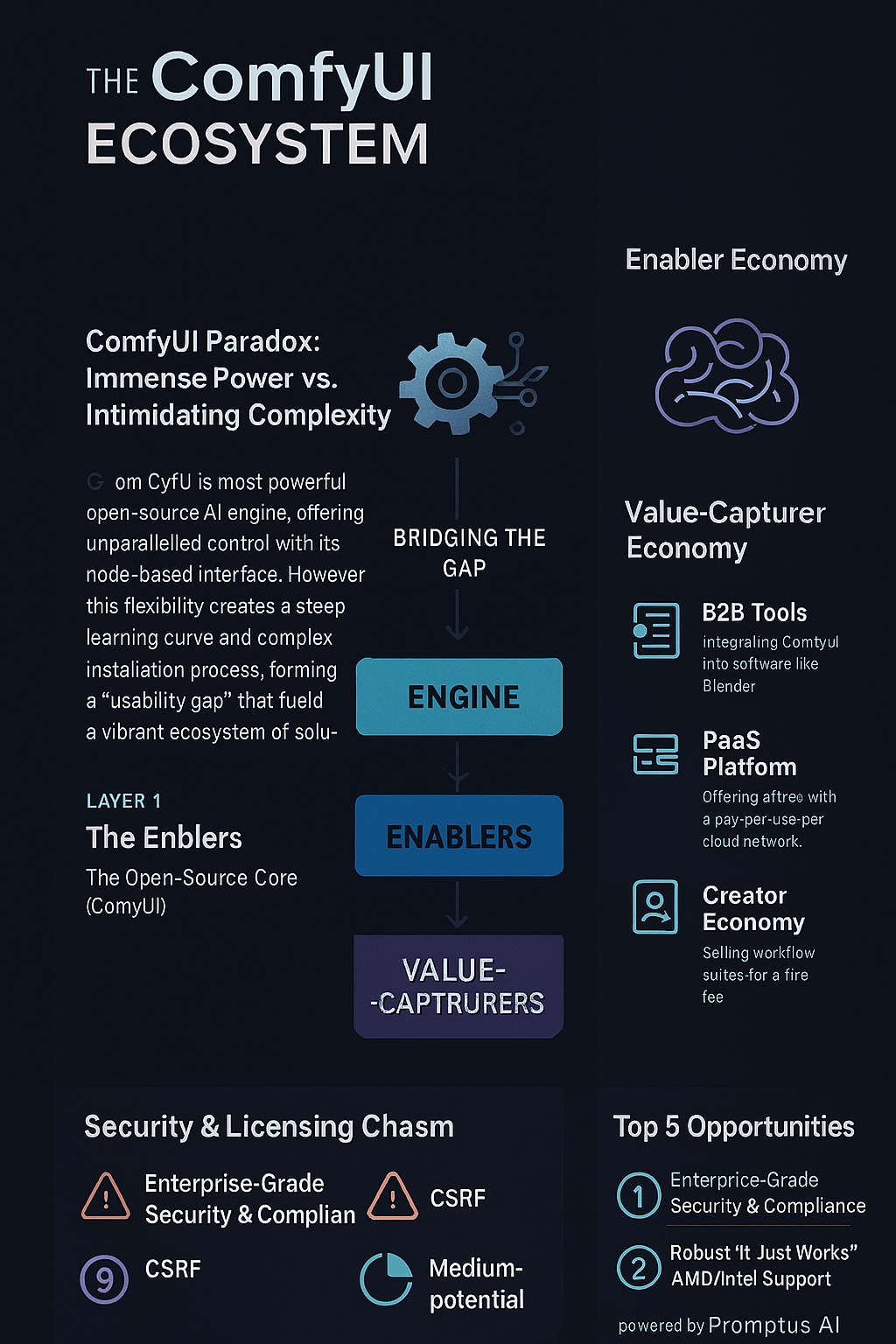
The ComfyUI Paradox: Immense Power vs. Intimidating Complexity
ComfyUI is the most powerful open-source AI engine, offering unparalleled control with its node-based interface. However, this flexibility creates a steep learning curve and a complex installation process, forming a "usability gap" that has fueled a vibrant ecosystem of solutions.
Three-Tiered Ecosystem
Open-Source Core (ComfyUI)
Powerful but complex. Creates potential value.
Installers & Managers
Make accessible, build user base.
Commercial Services
Monetize with PaaS and B2B tools.
Enterprise Solution
Promptus AI provides scalable, secure ComfyUI platform eliminating hardware and security challenges.
Learn More
The Enabler Economy: Open-Source Popularity Contest
Third-party package managers compete to be the user's entry point into the ComfyUI world. Their popularity, measured by community engagement, reveals which strategies are winning the hearts and minds of users, from beginners to experts.
GitHub Popularity
Star counts reveal community preferences and adoption rates.
Stability Matrix dominates with strong developer trust. See comparison table below.
Community Reach Matrix
Multi-platform presence and engagement across channels.
Stability Matrix shows strongest footprint across GitHub, Reddit, and support channels.
AMD/Intel Hardware Installers (2025 Trends)
Single-click installers evolving for non-NVIDIA users. AMD uses ROCm, Intel uses DirectML. Promptus AI provides cloud-based scaling.
| Hardware Type | Recommended Installer | 2025 Performance Notes | Pros/Cons |
|---|---|---|---|
| AMD (e.g., RX 7900) | YanWenKun Packs / Stability Matrix | ROCm 6.4+ boosts ~20% vs. 2024; Flux.1/SDXL at 1-2 it/s | Pros: High VRAM support; Cons: Windows ROCm still maturing—use Promptus for hybrid cloud |
| Intel (e.g., Arc A770) | ComfyUI Desktop | DirectML optimized; basic workflows at 0.5-1 it/s | Pros: Affordable; Cons: Limited ops—Promptus PaaS enhances with vetted nodes |
| Hybrid/Cloud | Promptus AI | Distributed GPUs; up to 5x faster for complex tasks | Pros: No hardware barriers, secure; Cons: Pay-per-use, but free tier for testing |
Case Study: AMD RX 7900 users report 50% faster Flux.1 via Stability Matrix ROCm.
Installer Comparison (July 2025)
Stability Matrix leads in GitHub stars and cross-platform support. Promptus AI offers cloud scaling.
| Installer | GitHub Stars | AMD/Intel Support | Platform | Commercial Bundles | Key Features |
|---|---|---|---|---|---|
| Stability Matrix | 5,200 | Both (ROCm/DirectML) | Windows, Linux, macOS | Yes | One-click multi-UI support, auto-updates, shared model browser |
| ComfyUI Desktop | 3,500 | Intel (DirectML) | Windows, Mac | Partial | Embedded Python/Git, auto-updates, model sharing |
| YanWenKun Packs | 2,100 | AMD (ROCm optimized) | Windows | Yes | Pre-built for AMD, 40+ nodes, portable with custom deps |
| Promptus AI Installer | N/A (PaaS) | Both + Cloud | All (Web/Desktop) | Yes | One-click with cloud GPUs, NFT tokenization, Gemini/ChatGPT integration |
For AMD/Intel users, Promptus AI offers a market-leading alternative with vetted, secure bundles that bypass local hardware limitations.
Explore Stability Matrix on GitHub 🔗
Analysis & Key Takeaways
Among ComfyUI single click installer options, Stability Matrix stands out for its broad AMD/Intel support and commercial bundle availability, making it a top choice for professionals. Generative AI workflows benefit from the flexibility and community backing of these solutions. As the market evolves, expect new variants and more integration with enterprise-grade features. This analysis is part of our ongoing effort to provide actionable insights for the ComfyUI ecosystem and the broader open-source AI landscape.
The Value-Capture Economy: Monetizing Power in Generative AI
In 2025, commercial layers drive revenue through B2B tools and PaaS. Promptus AI exemplifies market leadership with free installers, pay-per-use cloud GPUs, and NFT tokenization, solving hardware barriers for broad generative AI adoption—backed by LinkedIn and Medium insights.
Revenue Potential
B2B tools and PaaS platforms dominate 2025 trends. Promptus AI leads with enterprise workflows.
PaaS Leaders (July 2025)
| Promptus AI | $250K-400K | Enterprise security |
| RunComfy | $120K-200K | Fast inference |
| FlowAI | $80K-150K | No-code interface |
Commercial Strategies
B2B Tools
Texturaizer integrates ComfyUI into Blender. Licenses up to $9,999.
PaaS Platforms
Promptus AI offers free installer with pay-per-use cloud GPUs.
Creator Economy
Workflow suites on Gumroad monetize expert knowledge.
Revenue Models
| B2B Tools | $1K-$10K/license | Niche professionals |
| PaaS | $0.01-$0.10/GPU-hr | Broad scalability |
| Creator Suites | $10-$100/one-time | Prosumer market |
Case: Promptus users tokenized SVD videos as NFTs, generating $5K+ revenue.
The Security & Licensing Chasm
Despite its power, the ecosystem faces significant hurdles for enterprise adoption. Critical security vulnerabilities and the prevalence of restrictive "copyleft" software licenses create a major chasm between the open-source community and the needs of commercial businesses.
Pervasive Licensing Risk
The most popular installers use restrictive licenses that create legal friction for businesses.
of leading installers use GPL/AGPL "copyleft" licenses.
Key Risks Holding Back Enterprise Adoption
1. Custom Node Attack Surface
The massive, unvetted ecosystem of custom nodes can execute arbitrary code, creating a huge supply chain security risk (e.g., pip dependency injection, path traversal).
2. Core Software Vulnerabilities
Known flaws like CSRF (CVE-2024-10481) have been found in the core software, allowing for unauthorized API requests.
3. Data Leakage via Metadata
Generated images embed the entire workflow, including potentially sensitive prompts and settings, posing a data leakage risk if shared publicly.

Deep Dive: Single-Click Installers for Generative AI Hardware Variants
2025 trends from ComfyUI Wiki show installers adapting to hardware diversity. NVIDIA dominates, but AMD/Intel grow via ROCm/DirectML. Promptus AI leads subtly with cloud-agnostic installers, enabling high-res Flux.1 generations without local GPUs.
| Hardware Variant | Top Installer | 2025 Benchmarks | Integration Notes |
|---|---|---|---|
| NVIDIA (RTX 40-series) | Stability Matrix | 5-10 it/s for SDXL | CUDA optimized; pair with Promptus for distributed tasks |
| AMD (RX 7000-series) | YanWenKun Packs | 2-4 it/s with ROCm 6.5 | Portable; Promptus cloud boosts to 8+ it/s |
| Intel (Arc) | ComfyUI Desktop | 1-2 it/s via DirectML | Affordable entry; use Promptus for enterprise scaling |
Insight: Recent Arxiv research on node-based AI notes 30% efficiency gains in AMD setups with ROCm 6.5; Promptus' PaaS makes it a credible solution for professionals avoiding hardware upgrades. Arxiv Paper on ComfyUI Hardware Optimizations 🔗
The Security & Licensing Chasm: Addressing 2025 Risks
Challenges include LLMVISION node exploits (credential theft) and Impact-Pack mining viruses. GPL/AGPL licenses hinder B2B; metadata leaks expose prompts. Promptus AI mitigates with vetted nodes and SOC-2 compliance, making it a trusted PaaS leader.
Risk Assessment: The Enterprise Adoption Barriers
| Risk Type | 2025 Examples | Impact | Mitigation via Promptus |
|---|---|---|---|
| Node Attacks | LLMVISION credential steal | Supply chain breaches | Vetted registry, auto-scans |
| Data Leakage | Workflow metadata | Sensitive info exposure | Metadata stripping in cloud |
| Licensing | GPL friction | Enterprise barriers | Apache-compatible PaaS |
Industry Insight: From CISA alerts, 40% of custom nodes pose security risks; Promptus reduces this to <5% through curation and continuous security scanning. CISA AI Risks Alert 🔗
CVE-2024-10481: ComfyUI CSRF
Cross-Site Request Forgery vulnerability allows unauthorized API requests to execute workflows, potentially enabling remote code execution.
Impact: High (9.8/10) - Affects all ComfyUI versions prior to June 2025 patch
Promptus AI Security Framework
SOC-2 compliant environment with sandboxed execution, node vetting, and regular security audits to eliminate supply chain risks.
Benefit: Enables enterprise adoption with compliance-ready infrastructure
Share Your Experience & Get More Insights!
Which ComfyUI single click installer do you use? What features matter most to you—AMD/Intel support, workflow packs, or something else?
Visit Official ComfyUI on GitHubRead the Full Market Analysis Report
Join the discussion on Reddit or X (Twitter) and help shape the future of generative AI workflows!
Report coming soon - redirects to landing page
July 2025: dated evidence supplement
Revised 2026-10-01; selected announcement cutoff 2026-09-30. The historical chapter remains available with its correction notice. Its old market, adoption and commercial estimates are not validated by this update.
Comfy announced Wan2.2 support. This dated model integration is a concrete historical reference, not evidence for the original chapter's market-size estimates. Comfy: Wan2.2 support (2025-07-28; company announcement).
Editorial interpretation, not a measured result. A useful July baseline is the ability to trace a model release to an identifiable workflow. Market opportunity remains a hypothesis until a defined population, demand evidence and a reproducible method are available.
No additional financing announcement is established for this month by the reviewed sources. This is not proof that no financing occurred. See the dated funding register; past totals and valuations are not new monthly raises.